Texas is big and Texas is rich. But on the things that decide whether a Texas family gets by — enough food on the table, safe care for a pregnant woman, a fair start for a kid — Texas keeps landing near the bottom.
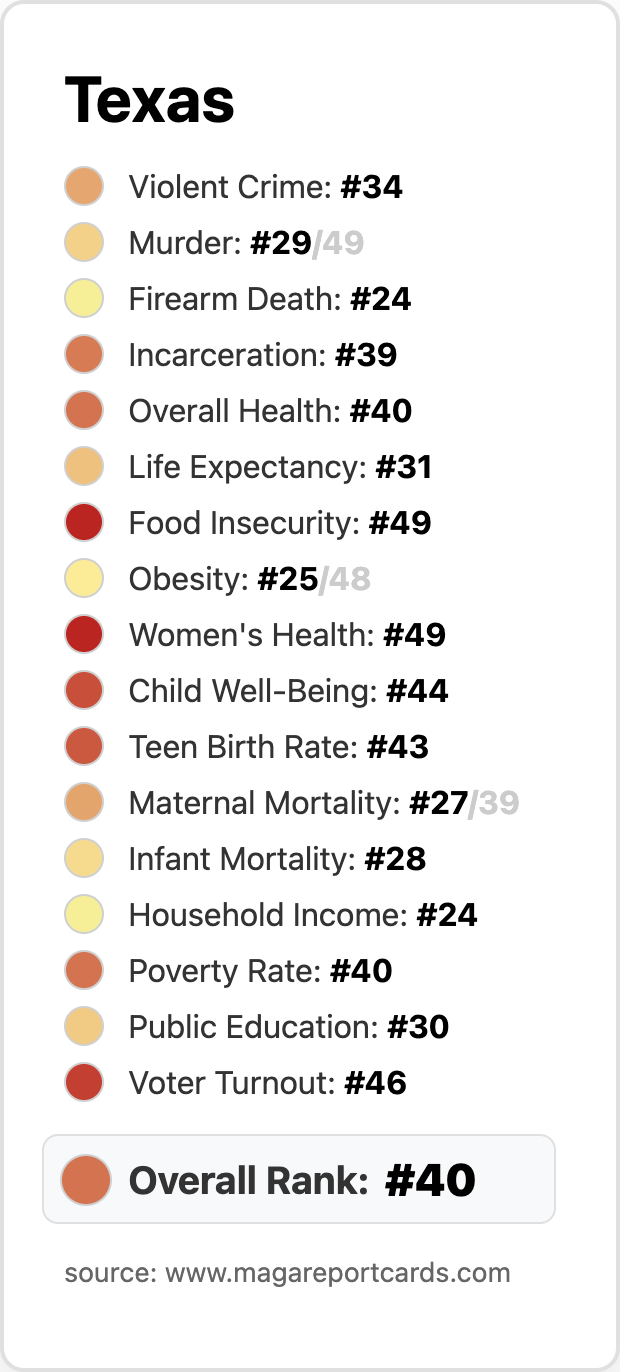
Add up the 17 measures we track across all 50 states and Texas ranks 40th. That number describes where the state already is. It does not, by itself, prove any one politician put it there.
Greg Abbott has been governor since 2015, and many of the decisions behind those numbers are his rather than Washington's: whether Texas expands health coverage, who regulates the grid, where school money goes, what a doctor is allowed to do for a miscarrying patient.
Republicans also hold 24 of Texas's 37 filled U.S. House seats, both of its Senate seats and the attorney general's office. One House seat is empty, and that's a story too. Here is what all of them did on top of the numbers above, and what each has been busy with instead.
What Texas's Republicans in Congress voted to cut
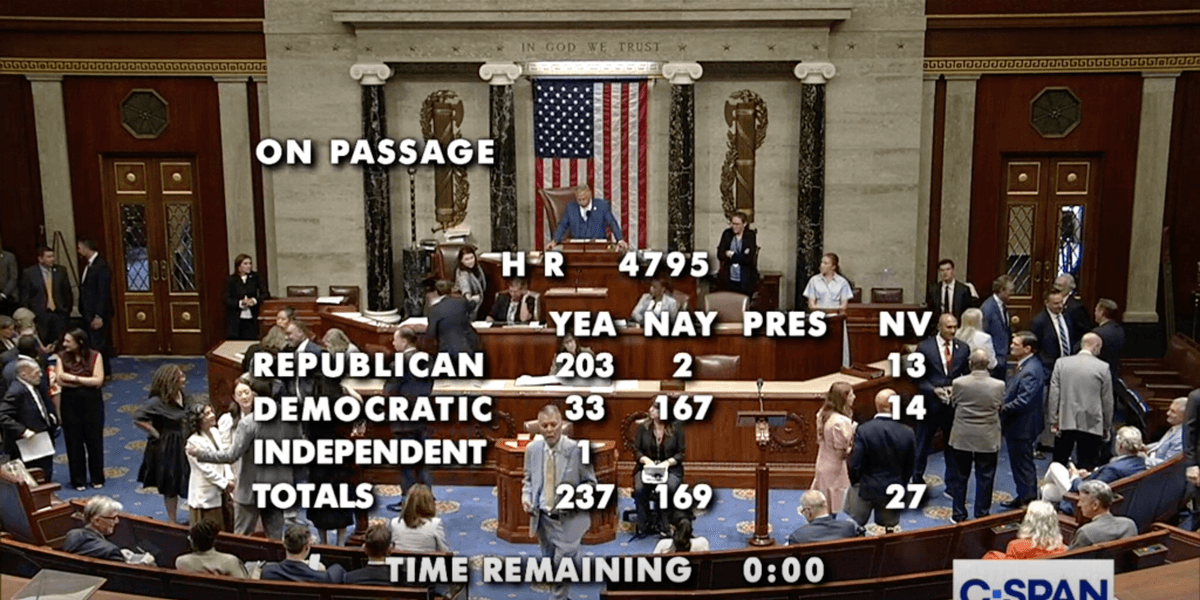
Texas is already 49th of 50 states on food insecurity, from the USDA's own data — second-worst in the country at feeding people — and it already has the highest uninsured rate of any state, for children and adults alike. Its Republicans in Congress then voted for a budget bill that cut both health coverage and food assistance. Take them one at a time.
KFF's allocation of the Congressional Budget Office's estimates projects that Trump's budget bill will leave 480,000 more Texans without health insurance by 2034 — 1.4 million once you count the Affordable Care Act premium tax credits that expired at the end of 2025 and that the bill did not extend. Texas also stands to lose $27.9 billion in federal Medicaid funding over ten years.
That lands on a state where, in 2024, the Census Bureau's American Community Survey put 13.6% of Texas children and 21.6% of working-age Texas adults without any coverage at all — the highest rate in the country in both cases, against national rates of 6.0% and 11.3%. And the hole is not only Washington's doing. Texas, under Abbott, is one of the few states that never expanded Medicaid, which the Texas Tribune reports has contributed to that rate. Turning the expansion down was a decision made in Austin, and it is his.
On food: 1 in 4 Texas kids faces hunger every day, and about 3.47 million Texans — 11% of the state — get SNAP benefits every month. The same bill squeezed that program too.
Every Texas House Republican named below voted for it.
What 49th on women's health looks like
Texas ranks 49th of 50 states on women's health and reproductive care, from the Commonwealth Fund's state scorecard. Second-worst in the country. Here is part of why.
Texas has a near-total abortion ban, and Abbott signed it. On May 19, 2021 he signed the law that banned abortion after about six weeks and paid members of the public $10,000 to sue any doctor who performed one. "Our creator endowed us with the right to life," he said at the signing ceremony. The law took effect that September. After the Supreme Court overturned Roe, a criminal law followed, threatening doctors with up to 99 years in prison.
Doctors then started waiting. ProPublica's statewide analysis of hospitalizations for second-trimester pregnancy loss found that after the ban, the rate of sepsis in those cases jumped more than 50%.
Josseli Barnica is what that means. She was 28, a mother, and 17 weeks pregnant when she was admitted to a Houston hospital on September 3, 2021 — days after the law took effect with a miscarriage her doctors recorded as "in progress." More than a dozen medical experts told ProPublica that her doctors should have emptied her uterus then to head off an infection. Instead her husband arrived from a construction site to hear what she said the medical team had told her: "They had to wait until there was no heartbeat. It would be a crime to give her an abortion."
She waited 40 hours. Three days after she delivered, she died of an infection — sepsis, her autopsy said, with "retained products of conception." The experts who reviewed her records called her death preventable, and called the case "horrific," "astounding" and "egregious."
Barnica never asked for an abortion. Neither did Nevaeh Crain, who was 18, or Porsha Ngumezi. Texas's own Medical Board has since disciplined three doctors over the care those last two received — one for discharging Crain while she had a 103-degree fever and had screened positive for sepsis. Each doctor was ordered to take eight hours of continuing education.
Even the Republican-led Legislature conceded something was wrong and passed a bill to clarify the ban's medical exceptions. The ban itself stands.
The data centers
The biggest new fight in Texas isn't in Washington. It's over giant warehouses full of computers that run artificial intelligence, and the electricity and water they drink.
Greg Abbott spent years bringing them here. In November 2025 he stood next to Google's CEO and called Texas "the epicenter of AI development." The grid operator now says companies have asked to pull 474 gigawatts off the Texas grid — more than five times the most electricity Texas has ever used at once — and about 90% of those requests are data centers. We laid out that record here.
Then, in August of an election year, Abbott announced a pause and an audit. Regulators set the delivery date for the report at December 10. Election Day in Texas is November 3. Texans vote 37 days before the state tells them what it found.
Texas's own Agriculture Commissioner, a Republican, called the pause "smoke and mirrors" and said Abbott is stalling so his donors' projects can be grandfathered in.
The public schools
Nine out of ten Texas kids sit in a public school. The state spent this year moving money the other way.
The private school voucher program is Abbott's. He campaigned on it, and on May 3, 2025 he signed the $1 billion bill creating it, telling the crowd he had promised school choice when he ran for reelection in 2022. Texas launched the program for 2026-27 with that $1 billion. In September 2026 the state's comptroller, Don Huffines, asked the Legislature to double the program's base funding to more than $2 billion. Roughly 110,000 students have been funded and more than 106,000 families are on the waitlist. Paying for the waitlist too, the comptroller's office said, would come to about $4 billion over two years.
Here is the part that decides who this is for. State data shows that 70% of the families who have joined the program or hold pending invitations were already in private school or home-schooling. This is not mostly money helping kids leave a failing public school. It is mostly money for families who had already left.
Meanwhile the public schools are cutting. The Legislature put nearly $8.5 billion into schools last year, earmarked for teacher pay, educator training and special education, and districts told a Capitol hearing in June that it did not stop the cuts. The money a district can actually spend on keeping the buildings open, the benefits paid and the buses running is its basic allotment — and at Navarro ISD that went up by $55 per student, which its chief financial officer told lawmakers fell short. Austin ISD is closing a $181 million shortfall. El Paso's district is short nearly $53 million. Before last year's bill, Texas students had gone six years with no comprehensive funding increase at all.
And Texas is short of teachers. The state employs more educators on H-1B visas than any state in the country, and districts use those visas for jobs they have already tried and failed to fill locally — above all bilingual education, which sits on Texas's own official teacher shortage list, in the state with the largest share of students learning English in the country. Abbott says he wants "exactly zero", and he wants it to reach the teachers already standing in Texas classrooms. In the rooms Texas cannot staff, it would become illegal to keep the teacher who took the job.
Three of the Texans below — Keith Self, Randy Weber and Brandon Gill — went a step further and cosponsored a one-sentence bill to abolish the Department of Education outright.
Texans are still paying for the last grid failure
Before the data centers, there was Winter Storm Uri. 246 people died. Craig Goldman chaired the Texas House Energy Resources committee in the session that followed, and his committee advanced a bill that put $3.5 billion of the gas companies' storm costs onto customers' bills through April 2039. The weatherization rules passed after the storm have caught almost nothing, and a 2025 state audit found why: regulators issued two violations across 8,732 inspections, and never compared what companies actually did to the state's own best practices. The gas companies set their own standard, and passed.
Texans will be paying that off for another 13 years, while the grid takes on the biggest new load in its history.
The agency that let that happen is Abbott's too. He appoints the Public Utility Commission's board, which was expanded from three members to five after Uri, and the Tribune reported that he took over the search for the grid operator's chief executive — a process he has no formal role in — with one person involved saying he had "total veto power."
The seat that isn't being filled
On April 14, 2026, Republican Tony Gonzales resigned from Texas's 23rd District. He quit amid allegations that he had a sexual relationship with a staffer who later took her own life, an affair he had denied and then essentially admitted in a talk-radio interview. Abbott has still not called a special election, and the seat is not on track to be filled until January — roughly 260 days empty. A Democrat resigned in California the same day. Voters there have already picked his replacement.
That is the empty seat: about 800,000 Texans with nobody voting for them.
The Republican nominee waiting for that seat is Brandon Herrera, a gun YouTuber who called a child a "c*m trophy" while attacking Shannon Watts, who founded Moms Demand Action after the Sandy Hook shooting. When reporters asked Texas Republicans about it, they walked away. He has also called Social Security "a joke" after his own campaign website promised to protect it.
The rules of the election itself
Texas ranks 46th of 50 on voter turnout. Its Republicans have spent the year working on the map and the polling places rather than the turnout.
In 2025 the Legislature redrew the congressional map mid-decade to target five Democratic-held seats. Two federal judges blocked it, finding "substantial evidence" that it was racially gerrymandered in a 160-page opinion. The Supreme Court cleared it for use in the 2026 midterms anyway, over the dissents of Justices Kagan, Sotomayor and Jackson.
Underneath that, the same work is happening county by county. Galveston County held its March primary under one map and adopted a different one in June, telling a court the reason was to "increase partisan performance." Tarrant County's Republican majority voted to cut 92 Election Day polling places, taking the state's biggest swing county from 316 sites in 2022 to 224 this November.
The candidates up for reelection
Texas sends 24 Republicans to the U.S. House. The seventeen running for reelection in 2026 have a report card on this site. Here's something about each of them:
- August Pfluger chairs the Republican Study Committee and wrote the blueprint for the next budget bill, saying the point of the process is that Democrats can't block it.
- Beth Van Duyne called this "the golden age of DOGE." The Government Accountability Office then reported that DOGE couldn't show its work on 96% of its claimed savings.
- Brandon Gill filed a bill to stop people from buying a hot meal with food stamps. The option he calls a loophole exists for SNAP recipients who are elderly, disabled or homeless.
- Brian Babin's campaign paid the Federal Election Commission $26,700 after a donor pleaded guilty to funneling $37,000 in corporate money to it through his own employees.
- Craig Goldman — the Uri bill above. His one law in Congress so far killed an efficiency rule the Energy Department said would save $1.3 billion.
- Jake Ellzey announced a "historic investment" in rural health care. He voted twice for the law that made it necessary, which cuts $137 billion from rural Medicaid.
- John Carter's last in-person town hall was in 2013. When 150 constituents held one for him, they brought a life-size cutout.
- Keith Self calls the national debt "an existential threat to our Republic," voted for the $3.4 trillion bill, then introduced a bill to stop bills like it.
- Lance Gooden is under House Ethics investigation over his spending. His first move was to call the investigators "dishonest unelected bureaucrats."
- Michael Cloud wrote a bill that would put every federal agency on a countdown to abolition — including the ones that warn Texas about hurricanes.
- Monica De La Cruz told donors on leaked audio that "it's not that people don't like me, it's that people don't know me yet." She has never held an in-person town hall.
- Nathaniel Moran spoke against site-neutral Medicare payment, the one change that would lower what patients pay for the same service. The hospital lobby has given him $20,000.
- Pat Fallon sits on the Oversight panel built to work hand in hand with DOGE and went on Fox Business to call it a chance to "fix our Republic".
- Pete Sessions put it in writing that a $7 billion Ponzi schemer was "a man of great strength, character and financial stability".
- Randy Weber has represented the Texas coast for 13 years. He called $5 million for the Ike Dike a win; the barrier carries a $35 to $57 billion price tag.
- Roger Williams, a second-generation auto dealer, slipped an exemption for car dealers into a rental-car safety law at midnight. It got him an ethics investigation and was stripped out.
- Ronny Jackson kept paying for a private Amarillo dining club with campaign money after the ethics office told him to stop, and changed what he called it.
And the party's Senate nominee is Ken Paxton, the sitting attorney general, whose own party's voters picked him over a record of indictments, an impeachment and abuse-of-office findings that we laid out in full.
Above them both on the ballot is Greg Abbott, who opened his fourth run for governor by declaring the country's largest Muslim civil rights group a terrorist organization. Texas Monthly set his proclamation's thirteen points beside a paper written by a fellow at a think tank the Southern Poverty Law Center lists as an anti-Muslim hate group, and found twelve of them matched.