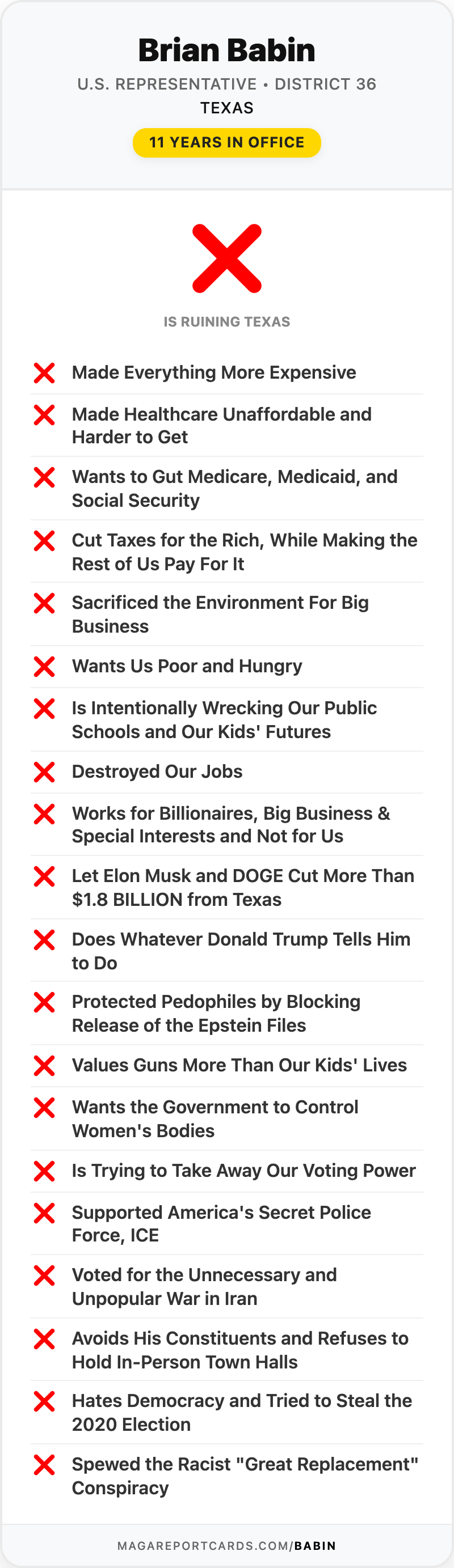
Before he was a congressman, Brian Babin ran for Congress twice and lost. The first of those campaigns, in 1996, ended with a donor pleading guilty in federal court and Babin's own campaign committee signing two settlement agreements with the Federal Election Commission.
The documents are public. They are on the FEC's website. Almost nobody has read them.
What the donor did
Peter Cloeren Jr. ran Cloeren Incorporated, a company based in Orange, Texas. He wanted to help Babin's 1996 campaign in Texas's 2nd District, and he had already given the legal maximum himself.
So he used his employees. According to the Democratic minority's views in the House Government Reform and Oversight Committee's November 1998 report, Cloeren said he got $37,000 to Babin through workers who each wrote $1,000 checks with the understanding that he would reimburse them. That's a straw-donor scheme, and it's a federal crime.
On June 24, 1998, Cloeren and his company pleaded guilty in U.S. District Court for the Eastern District of Texas to misdemeanor violations "in connection with having made $37,000 corporate contributions in the name of others to Brian Babin for Congress." That quote comes from the FEC's own conciliation agreement in the matter.
What Babin's campaign did about it
Not much, and not quickly.
Under federal rules, once a campaign learns it is holding illegal money, it has 30 days to refund or surrender it. Babin's committee got notice of Cloeren's guilty plea on or around June 24, 1998 — including the fact that it was sitting on $37,000 in illegal corporate money made in the names of other people.
It handed the money over to the Bureau of the Public Debt on or around August 17, 1998 — "approximately 54 days after first learning that it possessed the illegal funds," the FEC agreement says. And that delay, on its own, was the violation:
"By not refunding or disgorging the funds within 30 days of learning they were illegal, Brian Babin for Congress accepted prohibited contributions."
The same agreement documents two more things:
- A free flight for Tom DeLay. On August 29, 1996, then-Rep. Tom DeLay flew from Sugar Land to Orange, Texas to attend a Babin campaign event. Cloeren, Inc. paid the charter company $1,320. That's an illegal corporate in-kind contribution. Babin reimbursed Cloeren, Inc. by check dated July 31, 1998 — nearly two years later, and weeks after the guilty plea.
- An unreported flight for Babin himself. On September 14, 1996, Babin flew to a campaign event at Cloeren's own house on a privately owned plane. The owner valued the flight at $135. Babin's committee amended its 1996 disclosure reports to include it in February 2000 — more than three years late.
Babin's committee paid a $6,700 civil penalty. The FEC made no finding that anyone acted knowingly and willfully.
That was the smaller of the two settlements.
The second settlement: $20,000
A separate FEC matter looked at money that reached the Babin campaign through outside groups — Citizens United Political Victory Fund and a Virginia corporation called Citizens for Reform, whose 1996 activities were run by a consulting outfit named Triad.
In that conciliation agreement, Babin and his committee agreed to these findings:
- They accepted $5,000 in excessive contributions from Peter Cloeren routed through Citizens United Political Victory Fund.
- They failed to report the true source of that money.
- If Citizens for Reform counted as a political committee, they accepted $86,000 in excessive in-kind contributions from it in 1996 "by coordinating certain advertising expenditures."
- If it didn't count as a political committee, they accepted $87,000 in prohibited in-kind corporate contributions the same way.
- They failed to report those expenditures as in-kind contributions at all.
The penalty: $20,000, payable in installments starting with $10,000 within 30 days. On top of that, the committee had to disgorge the $5,000 excessive contribution to the U.S. Treasury.
Add the two settlements together and Babin's 1996 campaign paid the government $26,700 in civil penalties, plus $42,000 in illegal money surrendered.
What Babin said
The agreement records his side, and it should be read too.
Babin disputed Cloeren's account. He testified that either the events didn't happen as Cloeren described or that he didn't recall them that way, and specifically that he did not recall ever soliciting funds from Cloeren except for his own campaign.
The FEC noted that telephone records show calls between Babin campaign headquarters and Cloeren, Inc., and between Babin headquarters and Triad. Babin's side responded that the records don't show who was on the calls or what was said, and that calls in that period were about arranging a fundraiser at Cloeren's home and a rally at his company.
Babin also testified he never spoke to Triad or Citizens for Reform about issue advertisements.
He agreed to the findings and paid the penalties anyway. That's how conciliation works — you settle without admitting you meant to.
The DeLay allegation
There's one more piece, and it's the one that made national news at the time.
Cloeren gave a sworn affidavit alleging that Tom DeLay — then the House majority whip — had personally coached him on how to get more money to Babin after he'd maxed out. The same minority views describe Cloeren saying DeLay told him "additional vehicles" could be used, including Triad Management Services and the campaigns of other Republican candidates.
DeLay denied it. So did Babin. DeLay was named as a respondent in the FEC's Babin matter; the Commission's public case record lists no penalty against him.
But the FEC's separate finding stands on its own: Citizens for Reform, run by Triad, spent $87,000 on a television ad that the FEC concluded was coordinated with the Babin campaign — exactly the "additional vehicle" Cloeren said he'd been pointed toward.
Why it matters now
Babin has represented Texas's 36th District since 2015. He chairs the House Science, Space and Technology Committee, which oversees NASA, and he sits on Transportation and Infrastructure. He is a dentist, a former mayor of Woodville, and a deacon at his church.
He got to Congress on his third run, in 2014. The story above is from 1996 — old enough that most voters in his district have never heard it, and it doesn't come up in his campaign material.
But it isn't a rumor or an opposition-research memo. It's two signed federal settlement agreements, a guilty plea in federal court, and a sworn affidavit printed as an exhibit to a congressional report, all still posted on government websites. Two settlements, $26,700 in penalties, $42,000 in illegal money handed to the Treasury, and a donor who went to court over it.
Members of Congress get caught out on money rules more often than the coverage suggests. Susan Collins helped write the law requiring members to disclose their stock trades, then failed to report up to $395,000 of her husband's. Marsha Blackburn moved $4.8 million out of her Senate account, and almost exactly that much came back through a super PAC to help her run for governor. What's unusual about Babin's case is only how much of it is on the record.
Whether it still matters is a judgment for voters in the 36th. Knowing about it shouldn't be optional.
Source
Federal Election Commission conciliation agreements in MUR 4783 (Brian Babin for Congress, March 2001) and the Citizens for Reform matter (November 2001). Cloeren's affidavit as described in the minority views printed in House Report 105-829, Committee on Government Reform and Oversight, November 5, 1998 (volume 4 of 4). Photo: official congressional portrait.