In 2012, Congress passed a law called the STOCK Act. The idea was simple and popular: members of Congress shouldn't be allowed to quietly trade stocks and hide it from the public. They have to report their trades quickly, within 45 days, so voters can see whether their representatives are getting rich off information the rest of us don't have.
Susan Collins didn't just vote for that law. She was the first Republican to back it and helped push it across the finish line. She wanted credit for cleaning up Washington.
So it's worth asking why she's been breaking it.
Up to $395,000 in trades, reported late
A review of Collins' financial disclosures found that she failed to properly report up to $395,000 in stock trades. The news outlet NOTUS counted 24 separate transactions reported more than 100 days late between 2013 and 2018 — long past the 45-day deadline the law requires.
The trades were made by her husband, Thomas Daffron, a former lobbyist. They included shares of big companies like Microsoft, JPMorgan Chase, and CVS. Under the STOCK Act, a spouse's trades count — that's exactly the kind of activity the law was written to make public.
And this isn't ancient history. As The Maine Monitor reported, in early 2026 Daffron bought a Pfizer bond worth between $15,000 and $50,000 — and Collins again disclosed it late, days past the deadline. That one matters for another reason: Collins sits on the Senate committee that oversees the Food and Drug Administration, which regulates drug companies like Pfizer.
A law with no teeth — and she knows it
Here's the part that should bother every Mainer. Breaking the STOCK Act is supposed to come with a penalty. But the fines are routinely waived by the House and Senate ethics committees — the lawmakers policing themselves. It's unclear whether Collins faced any penalty at all.
So the law she helped write has a loophole big enough to drive a truck through, and she drove right through it. She got the good headlines for passing it. She skipped the part where she follows it.
She got rich while she was in office
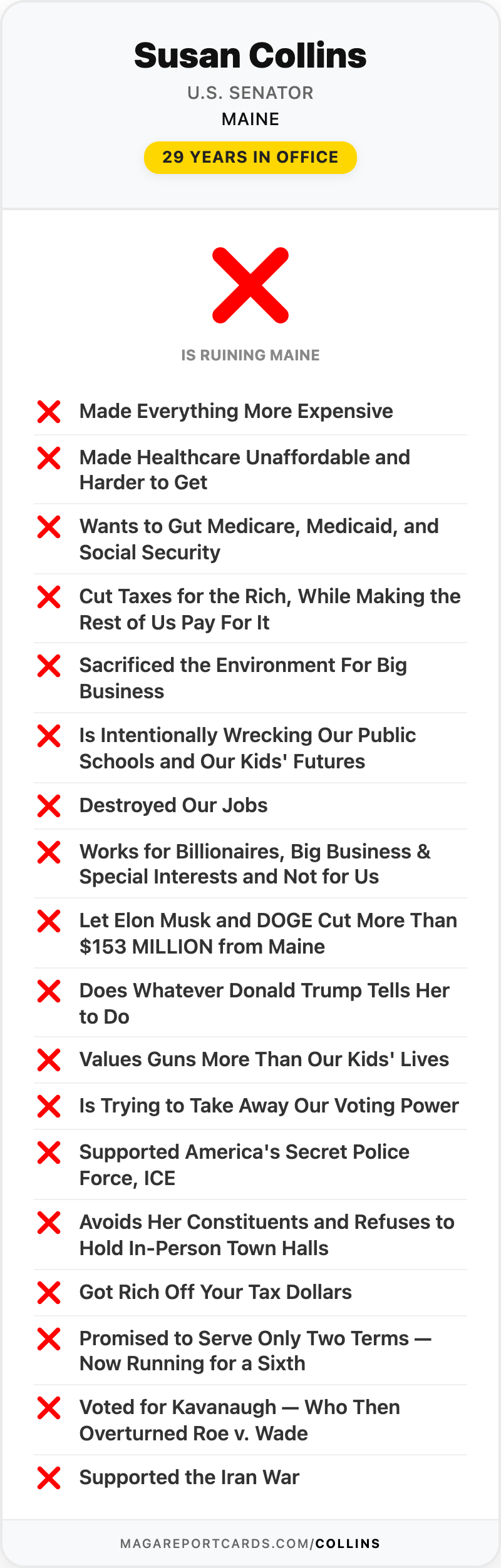
This fits a bigger picture. When Collins first came to the Senate, she wasn't wealthy — as we've documented, her net worth was once negative. Today it's around $9.8 million. Her opponent's campaign puts her investment income at $342,520 a year — more than most Maine families make from a full year of actual work.
She now holds one of the best-performing stock portfolios in the entire U.S. Senate. And when asked whether members of Congress should be banned from trading individual stocks altogether — something 81% of Americans support, including most Republicans — Collins has come down against a full ban.
Of course she has. The current system has worked out very well for her.
The "moderate" who plays by her own rules
Collins likes to sell herself as a careful, independent moderate. But this is a pattern. She advanced Trump's budget bill — which cuts Medicaid and food aid for Mainers — the day after a private equity billionaire gave $2 million to a PAC supporting her, then voted no on the final bill once it didn't matter. She promised in 1996 to serve only two terms and is now running for a sixth.
Over and over, Collins says one thing and does another. The STOCK Act is just the cleanest example: she literally wrote the rule, took the credit, and then didn't follow it.
We deserve a senator who lives by the same laws she asks the rest of us to follow.
Source
This post is based on reporting by American Journal News, built on the original investigation by NOTUS and The Maine Monitor.