Your health insurance costs more than it used to. A lot more. When Congress let the enhanced premium tax credits expire at the end of 2025, what Marketplace enrollees pay toward their own premiums rose by an average of 58%, from $113 to $178 a month, according to KFF. Deductibles went up 37% — about $1,027 a person — to a record $3,786, the steepest jump this market has ever seen. And it is not done: insurers have filed for a median premium increase of another 15% in 2027, the second straight year of double-digit hikes.
The House came back from its August recess on August 31. Over the next four days it held twelve recorded votes. Not one of them was about your premiums.
Here is what the House did vote on instead, according to the Clerk's own record: a resolution condemning socialism, a constitutional amendment to freeze the Supreme Court at nine seats, a bill fast-tracking mining permits, a bill delaying protections for the endangered North Atlantic right whale, and — on Thursday morning — a bill that strips federal student aid from any college that boycotts Israel.
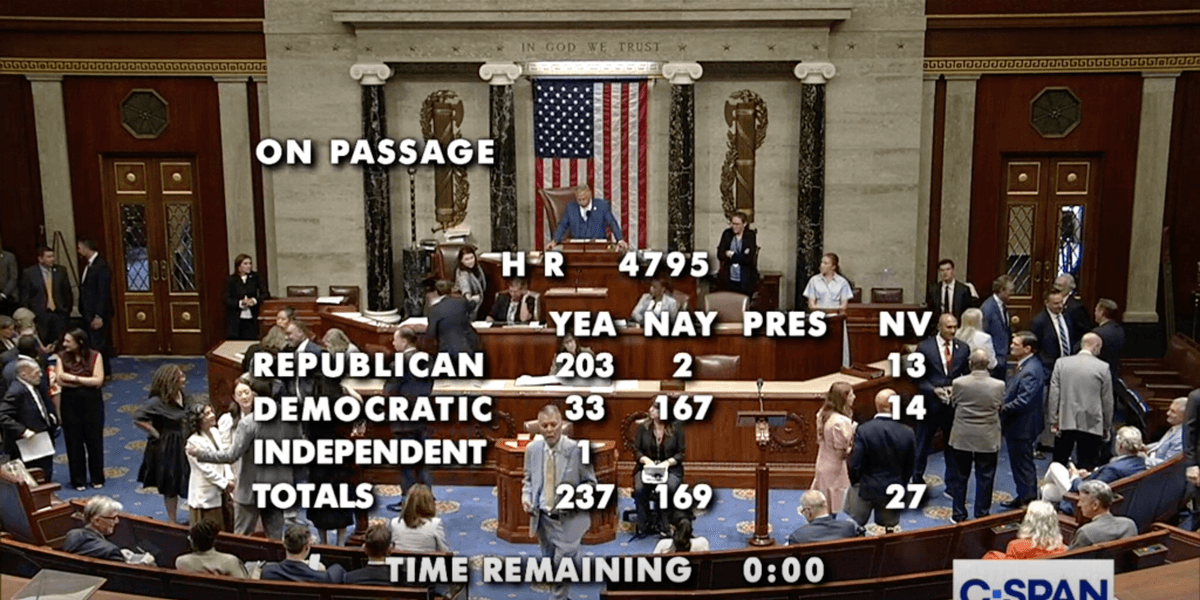
That last one is H.R. 4795, and it passed 237–169. House Republicans voted for it 203–2.
What the bill actually does
Read the text and the reach of it is the point. The bill amends the Higher Education Act so that any college taking part in a "nonexpressive commercial boycott" of Israel loses eligibility for federal student aid — Pell Grants, federal student loans, the money most students actually use to go to school. A second section says that if a school takes federal foreign-language and international-education funding, it has to file a certification every July 31 promising it will let students and faculty study in Israel on the same terms as anywhere else, and let Israeli students and faculty into its own programs on the same terms as students and faculty from any other foreign university. Miss the deadline and the money stops.
The operative text never says the word "Israel." It says "major strategic partner," and defines that by pointing at a 2014 law — the United States-Israel Strategic Partnership Act. The bill's official title says Israel out loud.
What counts as a boycott is a "commercial action" meant to limit business with Israel that "is not based on a valid business reason." So a university has to be prepared to explain, to the federal government, that its business decisions had a valid business reason and not a political one.
Nobody is doing the thing the bill bans
At the Rules Committee markup, Democrats made a simple point. "There has not been a single case of an American college or university administration adopting the BDS movement policies that are described in the bill. Not one," Rep. Bobby Scott said.
Morgan Griffith, who voted yes, answered that argument by embracing it. "Let's take my colleagues on the other side of the aisle and their argument, and that is the bill does nothing, and there's nothing to see here," he said at the markup. "Then there's no harm in passing it."
That is the whole defense: a federal speech rule aimed at conduct nobody has engaged in, and the case for it is that it might not do anything.
This is control, not freedom
The bill is called the Protect Economic and Academic Freedom Act. It does the opposite. It tells private and public institutions what political positions they are allowed to take with their own money, and puts their students' tuition aid on the table if they get it wrong.
The word doing the work is "nonexpressive." Boycotting is speech — that is why people do it. Congress can't punish speech, so the bill relabels the boycott as commercial conduct and punishes that instead. The ACLU told Congress exactly what that is: "Many of those engaged in boycotts of Israel do so not for commercial reasons, but because they wish to express their political opposition to the policies of the Israeli government... HR 4795's labeling such boycotts as 'non-expressive' does nothing to change this reality."
Rep. Jerry Nadler, who opposes the boycott movement and said so at length, called the bill "a direct and gross violation of the First Amendment." His reason is the one that should matter to everybody, whatever they think about Israel: "The First Amendment right to free speech does not apply only to agreeable speech... I will always fight to protect Americans' right to speech with which I disagree. It is the only way to ensure speech I do agree with is equally protected." Nadler also warns that the bill's definition sweeps in the occupied West Bank, treating it as part of Israel and erasing the Green Line.
And the certification requirement flips a ban into a mandate. Lara Friedman of the Foundation for Middle East Peace put it plainly: "The goal here is to basically say every university not only cannot refuse cooperation with Israel but must actively seek every opportunity to cooperate with Israel... And if they're not doing that, they're pro-BDS and anti-Israel." She notes that any group that wants to can go hunting for a missing Israeli partnership and accuse a school of lying on its federal certification.
A government that decides which boycotts you may join, and requires you to prove your cooperation with a foreign country every July to keep your students' financial aid, is not protecting freedom. It is rationing it.
Two Republicans said no
Warren Davidson and Thomas Massie were the only two Republicans who voted against the bill. Thirty-three Democrats voted for it, and the bill's sole cosponsor is a Democrat, Josh Gottheimer. This was not a party-line vote. It was a vote where two Republicans out of 205 were willing to say that the federal government does not get to police what a college may boycott.
The bill now goes to the Senate.
The choice they made
Nobody has to guess at the priorities here. In the same four days the House found floor time to condemn socialism, to fast-track mines, to delay whale protections, to try to lock the Supreme Court at nine seats, and to police what colleges say about a foreign country, the premium bills already sitting on kitchen tables went up 58% and are set to climb again next year. The House has taken 295 recorded votes in 2026. It has not used one of them to put the premium tax credits back.
Every Republican we track who voted yes
These 184 members have a report card on this site and voted yes on H.R. 4795. (Kevin Kiley left the Republican Party in March 2026 but still caucuses with Republicans; he voted yes.)
Alabama: Barry Moore, Dale Strong, Gary Palmer, Mike Rogers, Robert Aderholt
Alaska: Nick Begich
Arizona: Abraham Hamadeh, Andy Biggs, David Schweikert, Eli Crane, Paul Gosar
Arkansas: Bruce Westerman, French Hill, Rick Crawford, Steve Womack
California: David Valadao, James Gallagher, Ken Calvert, Kevin Kiley, Tom McClintock, Vince Fong, Young Kim
Colorado: Gabe Evans, Jeff Crank, Jeff Hurd, Lauren Boebert
Florida: Aaron Bean, Anna Paulina Luna, Brian Mast, Carlos Gimenez, Greg Steube, Gus Bilirakis, Jimmy Patronis, John Rutherford, Kat Cammack, Laurel Lee, Maria Elvira Salazar, Mario Diaz-Balart, Mike Haridopolos, Randy Fine, Scott Franklin
Georgia: Andrew Clyde, Austin Scott, Brian Jack, Clay Fuller, Mike Collins, Rich McCormick, Rick Allen
Idaho: Mike Simpson, Russ Fulcher
Illinois: Darin LaHood, Mike Bost
Indiana: Erin Houchin, Jefferson Shreve, Jim Baird, Mark Messmer, Marlin Stutzman, Rudy Yakym
Iowa: Ashley Hinson, Zach Nunn
Kansas: Derek Schmidt, Ron Estes, Tracey Mann
Kentucky: Andy Barr, Brett Guthrie, Hal Rogers, James Comer
Louisiana: Clay Higgins, Julia Letlow, Mike Johnson, Steve Scalise
Maryland: Andy Harris
Michigan: Bill Huizenga, Jack Bergman, John James, John Moolenaar, Lisa McClain, Tim Walberg, Tom Barrett
Minnesota: Brad Finstad, Michelle Fischbach, Pete Stauber, Tom Emmer
Mississippi: Michael Guest, Mike Ezell, Trent Kelly
Missouri: Ann Wagner, Bob Onder, Eric Burlison, Jason Smith, Mark Alford
Montana: Troy Downing
Nebraska: Adrian Smith, Mike Flood
New Jersey: Chris Smith, Jeff Van Drew, Tom Kean Jr.
New York: Andrew Garbarino, Claudia Tenney, Mike Lawler, Nick LaLota, Nick Langworthy, Nicole Malliotakis
North Carolina: Brad Knott, Chuck Edwards, David Rouzer, Greg Murphy, Mark Harris, Pat Harrigan, Richard Hudson, Tim Moore, Virginia Foxx
North Dakota: Julie Fedorchak
Ohio: Bob Latta, David Joyce, David Taylor, Jim Jordan, Max Miller, Michael Rulli, Mike Carey, Mike Turner, Troy Balderson
Oklahoma: Frank Lucas, Josh Brecheen, Kevin Hern, Stephanie Bice, Tom Cole
Oregon: Cliff Bentz
Pennsylvania: Brian Fitzpatrick, Dan Meuser, Glenn Thompson, Guy Reschenthaler, John Joyce, Lloyd Smucker, Mike Kelly, Rob Bresnahan, Ryan Mackenzie, Scott Perry
South Carolina: Ralph Norman, Russell Fry, Sheri Biggs, William Timmons
Tennessee: Chuck Fleischmann, David Kustoff, Diana Harshbarger, John Rose, Matt Van Epps, Scott DesJarlais, Tim Burchett
Texas: August Pfluger, Beth Van Duyne, Brandon Gill, Brian Babin, Craig Goldman, Jake Ellzey, John Carter, Keith Self, Lance Gooden, Michael Cloud, Monica De La Cruz, Nathaniel Moran, Pat Fallon, Pete Sessions, Randy Weber, Roger Williams, Ronny Jackson
Utah: Blake Moore, Celeste Maloy, Mike Kennedy
Virginia: Ben Cline, Jen Kiggans, John McGuire, Morgan Griffith, Rob Wittman
Washington: Michael Baumgartner
West Virginia: Carol Miller, Riley Moore
Wisconsin: Bryan Steil, Derrick Van Orden, Glenn Grothman, Scott Fitzgerald, Tom Tiffany, Tony Wied
Wyoming: Harriet Hageman
How they voted
- House Roll Call 295, September 3, 2026 — the official record of every member's vote
- Full member-by-member XML from the Clerk of the House
- The text of H.R. 4795 as passed by the House
- Every House roll-call vote of 2026, from the Clerk
- Rep. Jerry Nadler's statement, quoting the ACLU letter to Congress
- Blaise Malley, "House to universities: Don't you dare boycott Israel," Responsible Statecraft, September 3, 2026
- KFF: What We Know So Far About 2026 ACA Marketplace Enrollment, Premiums, and Deductibles
- KFF: how much and why ACA marketplace premiums are going up in 2027