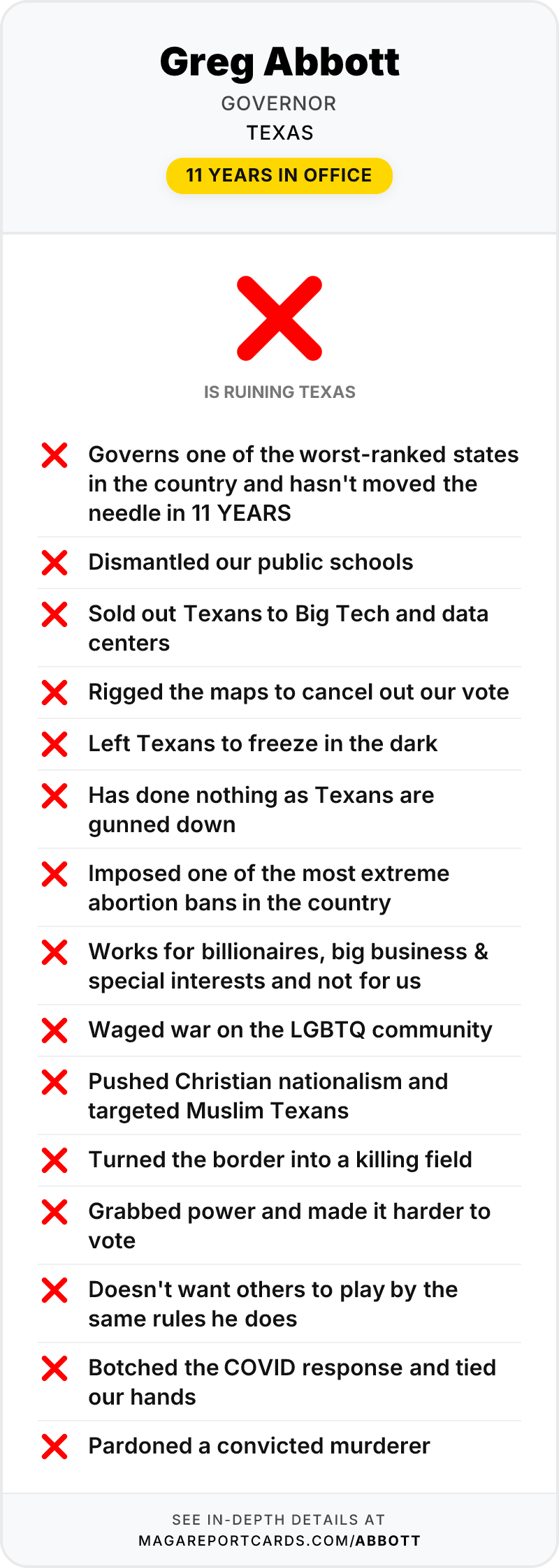
Texas is about to stop paying for therapy for autistic children — under a budget-cut order Greg Abbott issued with the state's two other top Republicans.
In July, Abbott, Lt. Gov. Dan Patrick and House Speaker Dustin Burrows told state agencies, courts and universities to cut their budget requests by 3% for the next two-year budget. Now we know one of the things Texas's health agency chose to cut. In its budget request to the Legislature, the Texas Health and Human Services Commission proposed eliminating all funding for the Children's Autism Program, the Texas Tribune reported on October 12.
Here is what that program does, who it helps, and what Abbott's order protected instead.
What the program does
The Children's Autism Program started in 2008. It pays 16 providers across Texas to give autistic children a kind of therapy called applied behavior analysis, or ABA, which advocates call the gold standard for autism treatment. Families pay a reduced price based on their income and insurance. Some pay nothing.
The numbers are small, which is part of the point:
- Over the last two years, Texas spent $13.7 million on it.
- In fiscal year 2026, it paid for treatment for 583 children.
- Providers say at least 1,000 more children are on waitlists across the state.
- This year Texas actually expanded it — raising the age limit to 21 and dropping the cap on yearly hours.
Now the line item in the agency's request is empty. "We were really shocked to see nothing, and it's just blank where the line item should be," Jacquie Benestante of the Autism Society of Texas told the Tribune. "We're used to having to fight for funding, but to actually have a program just slashed and canceled is pretty shocking."
The kids behind the number
The Tribune met the families. Israel Solis is 7. He was born with autism and can't speak. He used to bite and scratch himself when people couldn't understand what he needed. Therapy through the program taught him a picture system so he can tell people what he wants. His mother, Elizabeth Solis, pays nothing for his care or his brother's.
"If the doors just completely close to access that at all, you just feel like it's all caving in on you, like 'how am I going to get some help?'" she said.
At the University of Houston-Clear Lake's autism center, the program paid for therapy for 41 families last year. Another 200 families are on the waitlist. The center's director, Dorothea Lerman, called the plan "devastating."
"There is no other option for the majority of them, and so they would basically have no services," Lerman said.
"Lowest direct service impact"
Asked why it picked this program, the health agency pointed to its budget-cut summary, which says it "focused reductions on the lowest direct service impact to clients and minimizing impacts to federal funding."
Read that second half again. The autism program is paid for entirely with state money. Jeff Miller of Disability Rights Texas told the Tribune that may be exactly why it looked like an easy target: cutting it doesn't put any federal matching dollars at risk.
As for "lowest impact" — the agency's own budget request says the opposite. "The demand for services exceeds the availability of qualified providers especially in rural parts of the state," it says. "While private and public insurance now provide coverage for treatment services there are often not providers available in all parts of the state."
Medicaid has covered this therapy for young Texans since 2022, which can make the state program look like a duplicate. It isn't, advocates say. Medicaid doesn't help families with no insurance, or families on self-funded job plans that don't have to cover the therapy. And even families on Medicaid struggle to find a provider, because the state pays so little that many won't take Medicaid patients. Emily Pena's daughter Lila is on Medicaid, and Pena still couldn't find anyone until she found a program the state autism fund paid for.
We've seen how Abbott's health agency handles Medicaid already. In August it had 211,000 Medicaid applications stuck waiting on a decision, up from about 1,600 in January. Telling autistic kids to go use Medicaid instead is telling them to get in that line.
What Abbott's order didn't touch
The 3% order didn't apply to everything. According to the Tribune's July reporting, K-12 school funding and the state's new private school voucher program were exempted from the cut.
That voucher program is Abbott's. He signed it into law in May 2025, and it started with $1 billion in funding — the largest first-year plan of its kind in the country. It gives parents about $10,000 a year in state money toward private school, and up to $30,000 for students with special needs.
Put those side by side. Texas spent $13.7 million on the autism program over two years. The voucher program's first year alone is $1 billion — more than 70 times as much. One got a blank line. The other was walled off from the cut entirely.
Abbott also said what the savings are for. He said the budget guidance "delivers even more property tax relief." That's the same property tax promise we've looked at before: Abbott has been governor since 2015, and statewide property tax bills rose from $51 billion to $89 billion on his watch.
And Texas isn't broke. When lawmakers wrote the current budget they had a $24 billion surplus to work with, and the state's rainy day fund sat at a record $24.8 billion as of last November, per the same July report.
What happens next
The Legislature still has to agree. If it does, children in the program keep getting services through the end of August 2027, the agency said. The UH-Clear Lake center, which isn't set up to take Medicaid or insurance, would have until then to find other money before its state-funded programs shut down.
Jolene Pohl of the Coalition of Texans with Disabilities said the state has it backwards. "It would make more sense to increase the funding and get those kids off the waitlist and give them the services that they need," Pohl said, "because eventually it's going to cost the state more if we don't provide the services to these eligible families in a timely manner."
What the record shows
Greg Abbott ordered Texas agencies to cut their budgets by 3%, and his health agency's answer was to ask for the elimination of the Children's Autism Program — $13.7 million over two years, therapy for 583 kids, with at least 1,000 more waiting. The same order exempted his private school voucher program, which started at $1 billion, and Abbott said the savings would go toward more property tax relief.
Source
Sasha Draeger-Mazer, "Texas health agency proposes eliminating children's autism program," The Texas Tribune, October 12, 2026.