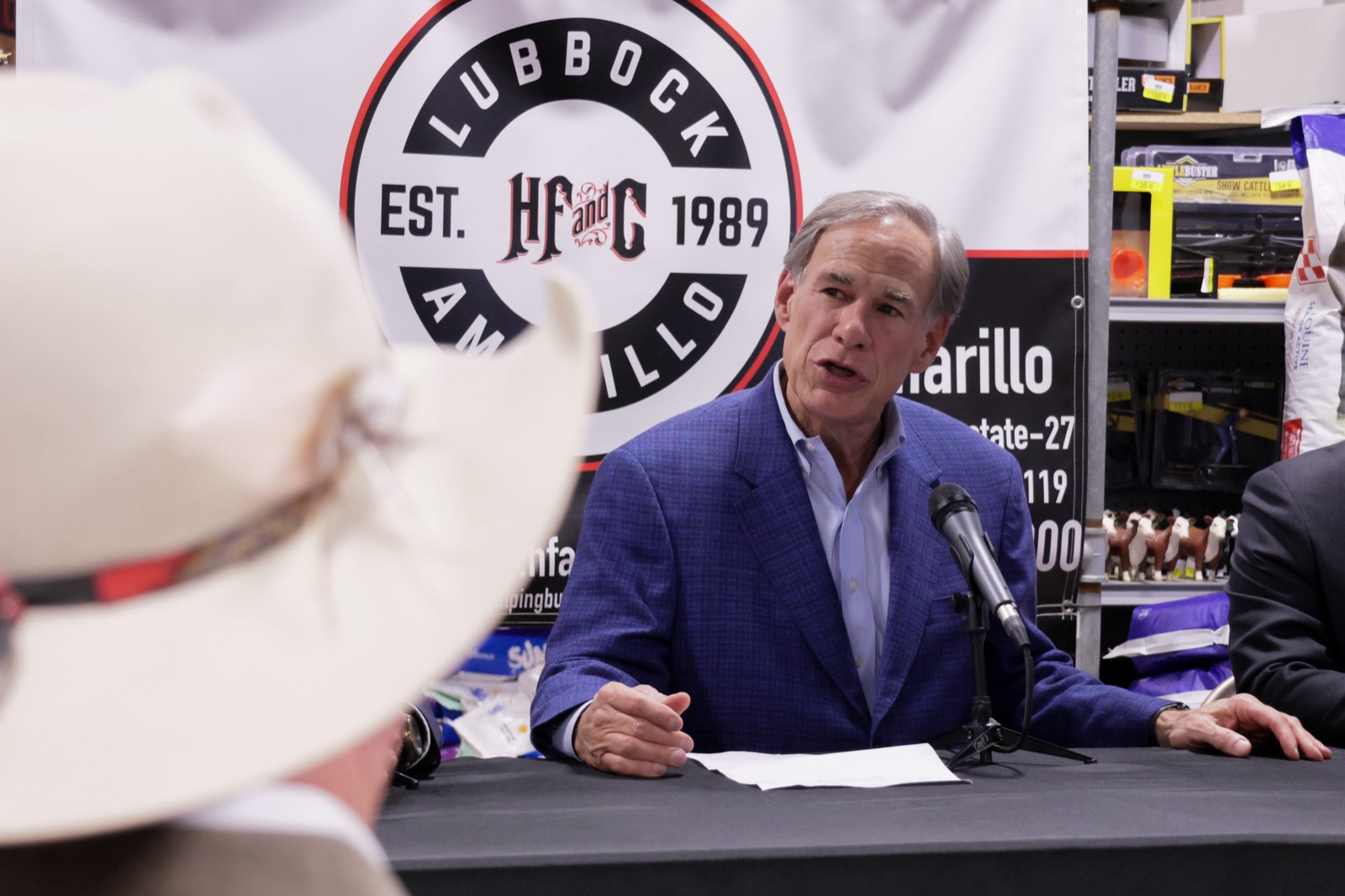
On September 4, 2026, in Lubbock, Greg Abbott stood in front of cameras and made Texans a promise about the thing they say they care about most: what it costs to live here.
"Texas ranks number one in the United States for the most jobs," he said. "We rank number one as the best economy in the United States. Now I want to make Texas number one for affordability."
The centerpiece is property taxes. Abbott says he will cut them by half. He would do it by requiring two-thirds voter approval before any local tax increase, letting voters roll back taxes, capping how fast a property's appraised value can grow at 3% a year, and above all by wiping out school district property taxes for homeowners entirely.
"What I say is, the state of Texas should assume that full responsibility of funding public education, not your homestead," Abbott said. "Instead of you paying whatever you pay right now for your homestead for public schools, that amount should be zero going forward, ensuring that your property taxes will be cut by more than half."
It is a big promise. He has made a version of it before.
He already signed the "largest property tax cut in Texas history"
On August 9, 2023, Abbott signed an $18 billion package and said this: "Today, I am signing a law that will ensure more than $18 billion in property tax cuts—the largest property tax cut in Texas history."
His office put a number on what it would do for you. Senate Bill 2, the release said, would "save the average Texas homestead owner over $1,200" for tax year 2023, and over $1,400 for homestead owners over 65 or with a disability.
His campaign is still running on it. The affordability page on his own website leads with the claim that he "delivered the largest property tax cut in Texas history — $18 billion," alongside raising the school homestead exemption from $100,000 to $140,000.
So the question is not whether Abbott has tried this. It is what happened after he did.
What actually happened to the bills
The Texas Comptroller of Public Accounts tracks how much every taxing unit in the state collects. Here is what Texans were billed, in total:
| Year | Statewide property tax levy |
|---|---|
| 2015, Abbott's first year in office | $51.2 billion |
| 2019 | $66.5 billion |
| 2023, the year of the "largest cut in history" | $81.4 billion |
| 2025 | $89.4 billion |
Those are the comptroller's own figures, compiled by Texas Policy Research, a group that describes its work as "independent analysis based on liberty principles" and lists "Eliminate Property Taxes" as one of the ten planks in its platform. This is not a critique from the left.
Texas has grown, and prices have risen, and much of that increase is simply more people in more houses. But not all of it. The same analysis ran the comparison: "If levies had simply tracked population growth and inflation, 2025 collections would be roughly $58 billion. Instead they are $89.4 billion." Over the longer run, it found levies up more than 378% since 1998 against population and inflation growth of about 210%.
Abbott does not set local tax rates, and he will tell you so. That is the point. He has spent eleven years promising a cut the state cannot actually deliver, because the bill that lands in your mailbox is set by school districts, cities, counties and special districts, and it kept going up anyway.
Nearly 4 in 10 homesteads already pay zero
The headline promise is that your school property tax goes to zero. For a lot of Texans, it already is.
In the first week of September 2026, the office of state Senator Paul Bettencourt, the Houston Republican who chairs the Senate Local Government Committee, presented that committee with data his staff had spent about four months pulling from all 254 Texas counties. It found that 39% of Texas homesteads now owe no school district property tax at all. Among homeowners 65 and older or with disabilities, it is roughly 61%.
That is what the $140,000 homestead exemption already did. And it is why the next step buys less than it sounds like it does. Once a home's value is fully covered by the exemption, raising the exemption again does nothing for that household. That was the concern raised at the hearing by state Senator Molly Cook and by nonprofit representatives: diminishing returns for the homes already exempt, and nothing at all for renters, who get no homestead exemption in the first place.
Texas has 4.1 million renters. The plan skips every one of them.
Abbott's proposal covers homesteads. A homestead exemption is something you can only claim on a house you own.
Texas has 4.1 million renters, and more than half of them are now cost-burdened, meaning rent eats more than 30% of their income. Before the pandemic that share was about 48%. Median rent in Texas grew 9.1% after inflation between the five-year periods ending in 2019 and 2024. Renters are the Texans losing the affordability race fastest, and they are outside this plan.
They would also keep paying. The Texas Tribune noted that under Abbott's proposal, owners of apartments, stores, factories and warehouses would still owe school property taxes. Apartment buildings are business property. The tax on them does not disappear. It stays on the building the renter lives in.
Where the $17.5 billion comes from
If homeowners stop paying for schools, someone else starts.
The Legislative Budget Board put the cost of replacing all school property taxes at $39.5 billion in tax year 2023. Abbott is not proposing that. He is proposing to zero out the share paid by single-family homeowners, which the Texas Taxpayers and Research Association put at about $17.5 billion in the same year. Every Texan, running the numbers on the current version of the plan, estimates a hole of roughly $20 billion a year, or $40 billion every two-year budget cycle.
Abbott says the money is already there. He has said there is no reason to raise the sales tax, and that Texas has the money to cut property taxes right now.
Every Texan cites the Texas Taxpayers and Research Association's calculation of what the sales tax route would actually take: raising it from 8.25% to 13.63%. That is a tax that falls hardest on people with the least, which is the same group that doesn't own the homestead being exempted.
The experts who study this for a living are not persuaded that the money is sitting there. Adam Langley, associate director of tax policy at the Lincoln Institute of Land Policy, called the package "basically a collection of the worst types of policies meant to constrain property taxes." Shannon Halbrook, a fiscal policy expert at Every Texan, said the proposal may be in Abbott's platform "for the purpose of messaging, but is not a realistic proposal."
The appraisal cap is the part that lasts
The other half of the plan gets less attention and would reshape more. Abbott wants to drop the annual cap on how much a property's taxable value can rise from 10% to 3%, extend it to every kind of property, and reappraise only once every five years.
Tax policy experts told the Texas Tribune the idea strongly resembles California's Proposition 13, the 1970s ballot initiative that put tight limits on property value growth and tax rates there. Manish Bhatt, senior tax policy analyst at the Tax Foundation, a conservative group, put it plainly: "Bringing California-style property tax reform to Texas is just not sound policy." Langley described what it produced there. "It's very common to see identical, side-by-side homes with one person paying taxes that are more than five times higher than their neighbors."
The reason is simple. A cap on value growth rewards whoever has owned longest and punishes whoever bought most recently, because the new buyer resets to market value while the neighbor stays frozen. Neva Butkus, a senior analyst at the left-leaning Institute on Taxation and Economic Policy, called it "a pretty anti-family policy," one that hinders young families trying to buy a first home.
"The state should assume full responsibility of funding public education"
That is the sentence to hold onto, because Abbott has been governor for eleven years and Texas has not done it.
Texas has had a chance. The state's teachers union kept a running tally of what he did with it: sitting on a record $33 billion surplus, Abbott "was holding public schools hostage to his voucher priority", and when the vouchers failed the extra school funding died with them. At that point the basic allotment, the per-student money a district can actually spend on staff, buses and keeping the lights on, sat at $6,160 and had not been raised since 2019.
He got the vouchers. On May 3, 2025 he signed the $1 billion law creating the program, telling the crowd he had promised school choice when he ran for reelection in 2022. In September 2026 the state comptroller asked the Legislature to more than double it to over $2 billion, with nearly 110,000 students funded and more than 106,000 families waitlisted. Seventy percent of the families who joined or hold pending invitations were already in private school or home schooling.
Meanwhile the public schools are still cutting. The Legislature put nearly $8.5 billion into schools last year, earmarked for teacher pay, training and special education — it raised the basic allotment by $55 a student — and districts told a Capitol hearing in June that it did not stop the cuts. Austin ISD is closing a $181 million shortfall. El Paso's district is short nearly $53 million. And the classrooms Texas cannot staff are the ones Abbott wants to make harder to staff: Texas schools employ more teachers on work visas than any state in the country, and he says he wants "exactly zero".
A governor asking to be trusted with the entire cost of educating Texas's public school children is asking on a record of withholding their funding to win a different fight.
He is taking credit on data centers too
The property tax promise was not the only one Abbott made in Lubbock. He also took credit for protecting Texans from the electricity costs of data centers, saying he had put in place the most comprehensive data center rules and guardrails of any governor in the country.
Texas Democratic Party spokesman Jacob Long answered that one directly: "You don't get to give data centers some of the largest tax breaks in the nation and vow to turn Texas into an AI epicenter, then shrug your shoulders and play dumb once Texas communities start asking legitimate questions."
We have written up that record three times. Abbott spent years selling Texas to the data centers before asking for credit for slowing them down. The audit he ordered to answer Texans' questions about them reports 37 days after Texans vote. And Texas's own Republican agriculture commissioner said the pause is stalling so Abbott's donors can get grandfathered in.
What the record shows
Greg Abbott has been governor of Texas since January 2015. In that first year Texans were billed $51.2 billion in property taxes. In 2025 they were billed $89.4 billion, about $31 billion more than population growth and inflation would explain, two years after he signed what he called the largest property tax cut in state history. He is now running on cutting property taxes in half by ending school property taxes on homesteads, a change that does nothing for the 39% of homesteads that already owe no school tax and nothing for the 4.1 million Texans who rent, and that leaves the state owing schools roughly $20 billion a year, which he says is already sitting in the budget and which the analysts who have run the numbers say is not.
Source
Mateo Rosiles, USA TODAY NETWORK, Texas Gov. Abbott pitches 50% property tax cut in affordability plan, September 8, 2026.