On Thursday, August 6, 2026, Texas Agriculture Commissioner Sid Miller sat down with The Texas Tribune in Lubbock and said something you almost never hear a statewide Republican say out loud: his own party is going to lose elections this fall, and it's their own fault.
The subject was data centers. And the man Miller blamed by name was Greg Abbott.
"Republicans should be on this issue and we're not," Miller said. "The Democrats are, and they're right on the issue. I'm not endorsing any Democrats, but we're going to lose some elections in the midterms because of this one subject."
Miller went further. Asked who he'd vote for in November, he wouldn't commit: "There's some Republicans I may have to leave blank, I just can't do it."
This is not a Democratic attack ad. This is the sitting Republican agriculture commissioner of Texas saying he may leave parts of his own ballot empty over what Greg Abbott has done — and hasn't done — about data centers.
The Calendar Is the Whole Trick
Three days before this interview, Abbott finally started acting like he was worried about data centers. He told the agencies that run the grid to pause new hookups until the state audits how much power and water these things use. He said he wants lawmakers to end the giant sales tax break data centers get.
Miller's argument is about timing, and it's worth understanding, because it's the part Abbott's press releases don't mention.
The Texas Legislature doesn't come back into session until January. Anything they pass wouldn't take effect until next September. So between now and then — well over a year — the rules stay exactly the way they are. Every project that gets in line before the door closes is on the old, generous terms.
Miller thinks that's the point:
"He's given a wink and a nod to his data center people saying 'Hey, you have plenty of time to get grandfathered in, then we'll put the screws on all your competition.'"
In other words: the crackdown isn't a crackdown. It's a starting gun for the companies already at the front of the line, and a moat for them once it's built. Miller called the whole thing "smoke and mirrors and campaign fluff to gain votes."
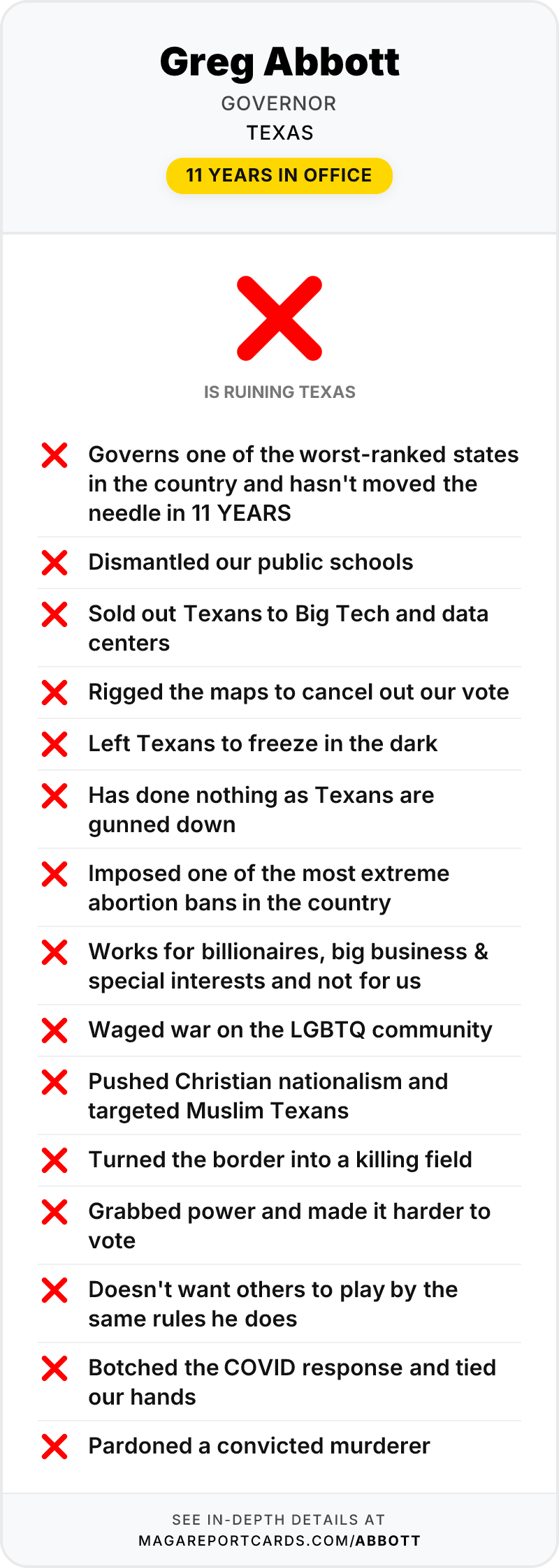
We laid out the full record earlier this week — Abbott branded Texas "the epicenter of AI development," stood next to Google's CEO to announce a $40 billion buildout, and presided over a data center tax break that ballooned from a promised $14.6 million to roughly $3.3 billion a budget cycle, with only about 20 of 138 certified facilities audited or under audit. That's eleven years of inviting the fire. The letter came in August of an election year.
"I've Never Got a Meeting With the Man"
Miller says he tried to get Abbott's attention the normal way first. He asked for a one-year pause on new data centers. He asked for a special session. He asked Abbott to give back the campaign money he's taken from data center companies.
Nothing came back.
"I haven't heard from him," Miller said. "It's not unusual, in the 12 years that we've both been in office, I've never got a meeting with the man. I've never got a phone call returned. Never got an email returned. Crickets."
Think about what that describes. Two Republicans, elected statewide in the same state, sworn in the same month of the same year, in office together ever since. One of them runs the agency that deals with Texas farmland and water. The other is the Governor. And in eleven years, by Miller's account, not one meeting. Not one returned call.
Abbott's press secretary, Andrew Mahaleris, didn't dispute any of it. He wrote back: "I'm not going to respond to Sid but it is obvious that Governor Abbott has taken significant action on data centers. I would refer you to those actions."
That's the answer. Not "we've met with him." Not "here's why he's wrong." Just: look at my press releases.
He Calls Special Sessions When He Actually Wants Something
Here's the test that matters, and Abbott fails it on his own record.
Miller says a special session on data centers could be finished in a week if it were the only thing on the agenda. Abbott won't call one.
But Abbott calls special sessions all the time — when he wants something.
In 2023, he dragged lawmakers back for four special sessions in a single year — something no Texas governor had ever done — and spent the last two of them trying to force through private school vouchers. As the Tribune put it, "never in the Legislature's 176-year history have lawmakers met for more than three special sessions in a year with a regular session." The House kept saying no. He kept calling them back.
In 2025, he called lawmakers in again to redraw the state's congressional map in the middle of the decade, at Donald Trump's request, signing a map engineered to flip five U.S. House seats before a single vote was cast.
Vouchers: worth two special sessions. Redrawing maps for Trump: worth a special session. A majority of Texans saying they don't want an industry draining their water and their grid: worth a study, run by people Abbott appointed.
The Governor has the power. He's shown he'll use it in a hurry when he cares. He just doesn't care about this one until after Election Day.
"They're Scared of Abbott, He's a Bully"
Miller has a blunt explanation for why no other Republican statewide official is saying any of this: money and fear.
"They're scared of Abbott, he's a bully," Miller said. "He spent $5 million against me. They don't want the wrath of Abbott, so they're staying quiet and hoping they can get by the general election."
Miller isn't guessing about being on the wrong side of it. In January, Abbott endorsed Nate Sheets — Miller's primary challenger — over the sitting Republican commissioner. Sheets won the March primary, and Miller is on his way out of office.
And the war chest is real. Abbott entered this year with $105.7 million on hand, after raising $22.7 million in the last six months of 2025 alone. That is the number every other Republican in Texas is looking at when they decide whether to say anything about data centers.
Miller's read is that the silence isn't agreement. It's self-preservation. The people who are supposed to represent us have decided that crossing the Governor is more dangerous than failing their constituents.
The Public Is Already There
The strangest part of all this is that Miller isn't describing an unpopular position. He's describing the popular one.
A University of Texas/Texas Politics Project poll of 1,200 registered voters found 56% of Texans oppose building a data center in their community, against just 29% who support it. In rural Texas — the heart of Republican Texas — it's 62% opposed. Even among Republicans statewide the party is split down the middle, 44% opposed to 42% in favor — inside a margin of error of 2.83 points.
There are already more than 300 data centers running in Texas, and a Tribune analysis found at least 248 more data center projects are planned.
So this isn't a case of a governor bravely taking an unpopular stand for the good of the state. It's a case of a governor ignoring what most people in his own state, and half of his own party, are telling him.
Where the Money Points
Miller's specific demand — that Abbott return donations from data center companies — is the part Abbott has never answered.
Earlier this summer Miller put it this way: "Governor Abbott has taken millions from the very interests pushing massive data center expansion throughout Texas. Those contributions are documented in public campaign-finance records. If the governor has truly changed his position, there is only one clear way to prove it. Give the damn money back."
He hasn't. And it isn't the only place where Abbott's policy and Abbott's donors happen to line up. Days before this interview, Abbott announced a plan to break up San Antonio's city-owned utility — the one that says it has the lowest combined residential rates in Texas — while electricity companies and their PACs have given his campaign at least $230,000. And when Corpus Christi ran short of water, he threatened to take over the city's water system while the river authority he actually controls, whose 21 board members he appoints, ran out of money for its desalination plant.
There's a pattern here, and it doesn't take a Democrat to see it. It took a Republican who spent twelve years trying to get a phone call returned.
What This Costs Us
Strip away the politics and what's left is the electric bill, the well water, and the grid.
Texans have already lived through what happens when the people in charge treat that grid as somebody else's problem. In February 2021, Winter Storm Uri knocked out the power and at least 210 Texans died. Abbott had been Governor for six years. Four years later, a state audit found the winterization inspections that were supposed to fix it are close to meaningless — 8,732 inspections across two winters produced exactly two violations.
Now we're bolting an enormous new industrial power demand onto that same grid, with a tax break nobody audits, on a timeline built around one man's election.
Greg Abbott has been Governor of Texas for eleven years, and he is the only person who can call the Legislature back. When he wanted vouchers, he called four special sessions. When Trump wanted new maps, he called another. When Texans of both parties asked him to slow down the data center boom, he ordered a study and kept the checks.
His own party's agriculture commissioner just said he may leave the ballot blank rather than vote for the people responsible.
We deserve better.
Source
Sid Miller says Republicans will lose statewide elections due to rapid data center development, backlash — Jayme Lozano Carver, The Texas Tribune, August 6, 2026. Photo: Kaylee Greenlee for The Texas Tribune.