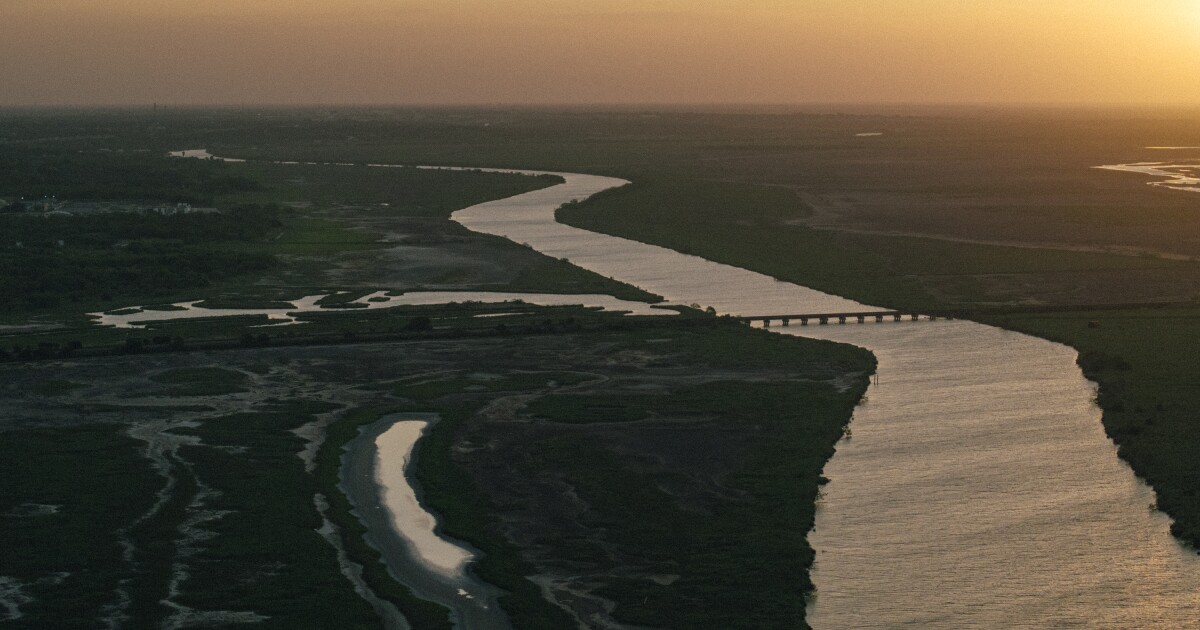
In March, Corpus Christi officials warned that a Gulf Coast region of more than 500,000 people was running out of water.
Greg Abbott was furious — at the city.
"You know what they did? They squandered it, and then they changed their plan and then they were indecisive about what to do."
He went further. If Corpus Christi leaders didn't make a decision soon, he said, "the state of Texas has to take over and micromanage that city and run that city."
At the same moment, a different agency was falling apart. Its entire 21-member board is appointed by Greg Abbott. He designates its president. With a majority board vote, he can remove any member for inefficiency, neglect of duty, or misconduct.
He has said almost nothing about it.
That's the finding of a KRIS 6 News investigation by Rachel Denny Clow, co-published with ProPublica and The Texas Tribune.
Two agencies, one governor, very different treatment
The Nueces River Authority is building its own desalination plant, separate from the city's. It is a critical piece of the region's plan to have water in ten years.
In late June, NRA board members learned their funding for that project could run out by the end of August. The agency was spending more than it was taking in. Contracts that had kept it solvent had been canceled. Since then, three more desalination contracts the authority was counting on expired and haven't been renewed.
The project is estimated to cost $6.4 billion. The NRA has an annual budget of up to about $5 million and is governed by unpaid, part-time board members who historically meet four times a year.
That is the mismatch. Cal Jillson, a political science professor at Southern Methodist University, put it plainly:
"The city of Corpus Christi needs a lot of help, it doesn't need threats, and the Nueces River Authority is in way over its head."
Abbott's response to the city — an elected council he has no legal authority over — was to threaten a takeover. His response to the agency whose every board member he personally appointed was to say the board is responsible for the board.
His press secretary, Andrew Mahaleris, wrote on June 27: "The NRA Board oversees the agency's operations and finances. The Governor appoints board members to the state's water authorities but does not manage their day-to-day operations. … The Governor expects accountability from appointed boards."
He knows how to use the power when he wants to
The "I don't manage day-to-day operations" defense would be more persuasive if Abbott hadn't repeatedly done exactly that.
In March — the same month he was blasting Corpus Christi — Abbott instructed a different river authority not to reduce the city's water allocation from Lake Texana. He also had the state environmental agency waive regulations so the city could move groundwater from Nueces County to its treatment plant.
He can also simply not reappoint people. Ron Beal, a retired Baylor law professor whose work on Texas administrative procedure has been cited by the Texas Supreme Court, spelled it out for KRIS 6:
"He can say that when each member's term ends, if the water project is not on its way, they will absolutely NOT be re-appointed to the job! In other words, he cannot force them legally to follow his orders, but there is no doubt he has the bully pulpit."
And back in October 2022, while campaigning for reelection, Abbott told KRIS 6 that if Corpus Christi didn't pursue desalination, "then the state of Texas will do it for them."
The state is not currently involved in the city's desalination project.
The records he doesn't want you to see
Here is the part that undercuts the whole "this isn't mine to manage" posture.
On July 2, KRIS 6 filed a public information request for emails, texts, meeting notes and correspondence between Abbott's office and two people: NRA executive director John Byrum and NRA board president Eric Burnett. The request covered the desalination project and any state funding or loan guarantees tied to it.
On July 17, the governor's office confirmed it had records matching the request.
It did not release them. Instead it asked the Texas attorney general for permission to withhold them, arguing that releasing them would "seriously disadvantage Texas" — without explaining how.
A governor's office that insists it has no role in an agency's day-to-day operations is fighting to keep its correspondence with that agency's leadership secret.
Separately, when the NRA's own chief operating officer accused Byrum in March of making "materially inaccurate" statements about the desalination project's finances, Abbott's office said it expected "a thorough investigation." The board eventually cleared Byrum of "intentional wrongdoing" — and then refused to release the investigation report. KRIS 6 asked Abbott what he thought of that outcome. His office didn't respond.
The contractor Abbott toured in Israel
In May, the NRA selected Israel-based IDE Technologies as its development partner for the desalination plant.
Abbott toured an IDE desalination facility in Israel in January 2016. At the time, IDE said Abbott "expressed his intention to partner with Israeli technology companies such as IDE to develop and deploy water solutions for Texas."
KRIS 6 asked whether the governor or anyone in his office was involved in the NRA's selection of IDE. Byrum said the "Governor's office was not involved." Abbott's spokesperson did not respond to the same question.
Meanwhile, Byrum has claimed President Trump promised funding for the project. The river authority has never made a formal request to the White House.
What "takeover" is really about
Abbott's threat to run Corpus Christi's water fits a pattern that has nothing to do with water.
In 2015 he signed a bill overriding a voter-approved fracking ban in Denton and blocking cities from restricting oil and gas drilling. In 2023 he signed the "Death Star" bill, which stripped city authority over eight policy areas including labor, natural resources, insurance and property.
And Republican state Rep. Denise Villalobos, who represents the Corpus Christi region, previously told KRIS 6 that Abbott directed her to draft a bill creating a state-level water infrastructure authority — something she compared to the state's highway department. If the Legislature passes it next year, decisions about local water supplies move to Austin.
Whether a takeover is even legal is unsettled. Under Texas law, surface water is public property and groundwater is private property. Desalinated seawater is neither. Gabriel Collins of Rice University's Baker Institute told KRIS 6 that a case could theoretically be made for state jurisdiction over water drawn within three miles of shore, but nobody has made it here — and doing so "would be a massive shift in water policy in the state of Texas."
Corpus Christi's city manager, Peter Zanoni, looked into how a takeover would work and found no example in Texas history of the state stepping in to run a water operation.
Collins raised the more useful question: would a takeover actually fix anything, "or would you be better off resolving those fundamental problems by having the state be a catalyst and a facilitator financially that helps the local political authorities solve a problem?"
What's at stake for people who live there
This is not an abstraction for the half-million people in the region.
If water supplies drop below certain levels, Corpus Christi's Level 1 emergency plan requires residents and businesses — including the oil refineries and petrochemical plants — to cut water use by 25%. Households get capped at 6,000 gallons a month. Landscape watering is banned. People who go over pay surcharges.
Recent rain has delayed that, not prevented it.
This is the same governor who, two days before this story ran, announced he was pausing new data centers until the state audits how much power and water they use — after years of branding Texas the "epicenter" of AI development and handing those data centers a sales-tax exemption now projected to cost the state billions.
The pattern is consistent. When something breaks in Texas, Abbott finds a local government to blame and a press conference to hold. The parts he actually controls — the boards he appoints, the incentives he signed, the emails he won't release — are somebody else's responsibility.
Sources
- "Greg Abbott blasted Corpus Christi for its water crisis. A river authority he has power over is falling apart." — Rachel Denny Clow, KRIS 6 News, co-published with ProPublica and The Texas Tribune, August 4, 2026
Photo: Brenda Bazán for ProPublica and The Texas Tribune.