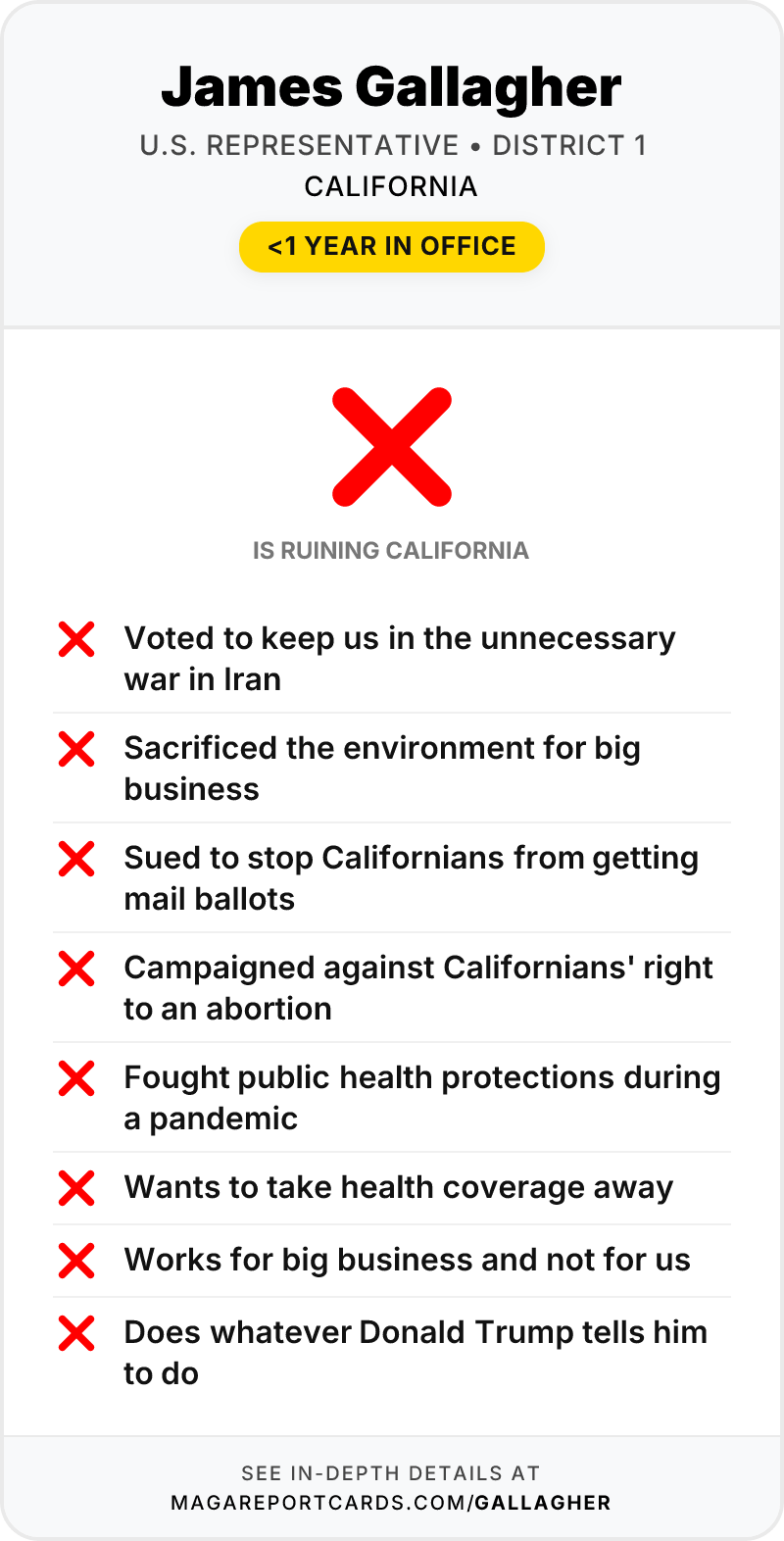
James Gallagher was sworn in to represent California's 1st District on June 10, 2026. On July 21 — six weeks later — he brought an amendment to the floor of the House.
It was amendment number 8 in Part A of House Report 119-755, attached to H.R. 8800, the National Defense Authorization Act for Fiscal Year 2027. Here is what the official summary says it would do:
"open up a study to be conducted to explore mechanisms by which federal authority can preempt or otherwise mitigate state actions that effectively undermine domestic refining capacity critical to national defense. Also, the amendment improves transparency on how state fuel policies may impact national security, and how the Federal government may intervene."
Strip out the procedural language and it says something simple. A congressman from California asked the federal government to draw up a roadmap for overriding California.
What "state fuel policies" means here
The summary never names a state. The amendment's text does: it tells the study to "take into consideration as a case study mechanisms available with respect to actions taken by the State of California." And Gallagher's office didn't pretend otherwise, describing it as examining the national defense impacts of California's energy policies. California is the state with the fuel policies — the low-carbon fuel standard, the refinery rules, the emissions requirements that the state adopted through its own legislature and its own regulators.
Those are laws California made for itself. Gallagher's amendment asks the Government Accountability Office, working with the Energy Information Administration, to study how Washington could "preempt, repeal, or otherwise mitigate" them, and how it "may intervene."
It is worth being precise about what that is and isn't. The amendment would have commissioned a study, not repealed anything. But a study of "mechanisms by which federal authority can preempt" state law is not a neutral fact-finding exercise. It is the first step you take when you want the option on the shelf.
And he attached it to the defense authorization bill — the must-pass annual bill that authorizes the military's budget. Framing California's fuel rules as a national security threat to "domestic refining capacity" is what lets a state-policy fight ride on a defense vehicle.
The vote
It failed. Roll call 261, July 21, 2026, at 9:28 p.m.: 212 yes, 216 no.
The breakdown is worth reading closely, because it doesn't split the way you'd assume:
- Republicans: 207 yes, 7 no. Seven Republicans crossing over is what sank it. Three votes the other way and it passes.
- Democrats: 4 yes, 209 no.
- One independent voted yes.
Two of the four Democratic yes votes were Californians — Jim Costa and Adam Gray, both from the Central Valley, where refinery and fuel-cost politics cut differently than they do on the coast. That is a real complication and worth stating plainly rather than pretending the vote was purely partisan.
Gallagher voted yes on his own amendment. Every California Republican in the chamber voted with him — Ken Calvert, Vince Fong, Darrell Issa, Young Kim, Tom McClintock, Jay Obernolte, and David Valadao. Not one California Republican voted no.
Every other California Democrat voted no.
The venue he chose
Gallagher spent eleven years in the California State Assembly, more than three of them as Republican Leader. He knows how to fight California policy inside California — and he has, including a 2020 lawsuit against Gov. Newsom's vote-by-mail executive order that a Sutter County judge decided in his favor, ruling the governor could not rewrite statutes by decree — a ruling a state appeals court reversed in May 2021.
Whatever you think of that case, it was an argument about who gets to make California's laws, brought in a California court, on the theory that the California Legislature holds that power.
This amendment is a different kind of move. It asks the federal government to study how it might override what California's Legislature and regulators decided. The venue changed, and so did the principle.
There is a genuine argument on his side, and his constituents deserve to hear it stated fairly: fuel costs in California are high, refineries have been closing, and a representative from a rural northern district can reasonably argue his constituents pay for policies written for a different part of the state. That is a real position, and Gallagher has held versions of it for years.
But there is a difference between fighting California's fuel rules in Sacramento, where the voters who elected those legislators can hold them accountable, and asking Washington to study how to steamroll them. The first is politics. The second asks a federal government Californians don't control to override a decision Californians made.
What it says about the new guy
Gallagher won his seat in a June 2 special election with about 62% of the vote after the death of Doug LaMalfa. He inherits a district and a short window: this term runs only through the end of LaMalfa's unexpired term.
In that window he has already voted twice against pulling American forces out of hostilities Congress never authorized, and used one of his early floor amendments to invite federal intervention against his own state's laws.
His other sponsored bills so far are local and unremarkable — a Sacramento River basin water bill named for LaMalfa, and the CLUSTER Act introduced August 3. The preemption amendment is the one he chose to spend a floor vote on.
Four votes. That's how close California came to having its own congressman put a federal override study into the defense bill.
Californians deserve a representative who fights for the state he was elected to represent. We deserve better.
Source
House Amendment 249 to H.R. 8800, sponsored by Rep. James Gallagher (R-CA-1), failed 212-216 on roll call 261, July 21, 2026. Official portrait, 119th Congress.