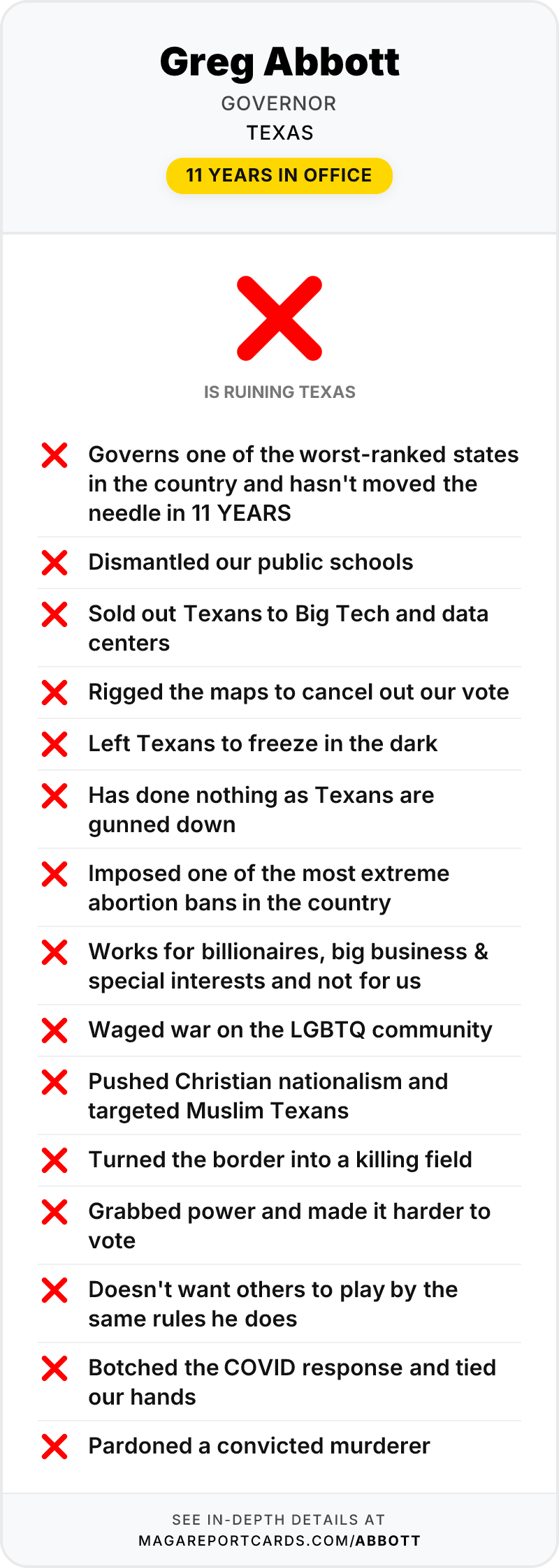
At a campaign stop in Austin on Tuesday, Greg Abbott said he wants a number, and the number is zero.
Specifically, he wants legislation guaranteeing that "exactly zero" employees of Texas public schools are in the state on an H-1B visa — the federal work visa for specialized jobs. And he wants it to apply not just to future hires, but to the teachers who are already in Texas classrooms right now.
Here is the problem with that number. Texas school districts employ more H-1B educators than any other state in the country.
Who these teachers actually are
The National Education Association counted them in October 2025: more than 2,300 educators working across more than 500 public school districts nationwide. Texas, North Carolina and California employ the most, with Texas at the top.
Dallas ISD alone employs 171 visa holders — more than any other district or public university in the state, according to federal data.
These are not people taking jobs Texans are lining up for. Districts use these visas specifically to fill critical teacher shortages — in roles such as bilingual education. Texas has a larger share of students learning English than any other state, and Bilingual/English as a Second Language is on the state's own official teacher shortage list for this school year.
So the policy reads like this: in classrooms Texas cannot staff, where districts have already tried and failed to hire locally, the state would make it illegal to keep the teacher who took the job.
Abbott said the quiet part himself when describing the tradeoff: "Texas is having to put our foot down, and that means making some tough decisions."
The tough decision falls on a bilingual second-grader in Dallas.
He tried this once already — and skipped K-12
This isn't Abbott's first move on H-1B visas.
In January he said he was reviewing whether taxpayer dollars were being used to pay H-1B visa holders at public schools and universities. He then ordered state agencies and public universities to freeze new H-1B petitions.
That order deliberately did not apply to K-12 schools.
Seven months later, on a campaign stop, that carve-out is gone — and the new version goes further than the old one ever did. The January freeze stopped new petitions. What Abbott described Tuesday would reach back and cover people already working here under visas the federal government reviewed and approved.
Because that's the other thing worth saying plainly: federal officials vet and approve every one of these applications. The teachers Abbott wants out of Texas classrooms are here legally, through a program Congress created, having passed the government's own screening. Abbott's own stated complaint is with the federal government's handling of the program, and the Trump administration's is with employers it accuses of using it to replace American workers. Neither is with the teachers.
The rest of the proposal
Abbott paired the visa ban with a second idea: barring public schools from accepting gifts or entering financial agreements with a foreign source, modeled on rules already applied to Texas universities.
Both were pitched as part of an effort to target "foreign influence" in Texas education.
It's worth being precise about what's being called foreign influence here. A bilingual teacher hired by an American school district, paid by an American school district, teaching an American curriculum to American children, under a visa approved by the American federal government, is not foreign influence. That's a hire.
Neither proposal is law. The Legislature doesn't convene until next year, and it would have to pass both for Abbott to sign them.
The pattern this fits
Abbott's record on this is not a series of unrelated policy calls. It's a direction.
He signed an executive order siccing state health agencies on hospitals and doctors over "birth tourism", pushing medical providers into immigration enforcement in a state already near the bottom for women's health. He declared Texas's largest Muslim civil rights group a terrorist organization using reasoning that Texas Monthly found tracked a report from a think tank the Southern Poverty Law Center lists as an anti-Muslim hate group.
And this is happening while public schools are under pressure from every other direction too — including a national Republican push to abolish the Department of Education outright and route public school money into private and religious schools.
Texas schools are short of teachers. That is the actual, measurable problem in front of the governor. His proposal does not hire a single new teacher, train a single new bilingual educator, or raise a single salary. It removes people who are already doing the work.
Dallas ISD, the district that stands to lose the most, answered the next day. Officials said the district only hires teachers from abroad to fill critical shortages, and that every one of them is certified by the Texas Education Agency.
"If the governor's new expectation is to eliminate these teachers, then we're going to need more Texans in the teaching pipeline."
Source
H-1B visa ban for Texas public schools proposed by Gov. Abbott — Megan Menchaca, The Texas Tribune, August 18, 2026.