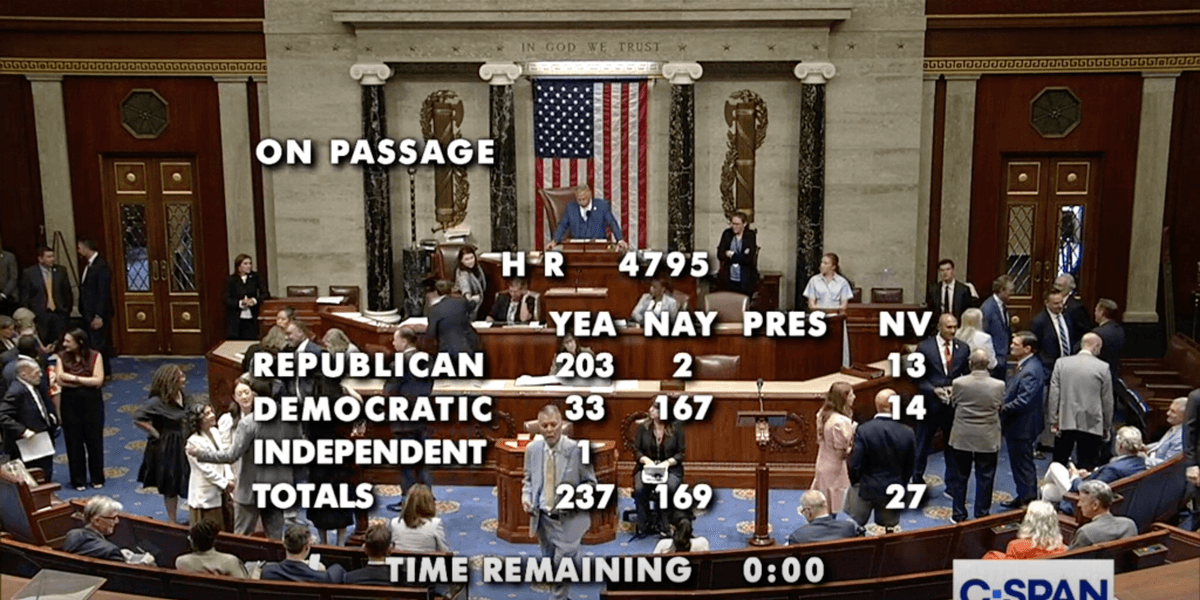
Most bills in Congress run hundreds of pages. H.R. 899 is one sentence:
The Department of Education shall terminate on December 31, 2026.
That's it. No plan for what happens to the money that goes to poor school districts. No plan for the student loans that millions of families depend on. No plan for the office that enforces the rights of kids with disabilities. Just a date.
Rep. Thomas Massie of Kentucky introduced it on January 31, 2025. Thirty-seven House Republicans have put their names on it as cosponsors.
Thirty-one of them have report cards on this site. Here they are.
The cosponsors
Twenty-seven members signed on the day the bill was introduced. These are the ones we track: Andy Biggs, Lauren Boebert, Josh Brecheen, Tim Burchett, Eric Burlison, Ben Cline, Andrew Clyde, Mike Collins, Eli Crane, Jeff Crank, Warren Davidson, Paul Gosar, Harriet Hageman, Andy Harris, Rich McCormick, Mary Miller, Andy Ogles, Scott Perry, Keith Self, Victoria Spartz, Claudia Tenney, Tom Tiffany, William Timmons, and Randy Weber.
Ten more signed on over the following months, including David Taylor, Brandon Gill, Greg Steube, Russ Fulcher, Anna Paulina Luna, Marlin Stutzman, and — as recently as April 30, 2026 — Sheri Biggs.
Every one of them represents a district full of public schools. Nine out of ten American children — 49.6 million of them — go to one.
Abolishing the department is the loud part
Here's the thing about H.R. 899: it's mostly a flag to wave. The bill has sat in committee since the day it was filed. It's a way to tell primary voters where you stand without having to explain what happens to Title I money the following January.
The real work is happening somewhere else, and it's working.
Roughly half the Education Department's workforce is already gone — 1,400 laid off, 600 pushed into early retirement, about 100 probationary employees fired. Its work is being handed off to the Labor Department, HHS, the Interior Department, and the State Department. None of those agencies run schools. Around $30 billion in education programs has been shipped out. The department spent $38 million paying Office for Civil Rights employees to sit at home on administrative leave.
Congress noticed. In the spending package, lawmakers wrote that "no authorities exist for the Department of Education to transfer its fundamental responsibilities" to other agencies, and warned the moves would "create inefficiencies, result in additional costs to the American taxpayer, and cause delays and administrative challenges."
And then Congress did nothing. Instead of stopping it, lawmakers asked to be sent briefings. The transfers went ahead anyway.
That's the whole story of this Congress in one paragraph. They write down that something is illegal, request a status update, and let it happen. Meanwhile the House Education and Workforce Committee is moving 10 bills to make the breakup permanent — because an executive order can be reversed by the next president, and a law can't.
The quiet part is the money
While everyone was arguing about whether to abolish a department, Republicans did something far more consequential: they created the first national private school voucher in American history, and they hid it in a tax bill.
Buried in the "One Big Beautiful Bill Act" is a dollar-for-dollar federal tax credit for donations to private school scholarship groups. Read that again — dollar-for-dollar. It's the only credit in the entire tax code that pays a donor back 100 cents on the dollar. Give $1,700, get $1,700 back. It costs the donor nothing.
It starts January 1, 2027. And there is no cap on how much money it can pull out of the Treasury.
The Joint Committee on Taxation scores it at $26 billion over ten years. The Institute on Taxation and Economic Policy estimates it could run as high as $51 billion a year. For comparison, the federal government spends $18.4 billion on Title I for low-income schools and $14.6 billion on IDEA for students with disabilities. This one tax credit could cost more than both of those combined.
It's sold as help for low-income families. The law defines that as anyone under 300% of area median income — which in some parts of the country means a household making $500,000 a year.
Vouchers go to families who were never in public school
This is the part that never makes the press release. Every state that has tried universal vouchers gets the same result: the money goes to people who were already paying private tuition.
- 95% of Arkansas voucher users never attended a public school.
- In Florida's first year of universal vouchers, 69% of new recipients were already in private school. Only 13% had ever set foot in a public one.
- In Iowa, two-thirds were already in private school.
So the pitch — rescuing kids from failing schools — isn't what the program does. It cuts checks to families who had already made other arrangements, and it takes the money out of the schools where nine of ten kids actually are.
And the kids who do switch end up doing worse
Four rigorous studies found the same thing. In Washington, DC, voucher students scored 0.12 standard deviations lower in math than students who weren't offered one. In Louisiana, the average student fell from the 50th percentile to the 34th percentile in math after three years. Indiana and Ohio came out the same way. Students with disabilities lost the most.
Joshua Cowen, the Michigan State professor who spent nearly two decades evaluating these programs — including the original Milwaukee study — now opposes them outright. He called the Louisiana results "shockingly bad."
Where the money actually lands
Ohio spends nearly $1 billion a year on vouchers, with the vast majority flowing to Catholic and evangelical schools. Unlike a public school, those schools are free to turn your child away — over their religion, their disability, or who their parents are — and they face almost no accountability for the public money they take.
And the schools didn't use the windfall to enroll more kids. They raised tuition to capture the vouchers.
One religion, everybody's classroom
The voucher money is one half of it. The other half is what's being put into the public schools that survive.
In February 2026, the full 5th Circuit cleared the way for Louisiana's law requiring a specific Protestant version of the Ten Commandments in every K-12 classroom in the state — the law specifies the size and the font. Texas has passed a comparable law.
In June 2026, the Texas State Board of Education voted to put Bible passages on the required reading list for more than 5 million public school students. That's roughly 1 in 10 public school students in the country, and the first statewide mandatory reading list in America to include a religious text.
At a Religious Liberty Commission event held at the Museum of the Bible, Donald Trump announced Education Department guidance on prayer in public schools and said he was "restoring our identity as a nation under God." Rachel Laser of Americans United for Separation of Church and State called it a "Christian nationalist agenda."
Public schools belong to all of us — every faith, and none. A Jewish kid, a Muslim kid, a kid whose family doesn't go to church at all: they all pay for those schools and they all have to sit in that classroom.
College got more expensive too
The same "One Big Beautiful Bill Act" ended the Grad PLUS loan program, capped what parents can borrow, and eliminated the SAVE, PAYE, and ICR repayment plans.
Under the replacement plan, a family of four earning $81,000 sees their monthly payment jump from $36 to $440. Repayment stretches to 30 years. Even a borrower with no income at all has to pay $10 a month.
What this actually is
Put the pieces next to each other and the shape is obvious.
Drain the money out through an uncapped tax credit. Send it to private and religious schools that can reject your kid and don't have to answer for the results. Push one religion into the public classrooms that are left. Gut the federal department that's supposed to enforce civil rights and get money to poor districts. Then put your name on a one-sentence bill to finish the job, and go home and tell voters you're for local control.
Our public schools took generations to build. They are the one institution in American life that has to take every single child who walks through the door — rich or poor, disabled or not, any faith or none.
Thirty-eight members of Congress put their names on abolishing the agency that helps hold that together. Their constituents' kids will be living with the results long after the press release is forgotten. We deserve better.
Sources
The cosponsor list is from Congress.gov. Additional research on voucher outcomes from Brookings. Photo: ProPublica.