On January 20, 2026, Congress released a bipartisan spending package. Buried inside was a sentence that should have stopped everything:
"no authorities exist for the Department of Education to transfer its fundamental responsibilities under numerous authorizing and appropriations laws, including through procuring services from other federal agencies, of carrying out those programs, projects, and activities to other federal agencies."
Read that again. Congress — the branch of government that actually writes the laws — put in writing that the Trump administration had no legal power to do what it was already doing.
Lawmakers went further. They said the moves would "create inefficiencies, result in additional costs to the American taxpayer, and cause delays and administrative challenges in Federal funding reaching States, school districts, and schools." They called the agreements "unprecedented." They said the work was going to agencies that don't have the "experience, expertise or capacity" to do it.
And then they did nothing to stop it.
What was happening at the exact same moment
That same week, between 40 and 50 Education Department employees were told to pack up and move to the Labor Department.
Not transferred. Not reassigned. Just… moved. They still work for Education. They still get paid by Education. They do the same job, for the same boss. They just do it in a different building.
One official inside the department described the whole plan this way:
"What it really means is, 'Pick up your [Personal Identity Verification] card and laptop and move over to Labor."
Another put it even more simply: "Do your Education work at Labor."
Here's the part that tells you everything about how well thought out this was. Labor wouldn't give the workers parking spots. So the Education Department hired vans to shuttle people back and forth twice a day. If the van schedule didn't line up with someone's shift, they'd work part of the day at Education, ride the van over, and finish at Labor.
That's the "efficiency" plan. Vans.
Congress had the pen. It chose not to use it.
Here's the thing that should make you angry.
Congress wasn't a bystander here. This language was in a spending bill — the one thing Congress fully controls. If lawmakers believed the transfers were illegal, they could have written one sentence banning them and dared the administration to defy it.
They didn't. The package restricted moving money for these agreements without clear legal backing, but it did not ban the agreements or the employee moves themselves. Instead, lawmakers asked for briefings every two weeks on costs, staffing, and the effect on schools.
They wrote down that the administration had no legal authority to do this — and their response was to ask for a status update.
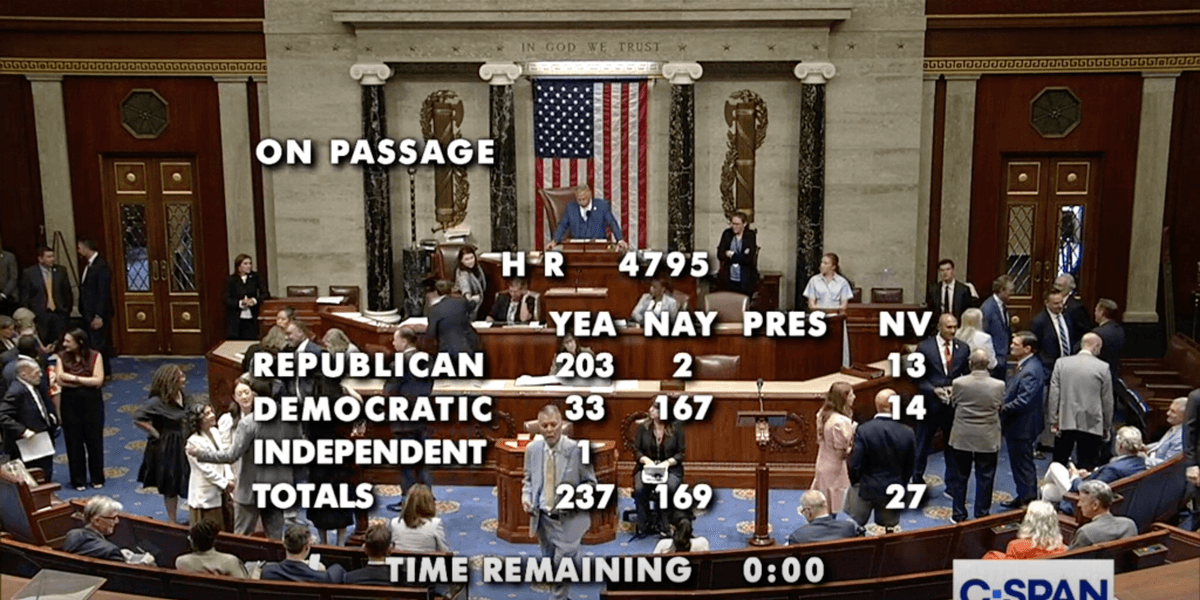
Then they passed the bill. The House approved the package 341–88 on January 22. The Senate followed 71–29 on January 30. The House cleared the final version 217–214 on February 3 — with 196 Republicans voting yes — and Trump signed it into law that same day.
The transfers went ahead. Nothing stopped.
This isn't just Democrats saying it's illegal
The day after the bill became law, Congress's own nonpartisan lawyers at the Congressional Research Service published their analysis. It's dry, careful, lawyerly writing — and it does not go well for the administration.
The Education Department leans mainly on an old law called the Economy Act, which lets one agency order "services" from another. CRS is blunt about the limit of that law: "the Economy Act does not authorize the transfer of statutory functions."
On whether the Education Secretary can hand her own duties to somebody else, CRS wrote that the law setting up the department lets her delegate to her own staff and make small changes inside the agency — but "Neither authority allows the Secretary to transfer her statutory duties outside of the department."
And there's a bedrock principle CRS quotes: a responsibility Congress hands to a specific agency "may not be transferred except by specific action of Congress."
Specific action of Congress. That's the whole ballgame. Congress created the Education Department. Congress assigned it these jobs by law. Only Congress can move them. A president can't. A Cabinet secretary can't. A handshake deal between two agencies definitely can't.
To be precise: CRS didn't declare the deals illegal. Its careful conclusion was that two questions are still open — whether the spending law's transfer ban reaches these deals, and whether the deals move real duties or just "services." Both are now being fought out in federal court in Massachusetts, where school districts, unions and a group of states are suing to block them.
But notice who isn't in that courtroom. Congress is the branch that was wronged here. It's the one that said the authority doesn't exist. And it's letting school districts and states do its fighting for it.
Six months later, Congress still hadn't gotten its briefings
Remember those biweekly briefings — the thing lawmakers asked for instead of a ban?
On July 30, 2026, Sen. Patty Murray told a Senate committee that the Education Department had spent over a million dollars just to carry out one of its deals with the Labor Department. Then she said this about all the rest:
"Show us the receipts. There are now 13 more of these agreements, and Congress has not received any information about what they cost."
Six months. Fourteen deals with six different agencies. Zero cost information handed over.
The one thing Congress actually asked for, it never got. And there was no consequence for that either.
Look at what's being handed away
Since May 2025, the Education Department has signed 14 interagency agreements. This isn't paperwork shuffling. These are the jobs Congress built the department to do:
- Special education — the office that carries out the law guaranteeing kids with disabilities a free public education — is moving to Health and Human Services.
- Civil rights enforcement — the office where families file complaints when a school discriminates against their child — is moving to the Justice Department.
- Tribal education is moving to the Interior Department.
- International education programs are moving to the State Department.
- The government's roughly $1.7 trillion student loan portfolio is headed toward the Treasury Department.
Meanwhile, roughly half of the department's 4,000-plus employees are already gone through layoffs and buyouts.
And the civil rights office? The Government Accountability Office found it took in more than 9,000 discrimination complaints between March and September 2025 and closed about 7,000 — by dismissing 90% of them.
That's what "efficiency" looks like in practice: your kid's discrimination complaint gets closed without being fixed.
Even the money argument falls apart. Education has long used a grant system called G5 that it gets to use for free. The system it now has to use at HHS and Labor costs money. And the union representing department workers says Education is on a hiring spree to refill jobs it eliminated last year — because it no longer has enough people to do the work the law requires.
Then Republicans started writing laws to make it legal
Here's the tell.
On July 15, 2026, the House Education and Workforce Committee — chaired by Michigan Republican Tim Walberg — approved a package of 10 bills that would permanently move Education's jobs to Labor, Treasury, State, HHS and Interior. Nearly along party lines.
Walberg called it the "first step toward ending the Department of Education's reign over our nation's education system."
But stop and think about what those bills are. They mostly mirror the interagency agreements that already happened. If the administration already had the authority, why does Congress need to pass a law giving it that authority?
Rep. Suzanne Bonamici said it out loud at the markup. The bills, she said, "demonstrate that Republicans in Congress know that the Department of Education lacks the authority to transfer offices and programs to other federal agencies without congressional action, and are now trying to cover for the unlawful actions already taken."
That's not a talking point. That's just what the legislation means. You don't write a law authorizing something that was already allowed.
Two Republicans tried. The rest didn't.
To be fair, a couple of Republicans have done something.
Sen. Tim Kaine introduced S. 5046 on July 21 — a bill that would flatly bar the Education Department from offloading four of its offices: special education, postsecondary education, K-12 education, and Native American education programs. Two Republicans signed on as cosponsors: Susan Collins of Maine and Lisa Murkowski of Alaska.
Two. Out of 53 Senate Republicans.
"This bill is straightforward," Collins said at the markup. "It keeps the administration of important landmark education programs at the Department of Education, where Congress specifically put them and where they belong." Moving special education to HHS, she said, "fundamentally misunderstands" a program created in 1975 to guarantee kids with disabilities a free and appropriate public education — an office that today serves more than 8 million children.
Murkowski said Alaska Native communities in her state weren't even consulted before the Indian Education office was handed to Interior. "So these are issues that have real-time impact on our children right now."
The bill cleared the Senate health committee 13–9 on July 30 — and even that was a watered-down version. Sen. Patty Murray tried twice to go further: once to block all the transfers, once to at least protect the civil rights office from being shipped to the Justice Department. Both amendments failed. Collins voted against the civil rights one; she wants that office moved to DOJ.
"Don't keep running up the middle"
Then there's what the rest of the Republicans on that committee said.
The panel's own chairman, Bill Cassidy, voted against the bill — even though he agrees moving special education to HHS is a bad idea. His reason:
"I do think the administration should be allowed to pilot how to address inefficiencies and the potential for efficiencies by operationalizing these IAAs."
The administration should be "allowed" to keep doing a thing Congress put in writing it has no authority to do. That's the chairman of the committee that's supposed to oversee it.
Alabama's Tommy Tuberville — who is now running for governor — called the bill "misguided" and told the committee the Education Department deserves credit, not oversight.
"President Trump's Department of Education has changed. It's changed for the better. I'm hearing it from my state. We need to listen to them. We need to applaud them for what they're doing."
He finished with a football metaphor: "Don't keep running up the middle when we need to throw the football."
That's a United States senator, sitting on the committee that wrote the laws creating these offices, being asked whether an agency can ignore those laws — and answering with a play call.
Murray put the actual stakes plainly: only Congress can abolish the Education Department. "But despite this, President Trump and Secretary McMahon have tried to subvert Congress and the will of the people by entering into these illegal interagency agreements."
And even having cleared committee, the bill needs 60 votes on the Senate floor. Republicans hold 53 seats. Two of them are on board.
The bottom line
Congress said it was illegal. Congress had the power to stop it. Congress passed the bill anyway, asked for briefings, never got them, and then House Republicans started drafting laws to bless the whole thing after the fact.
This is what "checks and balances" looks like when the people holding the checks don't want to use them. A department created by Congress is being taken apart without a vote of Congress — and the members who wrote down that it was unlawful are the same ones letting it happen.
The kids losing here aren't abstractions. They're the child with a disability whose services get slower. The family whose civil rights complaint gets dismissed. The college student whose loan servicer changes hands mid-repayment. The rural school waiting on a grant that's now bouncing between two agencies and a shuttle van.
Our schools were built by law. They're being dismantled without one. We deserve better.
Source
Education begins moving out employees even as Congress says it lacks authority — Eric Katz, Government Executive, January 20, 2026. Photo: Jim Watson/AFP via Getty Images.