Congress writes the laws. The president carries them out. That is the first thing anybody learns about how this country is supposed to work, and it is the whole reason there are two branches instead of one.
An executive order is not a law. It is an instruction a president gives the executive branch, and the next president can throw it in the trash on day one. That's the deal — a president gets to run the agencies, and if he wants something permanent, he has to persuade Congress.
On July 23, 2025, Keith Self introduced four bills in a single day.
Here are their official titles, from the congressional record:
- H.R. 4727 — "To codify Executive Order 14235 relating to restoring public service loan forgiveness."
- H.R. 4728 — "To codify Executive Order 14280 relating to reinstating commonsense school discipline policies."
- H.R. 4729 — "To codify Executive Order 14292 relating to improving the safety and security of biological research."
- H.R. 4730 — "To codify Executive Order 14253 relating to restoring truth and sanity to American history, and for other purposes." This one also carries a short title, the Restoring Truth and Sanity to American History Act, which is the name it goes by.
Four bills. Four Trump executive orders. Written up, numbered, and filed by a member of the branch that is supposed to be checking him.
What's in them
These are not housekeeping measures. Each order does something real, and Self's bills would put each one beyond the reach of the next election.
Executive Order 14253, signed March 27, 2025, is the history order. It directs the Interior Secretary to review whether monuments and markers on federal land have been "removed or changed to perpetuate a false reconstruction of American history," to put the old ones back, and to make sure federal sites don't "inappropriately disparage Americans past or living (including persons living in colonial times)" — and instead "focus on the greatness of the achievements and progress of the American people."
Read that plainly: a federal rule that historical markers must be flattering. Self's H.R. 4730 opens with four congressional findings about a "revisionist movement" that casts the country's history as "inherently racist, sexist, oppressive, or otherwise irredeemably flawed."
Executive Order 14280, signed April 23, 2025, is "Reinstating Commonsense School Discipline Policies." It targets the 2014 guidance from the Education and Justice Departments that told schools they could violate the Civil Rights Act if their discipline fell much harder on students of one race than another. The order calls that framework "discriminatory and unlawful 'equity' ideology."
Executive Order 14235, signed March 7, 2025, is titled "Restoring Public Service Loan Forgiveness." Despite the name, it narrows the program. Public Service Loan Forgiveness is what teachers, nurses, public defenders and nonprofit workers count on after ten years of payments; the order declares that the program "has misdirected tax dollars into activist organizations that not only fail to serve the public interest, but actually harm our national security and American values."
Executive Order 14292, signed May 5, 2025, restricts federally funded "dangerous gain-of-function research" on pathogens.
You can agree or disagree with any of these on the merits. That is a separate argument. The thing worth noticing is who was doing the writing, and who was doing the signing off.
This is not what a constitutional conservative does
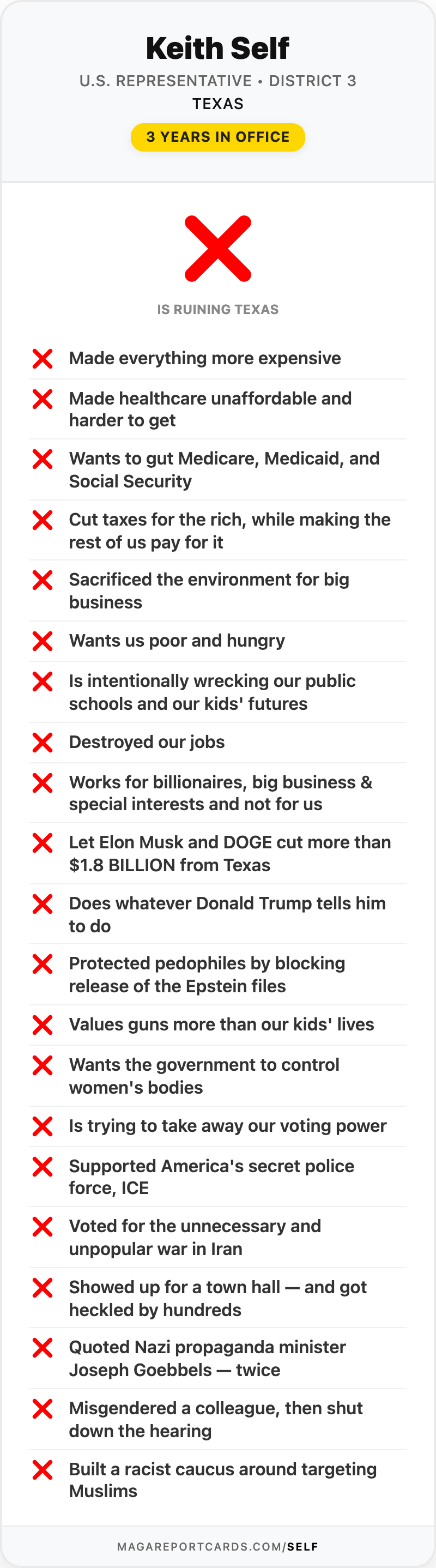
Self is a member of the Freedom Caucus. He talks about the Constitution constantly. He is the author of H.J. Res. 198, introduced June 25, 2026 with nine cosponsors, which would repeal the 17th Amendment and take away your right to vote for your own U.S. senators, handing that power back to state legislatures.
His stated reason for that one is restoring "constitutional balance."
Set the two next to each other.
On the one hand: a congressman so concerned with the original constitutional design that he wants to strip voters of a power they've had since 1913 — a proposal we've covered before, and one nine of his colleagues have signed.
On the other hand: the same congressman spending a day at his desk turning the president's orders into bills, which is the exact opposite of a legislature checking an executive. It is a legislature taking dictation.
Congress does not exist to ratify what the president already decided. If Congress independently concludes that a policy is right, it writes its own bill and defends its own reasoning. Self's four bills don't do that. All four of their official titles begin "To codify Executive Order." The argument for each is that the president already made it.
Why it matters beyond one member
There is a version of Congress where members introduce the president's agenda because they believe in it and are willing to own it. Fine. But then they should be able to say what's in it, defend it in their own words, and take the vote.
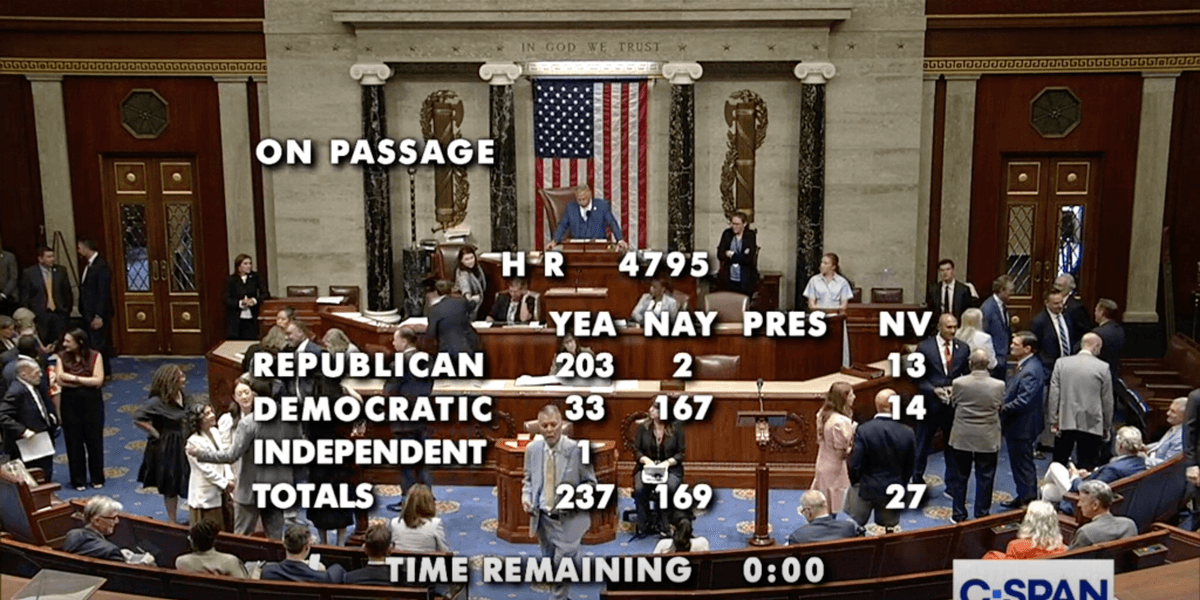
Self's page on the national debt says careless federal spending is "an existential threat to our Republic." He voted for the budget bill anyway — the one the Congressional Budget Office scored at $3.4 trillion in added deficits and 10 million more uninsured people.
That is the shape of it. When Congress's independence is inconvenient to the White House, it gets set down. When it's useful — repealing an amendment, co-founding a Sharia-Free America Caucus and signing on to its bills, lecturing about the Founders — it comes back out.
Texas's 3rd District sends one person to Washington to represent it. In July 2025 that person spent a day being a clerk for someone else's ideas.
Sources
Bill records from Congress.gov and the Government Publishing Office: H.R. 4730 bill text and H.J. Res. 198. Executive order texts from the Federal Register, including Executive Order 14253, "Restoring Truth and Sanity to American History". Photo: Official congressional portrait, 118th Congress.