Every two years, Hoosiers get to vote for a United States senator. It's been that way since 1913. Before that, Indiana's senators were picked by politicians in the Statehouse, and ordinary people had no say at all.
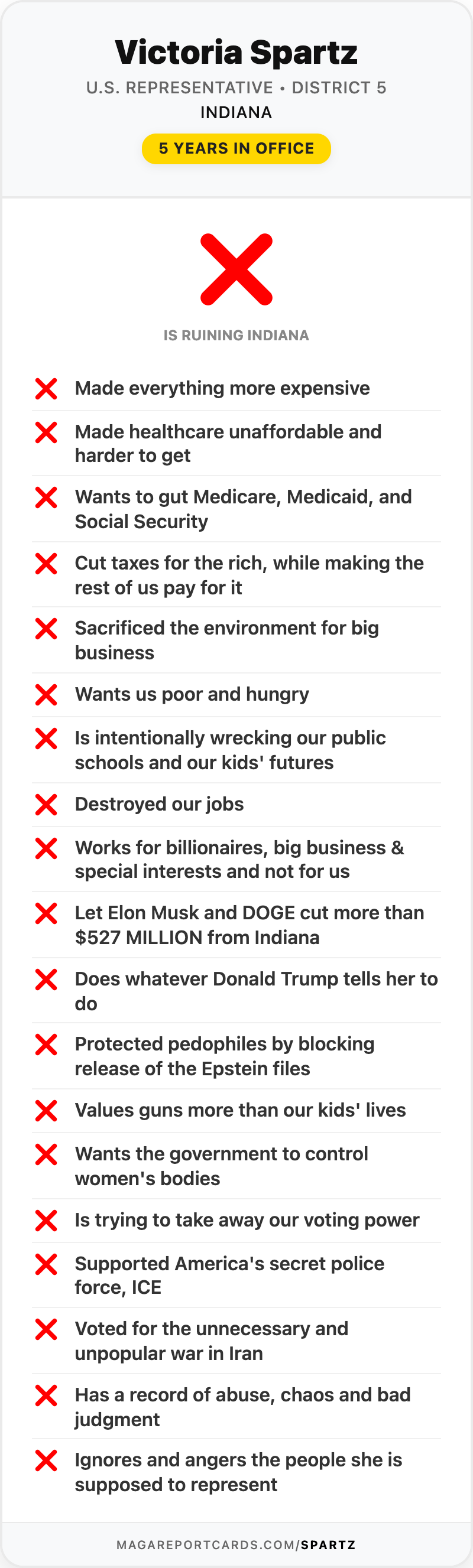
Victoria Spartz wants to go back.
On June 29, 2026, Spartz signed on as a cosponsor of H.J.Res.198 — a proposed constitutional amendment "to repeal the seventeenth article of amendment." In plain English: end the direct election of U.S. senators and give the power back to state legislatures.
The Herald Bulletin's senior reporter Ken de la Bastide opened his August 1 column on it with one line: if there was ever an issue that should be dead on arrival, this is it.
What the resolution actually does
The resolution was introduced on June 25, 2026 by Texas Republican Keith Self and has been referred to the House Judiciary Committee. Nine House Republicans have signed on: Eric Burlison, Andrew Clyde, Paul Gosar, Andy Harris, Scott Perry, Clay Higgins, Sheri Biggs, Michael Cloud — and Victoria Spartz.
Note the dates. The other eight signed the day it was introduced. Spartz joined four days later. Nobody put her name on this by accident. She read it and asked to be added.
If it ever passed and was ratified, here's what would change for you: nothing about your right to vote for president, or for your House member. But the two people who represent Indiana in the U.S. Senate — the ones who confirm Supreme Court justices, ratify treaties, and vote on every federal judge — would be chosen by state legislators in Indianapolis instead of by you.
Self's argument, from his press release, is about state power:
"Our Founding Fathers designed the Senate to protect state sovereignty and act as a check on federal overreach. If senators are supposed to represent their states, then the states should choose them."
Read that again, slowly. "The states should choose them." Not the people of the states. The states — meaning the legislature.
Spartz's office isn't waiting for the Constitution
Here's the part that should worry Hoosiers most, and it comes from Spartz's own office.
Amending the Constitution is close to impossible. It has to clear Congress and then be ratified by three-fourths of the states. Only one amendment has ever been repealed — Prohibition. So you might think this is a symbolic gesture with no real-world consequence.
Spartz's spokesperson told the Daily Caller News Foundation otherwise. Until the 17th Amendment is repealed, they said, "states can begin moving primaries to their state legislatures, party conventions, or a combination of both."
That is not a constitutional theory. That's a roadmap. It means: while we work on taking your general-election vote, states can start taking your primary vote right now — no amendment needed, no ratification, no three-fourths of anything. Just a state legislature deciding that party insiders in a convention hall will narrow the field instead of voters.
In a state where one party dominates, the primary is often the election that actually decides who wins. Handing that to a legislature or a convention isn't a technical adjustment. It's the whole ballgame.
We already ran this experiment. It failed.
The country didn't adopt the 17th Amendment on a whim. It adopted it after living with the alternative for 124 years.
Under the old system, state legislatures deadlocked. When a state's House and Senate were held by different parties, they simply couldn't agree — and the seat sat empty. Delaware went almost two years without one of its senators after a stalemate in the 1890s.
Worse, the seats were for sale. Political machines that controlled state legislatures installed senators widely regarded as their "puppets," and the Senate itself earned a nickname: the "millionaire's club," serving powerful private interests.
By 1912 — a year before ratification — 29 states had already given up and set up their own versions of direct election, because the legislative system was that broken. Congress passed the amendment only after at least 287 separate proposals for direct election had been introduced over the decades.
This is the system Victoria Spartz signed her name to bring back.
The "big money" argument doesn't survive contact with the facts
Some cosponsors argue the change would clean up campaign money. Rep. Clay Higgins told the Daily Caller the 17th Amendment is "arguably the most injurious amendment in history" because "big money has twisted our Senate races into circus acts."
Set aside whether that's true. Ask the obvious follow-up: if money corrupts an election with millions of voters, what does it do to an election decided by one room of state legislators?
That's the exact failure mode that produced the 17th Amendment in the first place. Buying a statewide electorate is expensive and hard. Buying a state legislature is neither. The reform being proposed here is a return to the system that got replaced because of corruption.
Consider the source
There's one more thing Hoosiers should weigh: who's asking.
Spartz has spent her time in Congress being, in the words of Indiana Capital Chronicle columnist Michael Leppert, "unquestionably unreliable." She announced she was retiring, then reversed and filed for reelection days before the deadline — after nine other Republicans had already filed for her seat. In December 2024 she announced she would stop attending committee meetings and the Republican caucus altogether, saying she didn't "need to be involved in circuses."
A member of Congress who won't show up to her own committees now wants to redesign the Constitution so fewer people get a vote.
What this comes down to
Politicians who want to make it harder for you to vote never say that's what they're doing. They talk about federalism, or original intent, or the Founders. Strip the language away and look at the mechanism, because the mechanism is the whole point.
The mechanism here is simple: today, you pick Indiana's senators. Under H.J.Res.198, politicians do.
Victoria Spartz put her name on that. In an election year. Four days after she didn't have to.
We deserve better.
Source
Ken de la Bastide, Spartz's amendment on election of U.S. Senators a bad proposal, The Herald Bulletin, August 1, 2026.