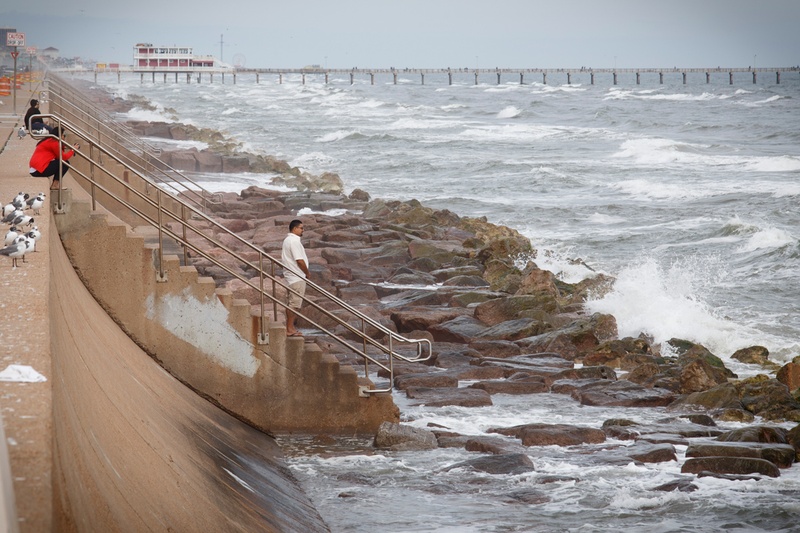
Hurricane Ike hit Galveston in September 2008. It killed people, flooded the island, and made clear that the Houston Ship Channel — one of the largest petrochemical complexes on Earth — sits wide open to storm surge.
The answer, proposed by a Texas A&M professor and eventually named the Coastal Texas Project, is a system of gates and barriers across Galveston Bay. Locals call it the Ike Dike.
Congress authorized it in 2022. As of early 2026, the federal government had put in a total of $5.5 million.
The project is estimated to cost between $35 billion and $57 billion. Washington is on the hook for 65% of it.
Randy Weber has represented that stretch of coast in Congress since 2013.
The math
Public Health Watch's Elena Bruess laid out the numbers in February 2026. The federal contributions to date: $500,000 in 2024, and $5 million in early 2026. Texas has appropriated $950 million for coastal projects, though by Public Health Watch's account only $220 million of it went to the Coastal Texas Project.
Bob Stokes, president of the Galveston Bay Foundation, put the gap plainly:
"They're going to need $2 billion a year in federal money for 20 straight years, and they've been able to maybe get $5.5 million at this point."
That is not a rounding error. At $5 million a year, the federal share of a $35 billion project finishes in about 4,500 years.
How Weber described the same news
When the $5 million cleared Congress in January 2026, Weber put out a news release. Houston Public Media's Natalie Weber quoted it:
"This funding package has now cleared both chambers, and more than $30 million is heading back to Southeast Texas once the President signs it into law. That means more ships moving through our ports, paychecks for working families, and stronger protections for a coastline that fuels America's economy."
"Stronger protections for a coastline." The Ike Dike's share of that $30 million was $5 million — about 0.02% of what the project needs from Washington.
In a statement to Public Health Watch, Weber's explanation was that these things take a while:
"These efforts take time because they must be engineered correctly, built to last and be responsible with taxpayer dollars."
It has been 18 years since Ike.
His own hometown paper started asking whether it's dead
On February 6, 2026, the Galveston County Daily News — the paper that covers his district — ran an editorial by editor Michael A. Smith under the headline "Is the Ike Dike project just napping, or is it dead?" It questioned whether the certainty coming from the project's own managers was "well founded or just wishful thinking."
That is the shape of the thing. Eighteen years after the storm, the paper of record in Weber's own district is no longer asking when the seawall gets built. It's asking whether the project still exists.
The part that isn't bad luck
Weber can fairly point out that he asked for more. In 2023 he requested an additional $100 million for the Coastal Texas Project and lawmakers turned him down.
But Weber's party has controlled the House since January 2023, and the House, Senate and White House since January 2025. The appropriations bills that shortchange the Ike Dike are bills his own majority writes. He is not a backbencher in the minority pleading with the other side.
And when that majority did move real money, it went elsewhere. Weber voted Aye on the One Big Beautiful Bill Act, the budget law that cut Medicaid and food assistance across Texas. That same law set aside $85 million to bring a retired space shuttle from a museum in Virginia to Houston and build a facility to house it — more than fifteen times what the Ike Dike has received from Washington in its entire existence.
A storm barrier for the Gulf Coast got $5.5 million. A museum exhibit got $85 million.
What's actually at risk
The Coastal Texas Project isn't a nice-to-have for Galveston tourism. As Houston Public Media put it, the barrier system is aimed at protecting the state's coastline and the Houston region's petrochemical industry from storm surge during hurricanes — the refineries and tank farms along the Ship Channel that Weber himself calls the coastline "that fuels America's economy."
Every hurricane season that passes without it is a coin flip Weber's district is asked to take.
Eighteen years. Thirteen of them with Weber in the seat. $5.5 million.
Source
Elena Bruess, "Massive Galveston Bay Barrier System Gets One Step Closer to Construction," Public Health Watch, February 19, 2026, and Natalie Weber, "Congress allocates its first round of funding for 'Ike Dike' project," Houston Public Media, January 21, 2026. Photo: V. Lawhorn / Houston Public Media.