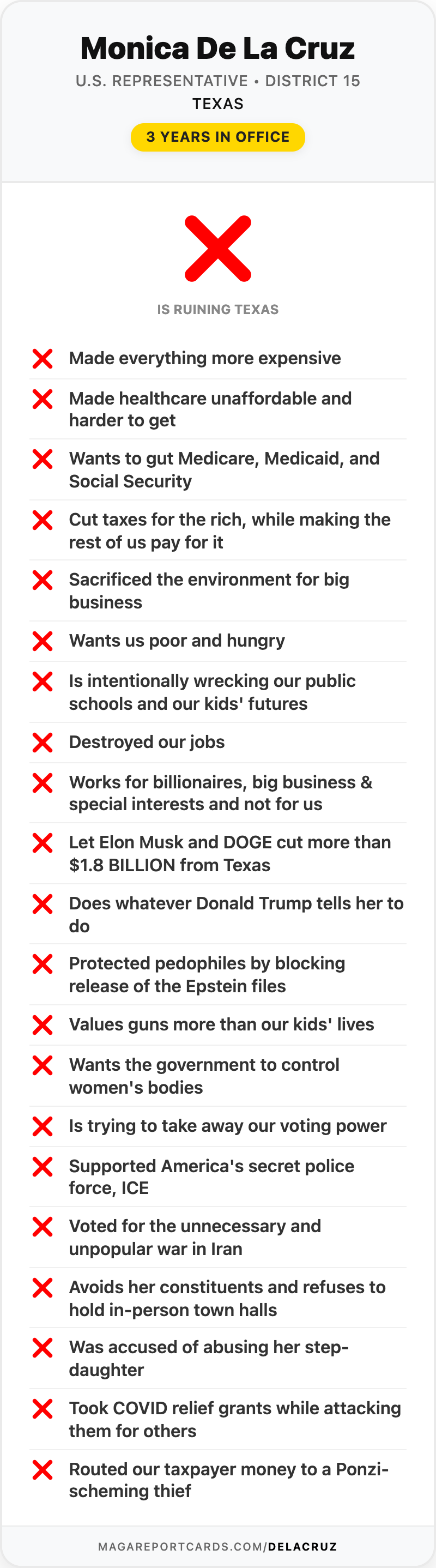
In May 2026, at a private fundraiser, Monica De La Cruz told her donors what her own pollster had found.
"We ran the poll and what we found was that I am up by only one point."
"One point. And I said, 'Oh, sweet Lord Jesus.' Right? That's not good."
Someone in the room recorded it. Punchbowl News reporter Max Cohen obtained the audio, and Raw Story reported it on June 9, 2026.
She had an explanation ready for the donors: redistricting had handed her a lot of new territory. Jon Taylor, a political science professor at the University of Texas at San Antonio, put the same point to the Texas Observer this way — "Eighty percent of that district she hasn't represented in the last two … election cycles. They really don't know her." So, she told the room:
"It's not that people don't like me. It's that people don't know me yet."
And the conclusion she drew from that is that fundraising had become critical.
There is another way to fix the problem of people not knowing you. You go to a room, in a town where they live, and you stand up and take their questions. De La Cruz has been in Congress since January 2023, and she has never done it.
The phone is the whole system
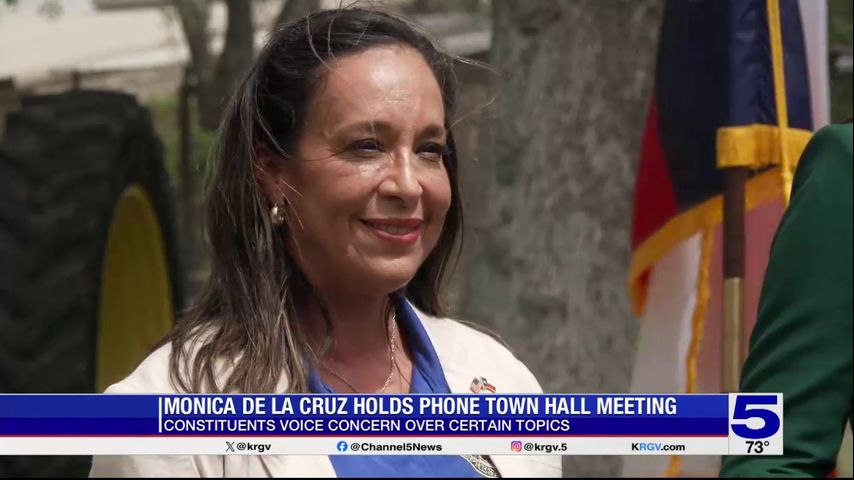
De La Cruz has told reporters plainly that this is deliberate. KRGV covered one of her phone town halls in March 2025 and reported that since she was elected to the 118th Congress, she has chosen to do them by phone because of the size of her district, which runs from Hidalgo County up along U.S. 281 toward San Antonio.
"I cannot do a town hall in each city, so this allows me to touch everybody at one time."
Nobody asked her to hold one in every city. They asked her to hold one.
Here is what "touching everybody at one time" looked like in practice on that call:
- Her team picked the questions. De La Cruz described them as "questions that all of the district is interested in."
- UnidosUS's Texas state director, Eric Holguin, was on the line and never got called. "I was not able to get a question in," he said. His question went into a queue.
- KRGV's own reporters tried to ask a question. They were put in the queue too.
- Everyone left in the queue was invited, at the end, to leave a voicemail.
Holguin's assessment: "People have legitimate concerns about Medicaid, SNAP Medicare and none of those were really addressed."
His request was modest. "We urge her to have an in-person town hall where we can have a respectful conversation, and she has an opportunity to explain why she votes a certain way."
Asked about the screening, De La Cruz explained who she thought was in the queue:
"Unfortunately, sometimes people get in the queue, and they have ill intentions and others are intentional and sincerely wanting to have clarity and information."
Taylor, the UTSA professor, told KRGV what the format signals.
"If you are engaging in this type of behavior, it suggests to me, that you are afraid of your constituents, and you are afraid to somehow be able to provide answers."
"Here is the problem, you do this long enough, people are going to get cynical and believe politicians are not representing them, or their best interest, and they believe they have something to hide."
What she told the callers about Medicaid
The screened phone call is not just a matter of style. On that same March 2025 call, De La Cruz was asked about Medicaid cuts. She answered:
"We have not made any cuts. When we voted for the budget resolution that was a top line number, it was a number."
Three months later, on July 3, 2025, she voted for the One Big Beautiful Bill Act — the bill that turned that number into law.
Democrats on the Joint Economic Committee project that 65,193 people in Texas's 15th District will lose health coverage from the Republican cuts to Medicaid and the Affordable Care Act — 61,700 losing Affordable Care Act coverage and 3,493 losing Medicaid. In the same district, 55,480 households — about 21% of all households — relied on SNAP in 2024, including 34,489 with children and 23,321 with someone 60 or older. The same bill cut that too.
The caller who was told "we have not made any cuts" has no way to follow up. That is what the queue is for.
By April 17, 2026, groups including the Latino Victory Texas Coalition and Poder Latinx were protesting outside her McAllen office over exactly this — cuts to food banks and to health coverage. Her office's response was that she is "delivering for South Texans."
What she is doing with the campaign instead
If the problem is that people don't know her, the fix she has chosen is not to meet them.
In March 2026, when Bobby Pulido won the Democratic primary, De La Cruz went on X and called him a "quinceañera act" and a "part-time Texan." She said the Democratic establishment "thinks it can buy this seat with a celebrity who brags about living in a foreign country." Her account reposted a Western Journal piece about his decade-old tweets and a New York Post item about a 2010 music video.
The quinceañera line did not land the way she meant it. In a majority-Hispanic South Texas district, Pulido treated it as an invitation, opened a page for booking requests, and — by the time the Texas Observer caught up with him in July — said he had performed at more than 50 quinces, handing out "Make Quinceañaras Great Again" hats.
Set the two side by side. Her opponent's campaign strategy is showing up at 50 family parties in the district. Hers is a fundraising appeal built on the fact that voters don't know her.
This is a party position, not a personal quirk
De La Cruz is following instructions. In March 2025 — the same month as that phone town hall — the chairman of the House Republicans' campaign arm told the entire conference to stop holding in-person town halls and switch to tele-town halls and Facebook Lives, so that video of members being confronted over Medicaid cuts would stop appearing. Ohio's Mike Carey ran a version where the phone number never got posted.
The strategy has an obvious short-term logic and one long-term cost, and De La Cruz named the cost herself, to her donors, in a room she thought was private.
People don't know her yet.
Sources
The leaked fundraiser audio was obtained by Max Cohen of Punchbowl News and reported by Raw Story on June 9, 2026. The phone town hall was reported by Sarah Cervera for KRGV Channel 5 on March 25, 2025. Photo: KRGV.