On Tuesday, March 4, 2025, House Republicans filed into a closed-door conference meeting. Their constituents were furious — about DOGE, about mass firings, about what was coming for Medicaid — and members were getting shouted down at town halls back home. Video of Republicans walking off stages was everywhere.
Richard Hudson, the chairman of the National Republican Congressional Committee, stood up and gave them a solution.
Stop holding in-person town halls.
As NOTUS reported from the meeting, Hudson told his colleagues to switch to tele-town halls or Facebook Lives instead. His reasoning was that members could still hear from constituents that way, while avoiding "disruption from activists."
The other way to describe that is: you can hear the voters, but the voters can't be seen or heard by anyone else.
The advice was about the pictures, not the listening
The timing tells you what this was about. The same reporting noted that going online would avoid "the recent images of Republicans running off stage, getting drowned out by boos and being challenged on unpopular cuts to programs like Medicare and Medicaid." Congress was in the middle of writing a budget bill that would cut $2 trillion in spending, much of it out of Medicaid.
Speaker Mike Johnson backed him up at his weekly press conference: "The best thing that our members can do is communicate directly, frequently, consistently, with their constituents. There are other avenues to do it than just going in to try to give the other side sound bites."
Hudson's spokesperson, Will Kiley, posted on X that Hudson supports members talking to as many constituents as possible. "Using technology makes this a heck of lot easier," he wrote.
Democrats' campaign arm was blunter. "So House Republicans' political strategy is 'see no families nor workers,' 'hear no protesters', 'speak to no one' and hope everyone gets less angry at them when they rip away Americans' health care? Got it," said DCCC spokesperson Viet Shelton.
It's worth being precise about who said this and what job he holds. Hudson isn't a random member with an opinion about scheduling. The NRCC chairman raises the money, recruits the candidates, and sets the campaign strategy for every House Republican on the ballot. When he tells the conference to stop appearing in public, that's the party's official advice to more than 200 members of Congress about whether to face the people who elected them.
Then he showed everyone how it's done
On April 22, 2025, Hudson took his own advice and held a tele-town hall. CityView, the nonprofit newsroom in Fayetteville, listened to the whole thing.
Here's what a Hudson town hall looks like:
- 50 minutes long. Eleven questions.
- Callers apologized for barking dogs and asked "can you hear me?" before speaking.
- Hudson's office ran a telephone survey during the event — "press 1 for jobs and the economy," "press 2 for immigration and border security" — five separate times, which CityView compared to a customer-service hold loop. CityView could not establish how the moderators chose the questions, or whether the survey fed into the choice.
- Nearly half the questions were about veterans and the military — safe ground in a district that includes Fort Bragg.
One caller got through on DOGE. A Fayetteville veteran named Sam told him: "I've worked on Fort Bragg. I've been to Europe fighting. And you know, I'm just wondering what you are going to do about an unelected official who is ransacking our government. You are an elected official and I just hope that you do something."
Hudson's answer was that Elon Musk only made recommendations, and cabinet secretaries made the decisions. "In some cases, maybe they move too fast," he said. "And so I've asked some questions about some specific moves in certain agencies, but overall, I think the process has been good."
He'd already told the Associated Press that voters would "reward us" for the DOGE cuts.
The Medicaid answer
The most important moment of that call came from a woman named Sylvia. She said she had taught in the Fayetteville area for 16 years and could no longer work because of a disability. She had health coverage because North Carolina expanded Medicaid to cover single adults like her. She wanted to know if Republicans were going to take it.
It was a sharp question, and she had the mechanics right. North Carolina's expansion is written so that it rolls back automatically if Washington stops covering 90% of the cost. And Hudson sits on the Energy and Commerce Committee, which had just been handed the job of finding $880 billion in cuts from the programs it oversees — Medicaid included.
Here is what he told her:
"There's been a lot of rumors that Republicans in Congress are going to cut Medicaid. That's just simply not true. But what we are going to do is we're going to look and see how many illegals are on Medicaid and we're going to stop giving them the benefits. We're going to look at able-bodied adults. And if you're an able-bodied adult with no dependents and you can work, then you either need to be looking for a job, getting an education or working."
Seventy-two days later, on July 3, 2025, Hudson voted for the budget bill that cut Medicaid. His "Aye" is on the roll call.
North Carolina stands to lose an estimated $49.9 billion in federal Medicaid money over the next decade because of it. Up to 195,000 North Carolinians are at risk of losing coverage — from the same expansion that covered hundreds of thousands of people like Sylvia. We put the full accounting of what that bill costs the state — Medicaid, food aid, farmers, DOGE grants — and the name of every North Carolina Republican who voted for it in one place.
Sylvia didn't get a straight answer. She got the word "rumors."
Somebody else had to hold the town hall
Two days after Hudson's phone call, Democrats brought an in-person town hall to his district anyway. On April 24, 2025, about 400 people packed the Haw River Ballroom to hear Sen. Chris Murphy, Rep. Maxwell Frost, state Democratic chair Anderson Clayton, state House Minority Leader Robert Reives, and state Supreme Court Justice Anita Earls. Murphy's line was that a congressman's job is to show up for his constituents, and that Hudson was hiding.
It became a national program. Democrats launched "People's Town Halls" in Republican districts that spring, and their pitch named him directly: "Voters across the country are furious, and instead of facing their constituents, Republicans are avoiding hosting in-person town halls because NRCC Chair Richard Hudson told them to hide."
By October 2025, NC Newsline reported, no North Carolina Republican had held an in-person town hall since the one in Asheville that March.
Why this one matters more than most
Plenty of members of Congress avoid their constituents. We've written about a lot of them — in Pennsylvania, constituents have protested outside one congressman's office every Monday for over a year asking for an open town hall, and he can name none that he has held, and says he won't turn up at the protests because he doesn't want to be a "piñata".
What makes Hudson different is that he didn't just dodge. He institutionalized the dodge. He took a personal instinct to avoid an uncomfortable room and turned it into official party guidance for the entire House Republican conference, in his capacity as the man who funds their campaigns.
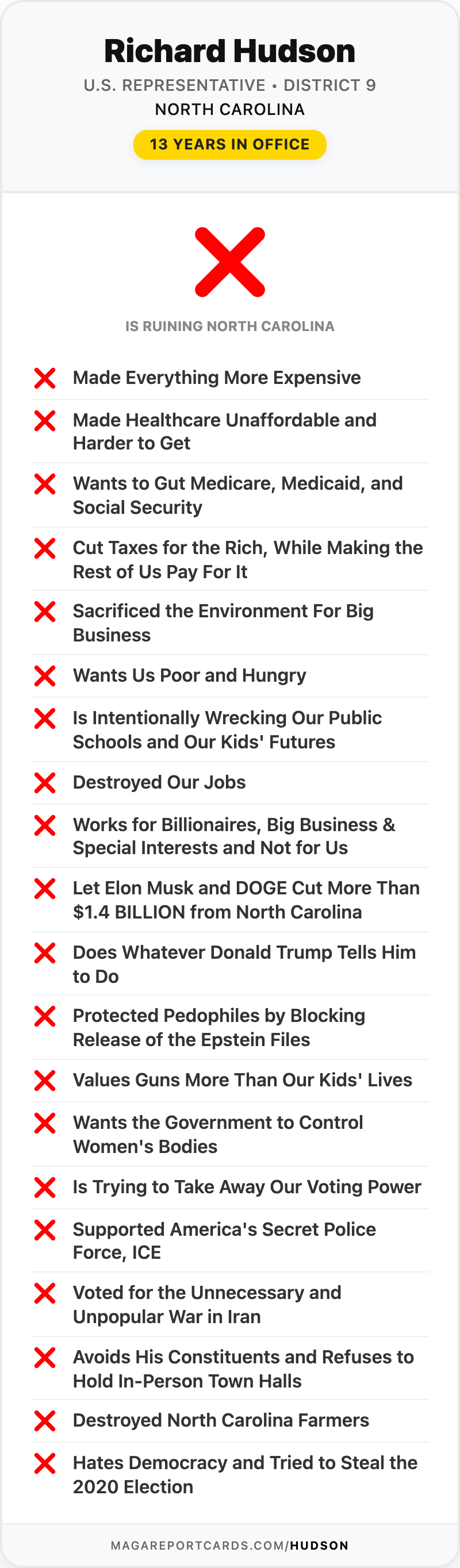
Hudson has been in Congress since 2013 — thirteen years — representing the 8th District until redistricting renumbered his seat the 9th in 2023. The district covers part of Cumberland County including Fort Bragg and parts of Fayetteville, plus all of Hoke, Moore, Randolph, and Alamance counties. Those are the people who don't get to ask him a follow-up question, because the format doesn't allow one.
A town hall isn't a gift a congressman gives you when he's feeling generous. It's the one moment where the person casting votes in your name has to stand in a room and account for them, in front of neighbors who can see his face while he answers. Hudson's advice to his party was that this part of the job is optional now.
Then he went and proved it. Fifty minutes, eleven callers, and a Medicaid answer that his own vote contradicted ten weeks later.
Source
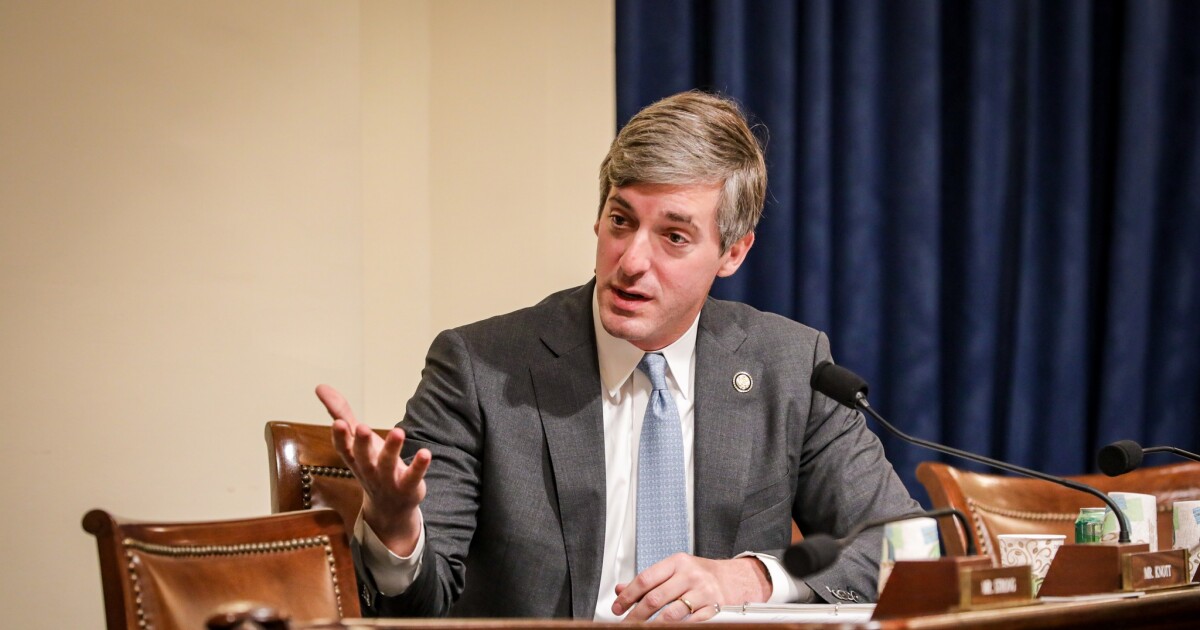
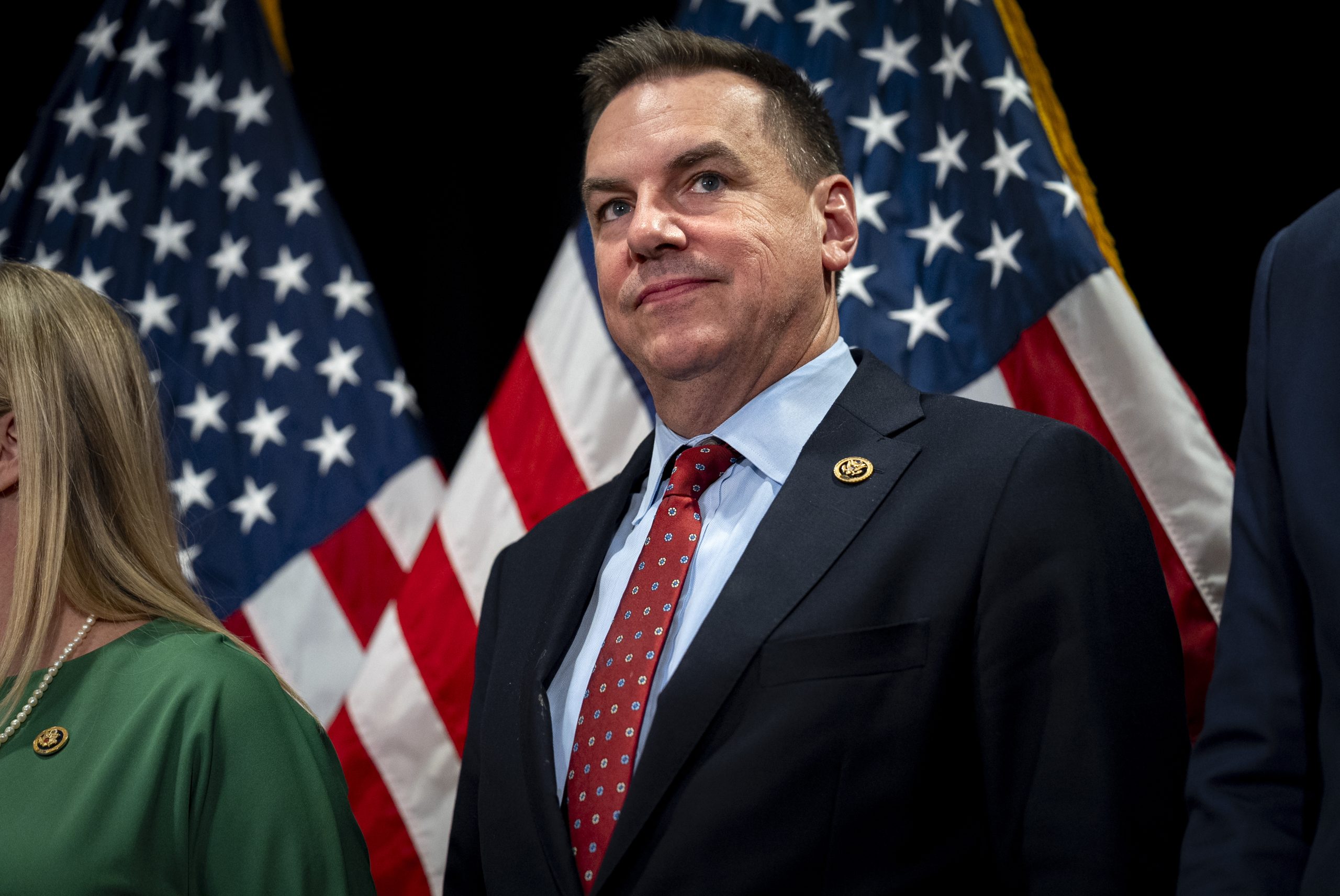
N.C. Rep. Richard Hudson Tells Republicans to Quit Doing In-Person Townhalls — Daniella Diaz and Reese Gorman, NOTUS, republished by The Assembly, March 4, 2025. Photo: Angelina Katsanis/POLITICO via AP Images.