In March 2025, House Speaker Mike Johnson told Republicans to stop holding in-person town halls.
Mike Carey found a way to comply and still look available. He announced a "tele-town hall" — a mass phone call where the congressman talks and staff decide which callers get through.
Even that turned out to be more openness than he wanted.
The number that never appeared
Carey's Facebook and X accounts told constituents: "Stay tuned for call-in information on my X and Facebook accounts. I will post the information shortly before the event."
The event was set for 5:30 p.m. The call-in information was never posted publicly, WOSU's George Shillcock found.
So how did anyone get on? Not by looking up the number. More than 12,000 people were on the phone line, Carey's office told WOSU, and Ben Feree, a registered Democrat from far south Columbus, got an unsolicited text saying the office would contact him to participate. Carey's own press release counts the night's reach "across phones, voicemails, and social media" — and a call you can leave a voicemail on is a call you placed.
About 2,000 more watched a Facebook livestream that went up the same day, with no advance notice. Those viewers could type questions into a live chat, or answer polls the office wrote.
The result is a "town hall" in which the office controls the invitation list, the queue, the questions and the polls.
"I got the sense that they were really trying to only answer questions that they wanted to answer," Feree told WOSU. He said he'd rather have an in-person event, because "in person town halls give the candidate a little bit less control."
Alissa Friedman, an organizer with Indivisible Central Ohio, put it more plainly: "I was disappointed not to be able to ask the real questions that are on all of our minds."
WOSU asked Carey's office how callers were selected, why the call-in information was never posted, whether he agreed with Speaker Johnson's directive, and whether he'd hold an in-person town hall.
His office didn't answer any of those questions.
Then he put out a press release about the turnout
The next day, Carey's own congressional website published an item under the heading "In Case You Missed It," celebrating that his telephone town hall drew over 12,000 callers.
Twelve thousand people is a real number. It's also a number you can only produce this way — by auto-dialing constituents into a call rather than announcing a room and seeing who walks in. The size of the audience is evidence of the office's phone list, not of the congressman's accessibility.
The pattern is consistent: telephone town halls, yes. Open, free, in-person town halls in OH-15, no.
Seventeen tries
If the tele-town hall were the whole story, you could call it a preference. It isn't.
By October 30, 2025, with the government shutdown approaching its second month, WOSU reported that reporters had tried to interview Carey 17 times — on the shutdown, on NPR funding, on what was happening in Washington. Carey and Troy Balderson, WOSU wrote, "have continually rejected or ignored WOSU's interview requests." Email questions for that story went unanswered too.
So the station went looking for him.
Carey lives in a duplex in German Village, near Schiller Park. WOSU knocked on his glass storm door. No answer. His Ring doorbell appeared to be broken.
They went to his district office on Town Street and left a handwritten note for his staff — who were going unpaid during the shutdown. The office, WOSU noted, requires a pre-made appointment before a visitor can even take the elevator up.
No response ever came.
His last local interview that he posted about had been on NBC4's Sunday Briefing, eight weeks earlier — before the shutdown started.
He was not, however, hiding. During the shutdown Carey posted about closed-door events with the Dublin and Ohio Chambers of Commerce, a carpenters' apprenticeship program and a Labcorp facility. He gave Capitol tours to students from Houston, Ohio. When HUD Secretary Scott Turner visited, Ohio's two Republican senators took questions from reporters; Carey met Turner behind closed doors.
And he kept doing interviews — with a conservative talk station, WTVN 610 AM, whose host routinely calls Washington "the swamp" and calls Carey "one of the good guys." Carey posts the clips on Facebook.
Ohio State political science professor Paul Beck told WOSU that members like Carey aren't incentivized to sit for interviews where they'd face questions they consider hostile. "Of course, on the Republican side, there's the regret of irritating President Trump, in addition to violating the loyalty, the discipline of the Republican Party in the House," Beck said. He added that Ohio's gerrymandered maps do their part: they "may lead to a tendency for them to say 'I don't really need to talk to the media here, because I've already got this actually pretty much in the bag.'"
Democratic Rep. Joyce Beatty, who represents the neighboring Columbus district and who WOSU noted has consistently made time for interviews, used a blunter word for it. She called her Ohio Republican colleagues "cowards." "I really think that they are scared. They're afraid," she said.
What he'd have to answer if he showed up
The reason this matters isn't etiquette. It's that Carey has a record he'd be asked about.
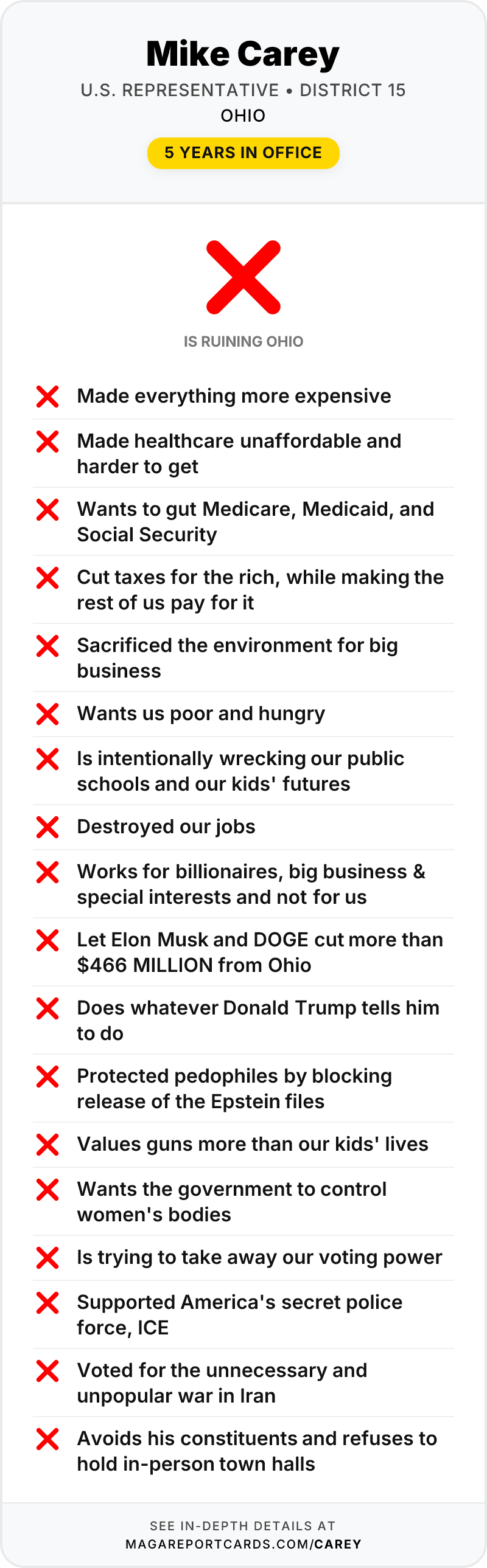
He voted for Trump's budget bill. In July 2025, central Ohio labor groups held a press conference on the Scioto Mile in downtown Columbus, near the Labor and Workers Memorial, to criticize him for that vote and its Medicaid and food assistance cuts. Dorsey Hager of the Columbus and Central Ohio Building and Construction Trades Council called the law "the largest redistribution of wealth in the history of our country." Lois Carson of the Ohio Association of Public School Employees warned: "Wait till your school district shuts down because it's small in a rural community. Wait till that hospital shuts down."
Carey's office declined to comment. He praised the bill on social media. We've laid out the statewide damage in what Ohio's Republicans in Congress are costing you.
He is also a former coal lobbyist who was a registered lobbyist on House Bill 6, the law at the center of Ohio's biggest bribery scandal, whose coal subsidies and the charges that preceded them took more than $683 million from Ohio ratepayers to prop up two 1950s coal plants.
Those are the questions in the room. That's why there's no room.
Not just him
This is a strategy, not a personality trait, and we keep finding it. In New York, Nick Langworthy's local radio station says his office keeps failing to tell it when he is holding news conferences in its county. In Pennsylvania, Guy Reschenthaler's chief of staff told reporters he'd answer questions about one grant and nothing else. In Florida, constituents put Scott Franklin's face on a "MISSING" flyer and his office answered that telephone town halls let him reach thousands "efficiently and effectively across eight counties at a time" — the same answer Carey gives.
The bet is always the same: a safe district means never having to explain the vote.
Carey is on the ballot again this year. Between now and November, the way to ask him anything is to hope his office dials your number.
Source
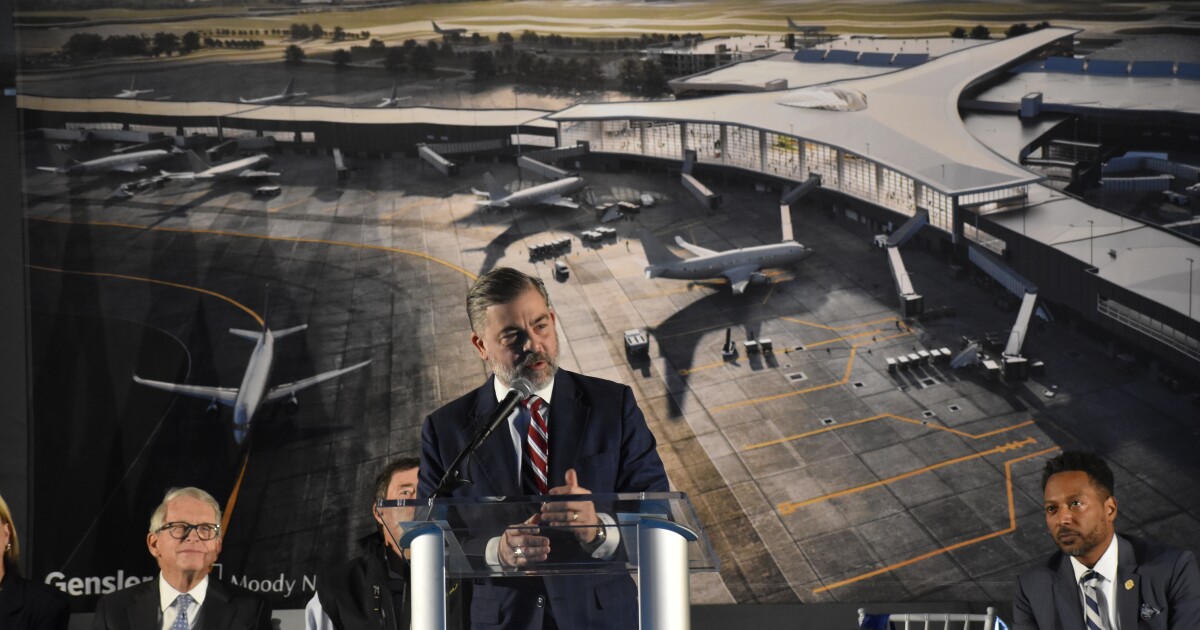
George Shillcock, "Republican U.S. Rep. Mike Carey's office didn't post call information for 'tele-town hall' publicly," WOSU Public Media, April 2, 2025, and "Central Ohio Republican U.S. reps ignore local media as shutdown nears one month mark," WOSU Public Media, October 30, 2025. Photo: Matt Rand / WOSU News.