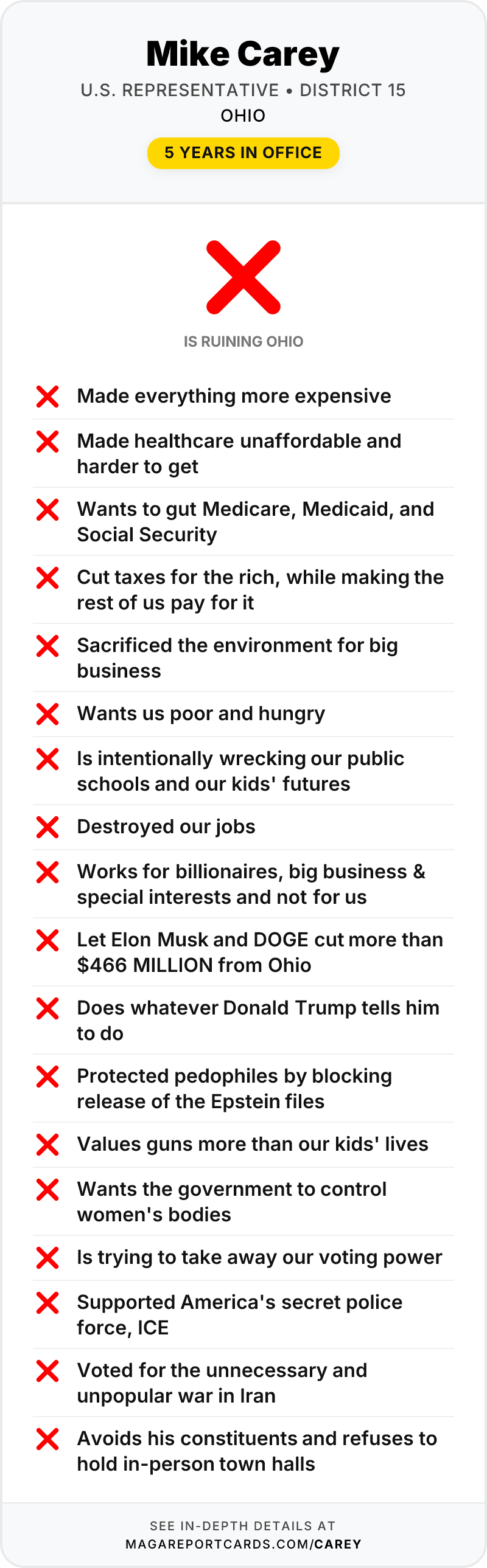
Every Ohioan who pays an electric bill has heard of House Bill 6. It's the 2019 law at the center of the largest corruption case in the state's history — a roughly $60 million bribery scheme that ended with former House Speaker Larry Householder sentenced to 20 years in federal prison in June 2023, a conviction a federal appeals court upheld in May 2025.
What fewer people know is that one of the registered lobbyists on that bill now represents Ohio's 15th District in Congress.
Mike Carey is a former coal lobbyist. Not incidentally — professionally, for more than two decades. And as Canary Media reported when he first ran for the seat, Carey was "a registered lobbyist on Ohio's scandal-tainted House Bill 6." His campaign's response was that his employer, Murray Energy, "was neutral on the legislation."
Carey did not respond to that outlet's repeated requests for an interview or comment.
What HB 6 did to your bill
Strip away the scandal for a second and look at the mechanics, because the mechanics are the harm.
Two coal plants — the Kyger Creek plant in Cheshire, Ohio, and the Clifty Creek plant across the river in Madison, Indiana — were built in the 1950s. They are owned by the Ohio Valley Electric Corporation, or OVEC, whose shareholders are the parent companies of Ohio's regulated utilities.
By the 2010s those plants were often among the most expensive generators in the regional grid. In a market, they'd have been retired or run only when needed.
Instead, HB 6 guaranteed that Ohio ratepayers would keep paying for them through 2030 — regardless. The state's consumer counsel, the Ohio Manufacturers' Association Energy Group and the Ohio Environmental Council are challenging at the Ohio Supreme Court what they call the utilities' decision to run the plants "full tilt even when it was uneconomical" and pass the cost along to customers.
The final tally, reported by Canary Media and the Ohio Capital Journal from an analysis prepared for the Ohio Manufacturers' Association: the HB 6 coal subsidies plus earlier charges came to more than $683 million taken from Ohio utility customers. Had the law run its course, they'd have paid over $413 million more through 2030.
"Instead of propping up shareholders, this money should have gone to help Ohio's families pay for needed items like groceries, health care, and other essentials," said Maureen Willis, the Ohio Consumers' Counsel — the state's official advocate for utility customers. "Ending the coal plant subsidies is long overdue."
And the plants weren't just expensive. Since 2020 alone, the Consumers' Counsel estimates, they've released more than 63 million tons of carbon dioxide, along with nitrogen oxides, sulfur dioxide and particulate pollution that harms people living downwind.
"That is a lot of dirty air," Willis said. "Consumers got the bill, while the environment and public health paid the price."
The part that tells you who the law was really for
Here's the detail that should stick with you.
Householder and others were arrested in July 2020. The scandal was front-page news across Ohio. Within less than a year, lawmakers repealed the nuclear bailout portion of HB 6.
The coal subsidy survived. Bill after bill to repeal it failed. It kept running for five more years, still charging 5 million Ohio households and businesses for two 1950s power plants, until HB 15 finally killed it in May 2025 — effective August 14, 2025.
The nuclear money was politically radioactive the moment the indictments came down. The coal money had someone protecting it.
And even now, it isn't over for everyone. Because of a 2011 agreement among OVEC's shareholders, both plants intend to keep running until 2040. More than 380,000 homes and businesses served by Ohio's Electric Cooperatives are still on the hook through their power supplier, and two challenges over whether the charges were even lawful are still waiting on the Ohio Supreme Court.
Who benefited, and who's writing him checks
The largest OVEC shareholder is American Electric Power, at roughly 39%.
American Electric Power is also one of Mike Carey's biggest donors. In the 2026 cycle it is his third-largest source of money — $34,100 across its PAC and the people who work there, according to OpenSecrets.
Small donors are not what funds him. Only 5% of his money comes from small donations, which puts him #341 out of 440 House members; political action committees supply 47% of it. The utility collecting those coal charges is part of what does.
Now he does it from the inside
Carey spent 13 years as president of the Ohio Coal Association, then became vice president of government affairs for Murray Energy, and continued in that role for American Consolidated Natural Resources after Murray Energy's bankruptcy.
He now sits on the House Ways and Means Committee, which writes the tax code the fossil fuel industry depends on, and on House Administration.
His record from that seat is exactly what you'd expect. His 2025 score from the League of Conservation Voters is 0%, against a 4% lifetime score, according to LCV's scorecard.
Zero percent is not a coincidence or a bad year. It's a job description.
Meanwhile, Ohioans are being told to brace for higher electric bills as data centers pile onto the grid — the same grid whose costs Carey's former industry has been socializing onto ratepayers for a decade. We laid out what Ohio's Republicans in Congress are costing the state here.
The through-line
There's a version of Mike Carey's biography that sounds like a virtue: a guy who knows the energy business, sent to Washington to work on energy policy.
Here's the other reading, and it's the one the record supports. A man spent 20-plus years being paid to win favors for coal companies in Columbus. He was a registered lobbyist on the bill that became Ohio's biggest bribery scandal — a bill whose coal subsidies, and the charges that preceded them, took $683 million from Ohio ratepayers to prop up two plants older than most of the people paying for them. Then he ran for Congress with heavy backing from coal and mining money, won, got himself onto the committee that writes tax law, and voted with the environment 0% of the time.
He didn't leave the coal lobby to serve Ohio. He got a bigger office.
Source
Kathiann M. Kowalski, "Ohio finally ends subsidies for two scandal-linked coal plants," Canary Media via Ohio Capital Journal, August 8, 2025, and "Coal lobbyist and health expert face off in Ohio's 15th District congressional race," Canary Media.