On September 30, 2004, three members of the United States Congress signed a letter to Dr. Trino Alcido Diaz, Venezuela's chief banking regulator. They were writing on behalf of a Houston financier named R. Allen Stanford, who wanted an international banking license for his Venezuelan operation.
Venezuela's regulators were hesitant. According to reporting by Murray Waas for VICE, they were reluctant "because of reports they had received that Stanford was running a Ponzi scheme and engaged in money laundering."
The three congressmen wrote to reassure them. Stanford, they said, was "a well-respected businessman" and "a man of great strength, character and financial stability." They asked that the license be granted with "every possible courtesy and consideration."
The regulators were right. The congressmen were wrong. Eight years later, Allen Stanford was sentenced to 110 years in federal prison for a 20-year scheme in which he misappropriated $7 billion. The judge called it "one of the most egregious frauds ever presented to a trial jury in federal court."
Two of the three men who signed that letter are long gone from public life. Bob Ney went to federal prison in the Jack Abramoff scandal. John Sweeney lost his seat in 2006.
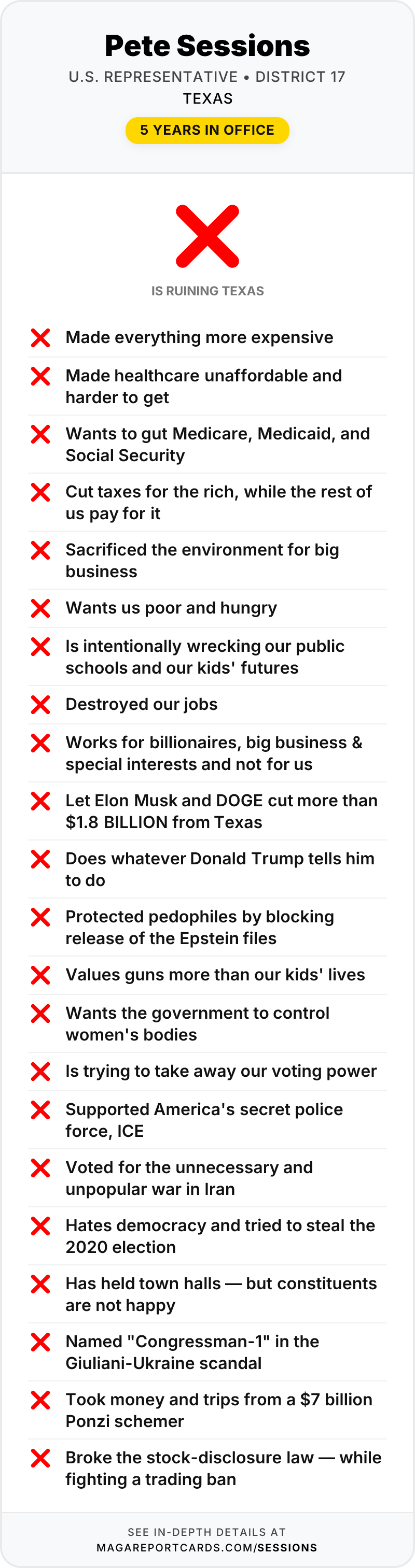
The third one is Pete Sessions. He is still in Congress today, representing Waco and Texas's 17th District.
What Stanford Bought
Sessions wasn't a casual acquaintance who got talked into signing a letter. Stanford was one of his most productive money sources.
Per VICE's reporting:
- Stanford, the Stanford International Group and Stanford's employees gave Sessions about $41,375 in political contributions.
- Stanford gave more than $238,500 to the National Republican Congressional Committee — "much of which was personally solicited from Stanford by Sessions."
- In the closing days of the 2004 campaign, after Sessions personally asked for help, Stanford raised almost $39,000 for him from his own employees.
That last one matters for the timing. Sessions signed the letter to Venezuela's banking regulator on September 30, 2004 — in the closing weeks of a hard re-election fight, with Stanford shaking money out of his own employees for Sessions's campaign at the same time.
Stanford also paid for travel. He financed congressional trips to Antigua in 2003, 2004 and 2005, complete with private jets and a party aboard his 112-foot yacht, the Sea Eagle.
The Cuba Favor
The letter to Caracas wasn't the last time Sessions used his office for Stanford.
Stanford was a fanatical cricket booster, and he wanted Cuba's cricket team to compete in a tournament he was staging in Antigua. That runs straight into the U.S. embargo, which is enforced by the Treasury Department's Office of Foreign Assets Control. So Stanford needed someone in Washington.
On December 27, 2007, Sessions emailed him directly, and included his cell number:
"Allen I have not heard from anyone about helping out with the cuba issues… don't forget I'm here if you wish."
Nineteen days later, on January 15, 2008, Sessions sent this from his BlackBerry:
"But I'm gonna pull of the cricket entry as you requested.. I have done the leg work… or half of it… ssshhhhhhhhh."
A sitting congressman, telling a private financier he was quietly working the federal sanctions bureaucracy for him, and asking him to keep it quiet. When VICE asked what exactly Sessions had done on Stanford's behalf, neither OFAC nor Sessions's congressional office would say.
"I Love You and Believe in You"
On February 17, 2009, the Securities and Exchange Commission charged Allen Stanford with defrauding investors of roughly $7 billion. It was one of the biggest fraud cases in American history, and it broke that morning.
At 11:31 a.m. that same day — hours after the charges landed — Pete Sessions sent Stanford an email. McClatchy later obtained it. Here is the whole thing:
"I love you and believe in you…If you want my ear/voice — e-mail."
Thousands of Stanford's investors had just learned their retirement savings were gone. Some of them, as victims told the sentencing judge three years later, could no longer pay for medical care or basic living expenses. Sessions's first instinct was to tell the man responsible that he still had a congressman's ear.
This Keeps Happening
Sessions's defenders will say he couldn't have known. That's what he has said about every one of these.
He also couldn't have known that Lev Parnas and Igor Fruman — the Rudy Giuliani associates who pledged to raise at least $20,000 for him while asking for his help removing the U.S. ambassador to Ukraine — would be indicted. The indictment named no one, referring only to "Congressman-1"; NBC News and other outlets identified that person as Sessions. As chairman of the House Rules Committee, he wrote the letter calling for Ambassador Marie Yovanovitch's ouster.
He also couldn't have known about David Rivera, the former Florida congressman whose $50 million contract with an American affiliate of Venezuela's state oil company ended in a federal conviction this year. Sessions flew to Caracas with Rivera as his translator and met Nicolás Maduro in a private meeting American diplomats were asked to stay out of — and in April 2026 he took the witness stand for Rivera's defense.
At some point, "I had no idea" stops being an explanation and starts being the pattern. Three decades, three criminal schemes, and every single time Pete Sessions is standing next to the man with the handcuffs, saying he's a person of great character.
The 2004 letter is the cleanest example, because he wrote it down. Foreign regulators told him, in effect, we think this man is running a Ponzi scheme. Sessions's response was to put his congressional letterhead behind Stanford's "character and financial stability" — while Stanford's employees were writing checks to his campaign.
What It Should Mean in Waco
Sessions now sits on the House Financial Services Committee, which writes the rules for the banks and investment firms that are supposed to protect ordinary people from exactly the kind of fraud Stanford ran. He also sits on the Oversight Committee and co-chairs the House DOGE Caucus, where he casts himself as Washington's watchdog against waste and fraud.
His donors reflect the first job more than the second. Since 2020 he has taken $40,000 from the UBS Americas PAC, $37,500 from the Council of Insurance Agents & Brokers PAC, $35,000 from the National Association of Realtors PAC and $32,000 from the America's Credit Unions PAC — all industries his own committee regulates, according to whoboughtmyrep. Just 1% of his money over that period came from small grassroots donors.
Voters in Texas's 17th District are entitled to ask a simple question of a man who wants a fifteenth term: when a con artist needed a member of Congress, why was Pete Sessions always available?
We deserve better.
Source
- New Disclosures About a Congressman's Relationship with a Now-Imprisoned Texas Billionaire — Murray Waas, VICE, June 12, 2014.