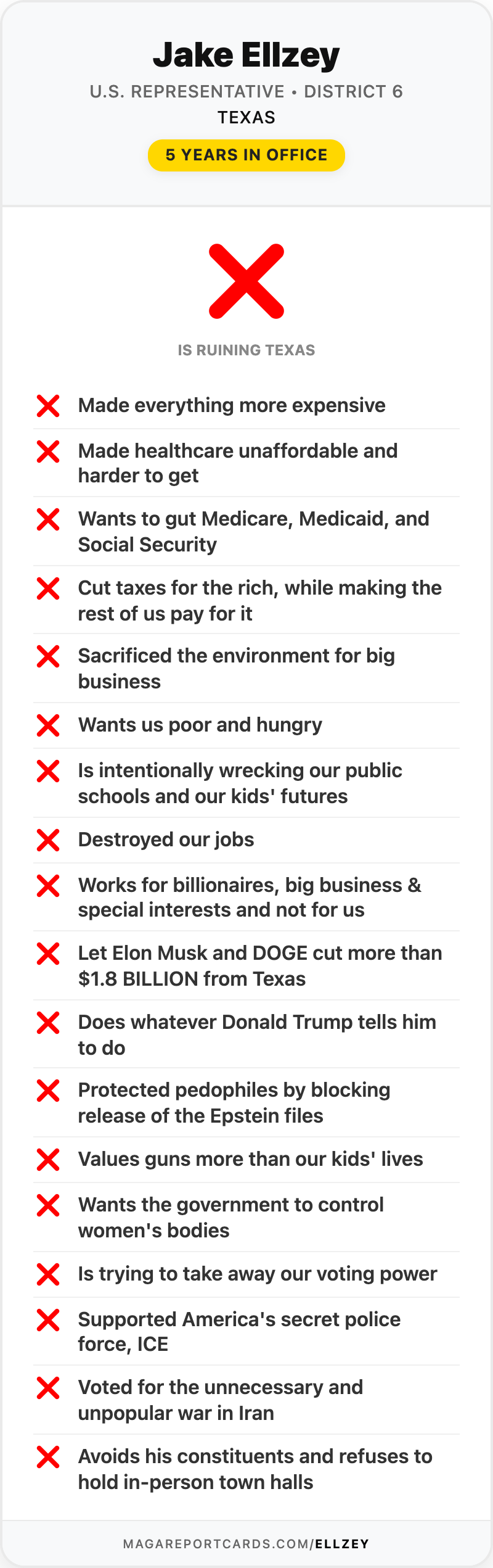
On September 18, 2025, Jake Ellzey's office put out a press release announcing good news for rural Texas.
Congress, it said, had approved a "first-of-its-kind initiative delivering $50 billion to strengthen health care access and innovation across rural America" — the Rural Health Transformation Fund. Ellzey's quote:
"Too often, rural families are left with fewer options, longer drives, and worse outcomes. This investment gives our communities the tools to build a stronger system that lasts, one focused on prevention, innovation, and dignity."
The release describes rural hospitals facing "mounting challenges: higher rates of chronic illness, declining patient volumes, and closures that leave residents without care close to home." It quotes Ellzey saying that past bailouts "have been a Band-Aid on a severed artery."
Read the whole thing and you will not find the other half of the story.
Where the fund came from
The press release does say where the money originated. It puts it this way:
"The fund was established as part of the President's Working Families Tax Cuts package."
That "package" is H.R. 1 — Trump's budget bill. And the reason it contains a $50 billion rural health fund is that the rest of it cuts Medicaid so severely that rural hospitals were expected to close without one.
KFF's analysis of the enacted law is direct about the scale. Federal Medicaid spending in rural areas is estimated to decline by $137 billion over ten years. The $50 billion fund offsets a little over a third of that — leaving a gap of roughly $87 billion.
And the two halves aren't the same kind of money. The cuts are permanent. The fund is temporary — five years of appropriations, and their effect shrinks each year as the cuts deepen.
Ellzey's own release says the fund provides "$10 billion annually starting in 2026," that it will "Allow Governors to apply with state-specific plans," and that "States must apply by early November." A grant program a governor has to compete for is not the same thing as a hospital knowing what Medicaid will pay it next year.
He voted for it. Twice.
This isn't a case of a member inheriting someone else's law.
- May 22, 2025 — Ellzey voted Yea on House passage of H.R. 1.
- July 3, 2025 — Ellzey voted Aye on final passage of the same bill.
Then, eleven weeks later, he announced the fund created to soften the damage as a "historic investment."
He is also not a rank-and-file member on this. By his own office's account, Ellzey sits on the House Appropriations Committee and on its Labor, Health and Human Services, Education subcommittee — the panel that writes the federal health budget. He knew what was in the bill.
What it means in Texas
Texas took one of the biggest hits in the country. KFF's allocation of the Congressional Budget Office's estimates projects that 480,000 more Texans will be without health insurance by 2034 because of the law, and that Texas will lose about $27.9 billion in federal Medicaid funding over ten years — 7 percent of what it would otherwise get.
Ellzey's district is exactly the kind of place that shows up in those numbers. It covers all of Ellis, Navarro, Anderson, Hill and Cherokee counties — small towns and farmland where the nearest hospital may be the only one for thirty miles.
Taking $39 billion out of Texas Medicaid and handing the governor a five-year grant application to compete for does not fix that.
We've seen this exact press release before
The rural health fund has become the standard thing Republicans announce after voting for the cuts.
Mississippi's Michael Guest spent an August recess promoting $206 million from the same fund after voting for the same law. West Virginia's Shelley Moore Capito signed on to a rural hospital rescue bill after casting one of the 50 Senate votes that will cost her state's hospitals a billion dollars a year. North Carolina's Brad Knott, asked directly by a constituent how he could support the cuts, pointed to the same fund and said that "if there are changes that need to be made, we stand ready to do it."
Same law, same fund, same announcement, different letterhead.
The honest version
There's a version of Ellzey's press release that would have been fine. It would have said: I voted for a bill that cuts Medicaid because I believe the program needed to be reined in. I fought to include a $50 billion fund to protect rural hospitals from the fallout. Here's how our hospitals can apply.
That's an argument. Voters could weigh it.
What they got instead was an announcement of a gift, with no mention of who took the thing it's replacing.
Ellzey's line about past bailouts being "a Band-Aid on a severed artery" is the most accurate sentence in the release. He just left out who was holding the knife.
Source
"Ellzey Highlights Historic Investment to Strengthen Rural Health Care," Office of Congressman Jake Ellzey, September 18, 2025.