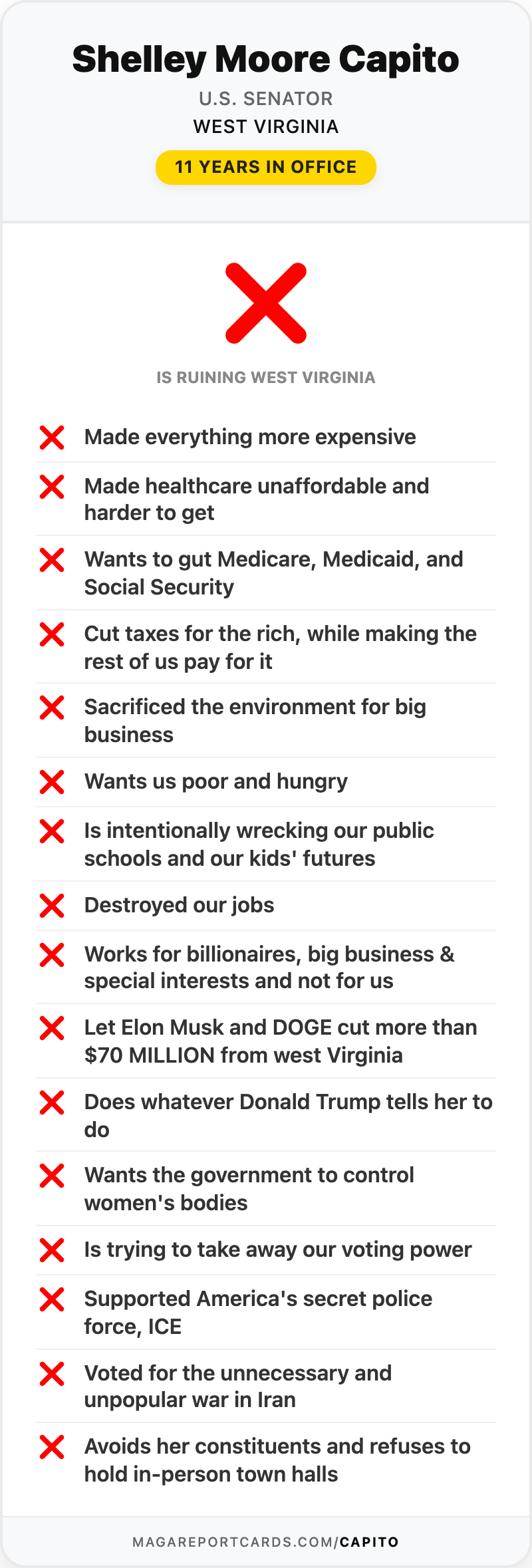
On July 29, 2026, Shelley Moore Capito signed on to a bill to keep rural hospitals from closing.
It's called the Rural Emergency Hospital Designation Improvement Act. Sen. Jerry Moran of Kansas leads it, Sen. Tina Smith of Minnesota is the lead Democrat, and Capito is one of five Republican cosponsors. It would let more small hospitals qualify for a special Medicare designation, reopen some that already closed, and add back services like obstetrics and psychiatric care.
Here's what Capito said about it:
"Across West Virginia and in rural communities nationwide, far too many hospitals are facing challenges that threaten their ability to maintain operations."
She's right. That is exactly what's happening.
She should know. Thirteen months earlier, she cast one of the fifty votes that made it happen.
July 1, 2025: the vote she could have stopped
The One Big Beautiful Bill Act came to the Senate floor after an all-night session. It extended and expanded the 2017 tax cuts, and to help pay for them it slashed Medicaid and pushed major food-aid costs onto the states for the first time.
The Senate split 50 to 50. Vice President JD Vance broke the tie.
Think about what a 50–50 vote means. Not one of those fifty senators was extra. Any single Republican who walked away kills the bill. Capito wasn't one voice in a landslide — she was one of exactly the number required.
And she wasn't reluctant about it. In a statement that day she celebrated, calling it a bill with "significant wins" for the state:
"I was proud to vote in favor of this commonsense legislation that not only delivers on the promises we've made to the American people, but will put West Virginia and our entire nation on a path to greater economic growth, national security, energy independence and opportunity."
More than 500,000 West Virginians rely on Medicaid or CHIP. One in six gets SNAP food benefits. The week before the vote, six protesters were arrested attempting a sit-in against the bill at Capito's own Charleston office.
Nobody had to guess what was coming. Lynette Maselli, state director of Protect Our Care, said at the time that Capito and Sen. Jim Justice had the power to stop the bill, and that instead they "put billionaires over West Virginians" and voted to "close rural hospitals."
That was not a prediction that required a crystal ball. It's in the bill.
What it does to West Virginia hospitals
Here's the mechanism, in plain terms.
West Virginia charges hospitals a 6% provider tax — the maximum allowed — and uses that money to draw down a 3-to-1 federal match for Medicaid. That money goes back out to hospitals based on how many Medicaid patients they serve. Starting in 2028, the law Capito voted for forces the state to cut that tax to 3.5%. It also drops Medicaid payment rates down to Medicare levels, which don't cover the full cost of care.
Jim Kaufman, president and CEO of the West Virginia Hospital Association, put the damage in one number: when the law is fully in effect, West Virginia hospitals will lose more than $1 billion per year.
"That will have an impact, and hospitals will have to figure out what they do to ensure access with fewer resources," Kaufman said. "And that may radically change what they can offer in certain communities."
Researchers at the University of North Carolina have named seven West Virginia hospitals as most at risk of closing: Logan Regional Medical Center, Welch Community Hospital, Broaddus Hospital Association, Minnie Hamilton Health Care Center, Grafton City Hospital, Jackson General Hospital, and Montgomery General Hospital.
"We will see hospital closures," said Rich Sutphin, executive director of the West Virginia Rural Health Association.
Capito's explanation for the Medicaid cuts was that the goal "is to root the waste, fraud, and abuse out of the program." Mountain State Spotlight reported that she also said she didn't know the extent of fraud, waste and abuse in West Virginia.
She voted to take the money anyway.
The rescue fund that doesn't rescue
Republicans saw this coming too. That's why they put a $50 billion Rural Health Transformation Program into the same bill — a fund created in response to the threat of rural hospitals closing because of the Medicaid cuts in the very same legislation.
It does not come close.
West Virginia may receive at least $100 million a year from it. The state's hospitals are losing more than $1 billion a year. That's roughly ten dollars going out for every one coming back.
And the incoming dollars are restricted. Kelly Allen, director of the West Virginia Center on Budget and Policy, explained that the federal government's own rules say the money isn't meant to fill the hole:
"In their notice of funding, they specify that no more than 15% of the funding can go to provider payments that would help fill in the gaps of the deepest cuts to Medicaid in our nation's history."
Sutphin was blunt about the limits: "You can't do capital expenditures beyond minor alterations to a facility. You can't use it to replace any provider revenue that is already being paid for."
It's also one-time money. As Kaufman asked: "The biggest thing is, how do you support the sustainability in year six, when the dollars dry up?"
Break the leg, then sell the crutch
So put the sequence together.
July 2025: Capito casts a decisive vote for a law that strips more than $1 billion a year from her state's hospitals, and calls it commonsense legislation she was proud to support.
October 2025: Hospital leaders confirm the replacement fund won't cover the loss, and can't legally be used to try.
July 2026: Capito cosponsors a bill to help rural hospitals avoid closure, saying too many face challenges that threaten their ability to operate.
The Rural Emergency Hospital bill isn't a bad bill. Letting a closed hospital reopen as an emergency facility, or adding back a psychiatric unit, is a real thing that helps real people. If it passes, some West Virginia town will be better off.
But it is a fraction of a fraction of what she voted to take away. And it arrives in an election year — Capito won West Virginia's Republican Senate primary on May 12, 2026 with Trump's endorsement, and faces Democrat Rachel Fetty Anderson in November.
We've watched this pattern in other states. Florida's Maria Elvira Salazar spent years handing out oversized checks for money she voted against, and when a reporter asked about the votes, she said she couldn't remember them. The move works because most people never line up the dates.
So line up the dates.
Capito chairs the Appropriations subcommittee that funds the Department of Health and Human Services. She is also chair of the Senate Republican Policy Committee, which made her the fourth-ranking Republican in the Senate. When she says rural hospitals are in trouble, she is not a bystander describing the weather. She is one of the people who made it rain.
West Virginia ranks 42nd of 50 states on the measures we track. It has one of the smallest cushions in the country to absorb a billion-dollar hit to its hospitals. Seven of them already have their names on a list.
A cosponsorship doesn't undo a vote.
Sources
- S. 5164, the Rural Emergency Hospital Designation Improvement Act — official bill status and cosponsors
- WVVA: Capito co-introduces bipartisan bill to prevent rural hospital closures, expand healthcare access (July 31, 2026)
- Senate Roll Call Vote 372 — passage of H.R. 1, July 1, 2025 (Capito: Yea)
- West Virginia Watch: West Virginia's Capito, Justice vote for Republicans' "big, beautiful bill" (Lori Kersey, July 1, 2025)
- West Virginia Watch: Federal program won't make up for Medicaid funding loss to WV hospitals (Lori Kersey, October 21, 2025)
- Mountain State Spotlight: West Virginia's health care crisis is about to get worse (Erin Beck, July 2, 2025)