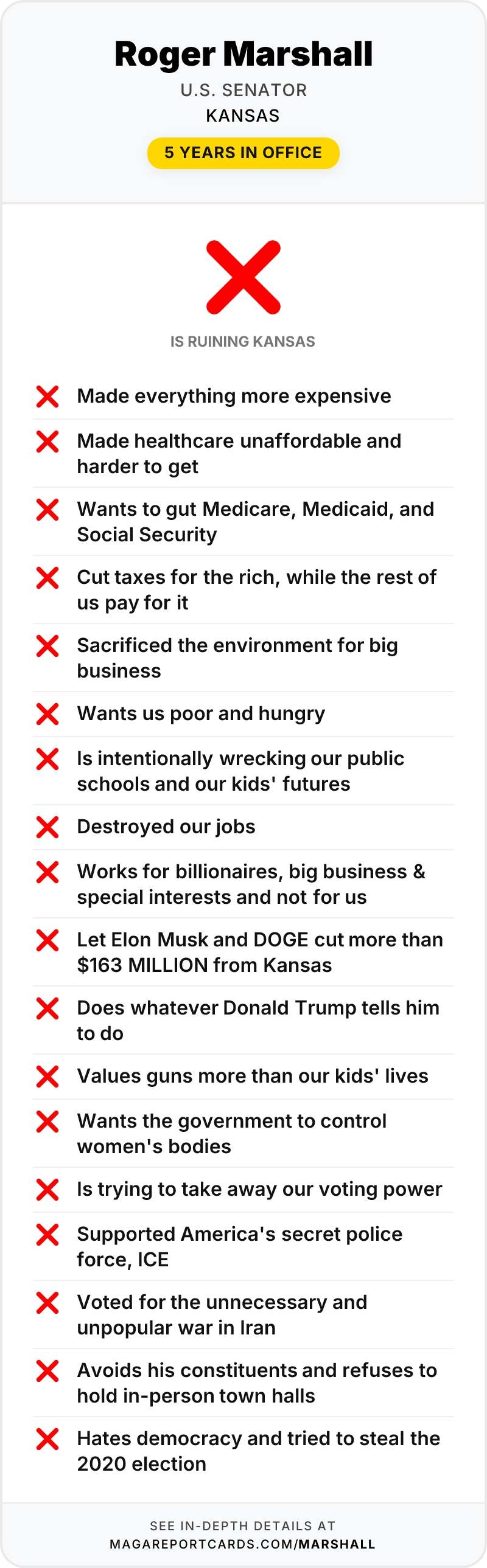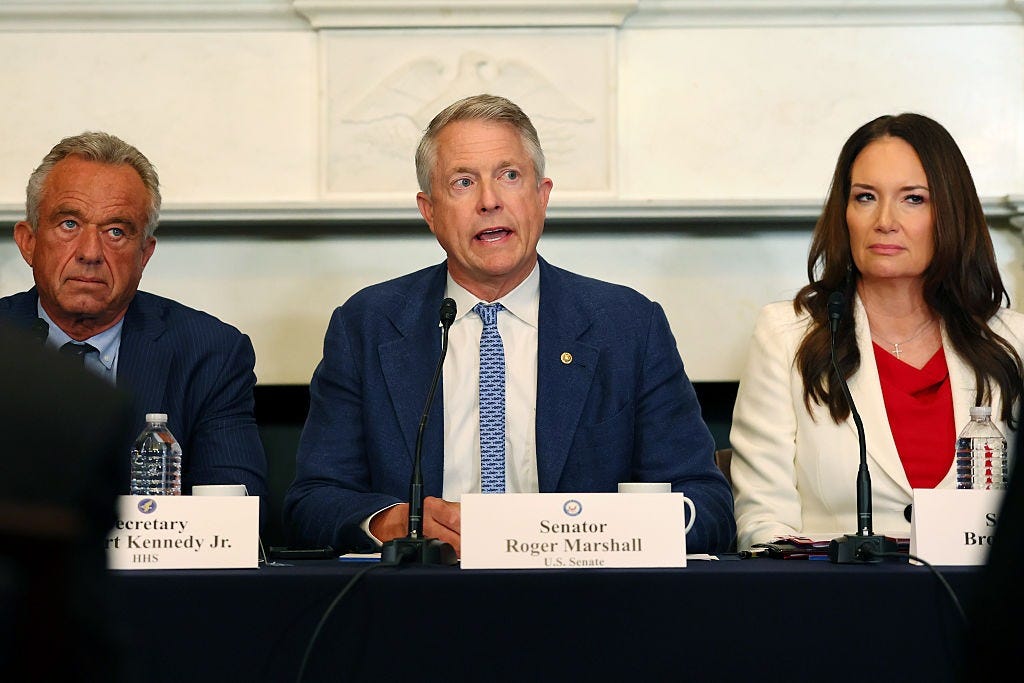
Roger Marshall has a habit of getting into investments at just the right moment — and telling the public about them late.
On November 8, 2018, when he was still a congressman, Marshall and his wife finished buying 1,250 shares of a private company called Ionics Life Sciences. They paid $250,000, or $200 a share. That's according to Irish corporate records obtained by Popular Information, which broke the story this week.
About a week later, the company's drug got the green light it needed.
What he bought
Ionics Life Sciences is an Irish holding company with no employees. What it owns is a small Kansas drug company, Genzada Pharmaceuticals USA, based in Sterling. Genzada is developing an experimental cancer drug called GZ17-6.02, made from plant extracts.
Genzada was founded by Gene Zaid. According to Popular Information, Zaid has given Marshall $6,800 over his career in Congress.
So this was not a stock Marshall bought on an index fund or through a broker. It was a private stake in a small Kansas company started by one of his own donors.
The timing
On November 16, 2018 — about a week after the Marshalls got their shares — Genzada announced that the FDA had approved its application to start a first-stage human trial of GZ17-6.02 for "patients with advanced solid organ tumors or lymphoma."
For a tiny drug company, that is a big deal. Getting cleared to test a drug on people moves it out of the lab stage and makes it more likely to someday reach the market. That usually makes the company worth more.
The founder said as much. When local lawmakers toured Genzada's offices in January 2019, weeks after the FDA news, Zaid told them, "Now we have something," the Hutchinson News reported. "Now, if you want to invite friends to invest, you can."
Marshall was already in.
Later disclosures show his stake had grown. By 2020, the Ionics stock was worth up to $500,000, according to Popular Information.
He didn't report it on time
The STOCK Act — the law that makes members of Congress disclose their trades — gave Marshall 45 days to report the purchase.
He didn't file the report until August 28, 2019. That is more than 240 days late.
And his disclosures got two things wrong, according to Popular Information. The transaction report listed the purchase date as October 1, 2018, and Marshall listed Ionics as being in Sterling, Kansas — which is where Genzada is, not Ionics. Marshall didn't report that Genzada was a subsidiary of Ionics until his August 2026 filing. That's seven years in which a reader of his disclosures had no easy way to see that his Irish shares were really a stake in a Kansas drug company.
This isn't the first time. We've already written about how Marshall disclosed his family's pandemic-era stock trades more than 17 months late — including shares of Gilead, the maker of a COVID drug — and then cosponsored a bill to ban that kind of trading.
Marshall's campaign and Senate office did not respond to Popular Information's detailed questions.
Now he oversees the FDA
When Marshall moved to the Senate in 2021, he joined the Health, Education, Labor and Pensions Committee. That committee oversees the FDA — the same agency that will decide whether Genzada's cancer drug ever gets approved for sale.
And while on that committee, he has pushed policies that could help a company like Genzada:
- In 2025 he cosponsored the Small Biotech Innovation Act, which would exempt drugs made by small drug companies from having to negotiate their prices with Medicare.
- In 2022 he offered an amendment to Democrats' drug-pricing bill to exempt "breakthrough treatments and life-saving medicine" from Medicare price negotiation. He pitched it as a way to protect new cancer drugs.
- In May 2026 he told Just the News he wants doctors and patients to have more say in trying drugs once they've been found safe — especially, the site reported, for rare diseases.
He has also described hearing from drug companies that struggle to win FDA approval. "The people that struggle to get their drugs approved blow up my office, but then I dig down with the FDA a little bit, and they're approved in record numbers," Marshall said at an April 16, 2026 committee hearing.
None of that proves Marshall did any of it for Genzada. But it is exactly why the disclosure law exists: so voters can see when a senator who shapes drug policy owns a piece of a drug company, and judge for themselves. Marshall kept that hidden for most of a year, and for seven more years his reports didn't say that the Irish company he'd bought into was really a Kansas drug company.
A pattern with his donors
Last week, the American Prospect reported that Marshall introduced legislation that would help Nueterra, a Kansas private equity firm run by his longtime business partner and donor Dan Tasset. Marshall's family is invested in Nueterra funds. We laid out how Marshall wrote a bill to free a new kind of farm chemical from pesticide rules while his wife was invested in two companies that make it, through Tasset's firm.
In summary
In November 2018, Roger Marshall and his wife paid $250,000 for a stake in the parent company of Genzada, a Kansas drug company founded by one of his donors. About a week later, the FDA cleared Genzada's cancer drug for human trials, and by 2020 the stake was worth up to $500,000. Marshall reported the purchase more than 240 days past the legal deadline, didn't name Genzada on his reports until 2026, and now sits on the Senate committee that oversees the FDA.