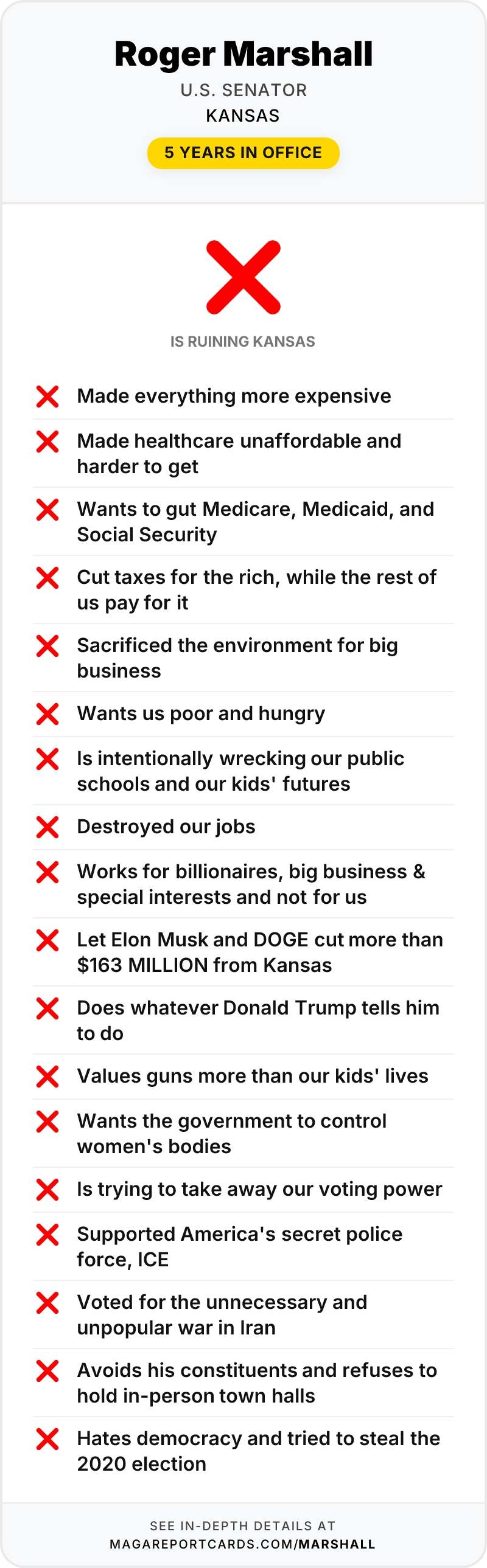
Roger Marshall, the Republican senator from Kansas, is in a tight race for reelection. This week, The American Prospect published a two-part investigation into his relationship with a Kansas private equity investor named Dan Tasset.
The short version: Tasset has been Marshall's business partner for almost 30 years and one of his steady donors. Marshall's family has money in Tasset's funds. And Marshall has written laws that would help companies Tasset's firm owns, including two that Marshall's own wife is invested in.
Who Dan Tasset is
Tasset runs Nueterra, a private equity firm based in Leawood, Kansas. According to the Prospect:
- Marshall and Tasset co-owned a health facility in Great Bend, Kansas, back in 1998.
- Marshall and his family have invested in several Nueterra funds.
- Since 2016, Marshall's campaigns have taken more than $218,000 from employees of Nueterra and its companies, including $47,600 from Tasset himself. A Tasset company gave $100,000 to a super PAC that helped Marshall win his Senate seat in 2020.
- Marshall's son has worked for a Tasset-owned company since 2019 and lives in a Washington property owned by an LLC whose agent is Tasset. A Tasset family member worked in Marshall's office.
- When the Marshalls set up an investment company in 2021, Nueterra's lawyer registered it at Nueterra's headquarters.
What Nueterra did to two Missouri hospitals
Nueterra's main business has been rural health care. In 2019, Tasset started a company called Noble Health, which said it would rescue struggling rural hospitals. It took over two in Missouri, in Fulton and in Mexico.
Almost right away, the hospitals stopped paying their bills. They ran out of medicine and supplies. State inspectors pulled the last patients out of the Fulton hospital in 2021. In March 2022, Noble shut both hospitals down.
The workers got hit hardest. Noble stopped paying more than 440 of them. Workers found out it had been taking health insurance premiums out of their paychecks without actually paying for the insurance, even after the company took in nearly $20 million in COVID relief money, according to the Prospect. The U.S. Labor Department put workers' damages at $5.4 million. One janitor's daughter had to sell his belongings at a garage sale to pay for his cremation.
The Prospect notes that nobody at Nueterra has faced real consequences. Compare that to how Marshall treated his own patients' debts: his medical practice sued more than 700 of them, and 81 were arrested.
The farm chemicals his wife is invested in
The second part of the Prospect's story is about a newer Nueterra business: farm chemicals.
A Nueterra fund called NCM Bioscience Partners owns two startups, NewLeaf Symbiotics and Vestaron. They make "biological pesticides" and related products: bug killers and plant boosters made from bacteria or spider-venom proteins, sold as an alternative to weed killers like glyphosate.
Marshall's own Senate financial disclosures show that his wife, Laina Marshall, has been a 3% investor in NCM Bioscience Partners since at least 2015. The disclosures list her stakes as $1,000 to $15,000 in NewLeaf and $15,000 to $50,000 in Vestaron. Those aren't huge amounts. But these are startups. If the government helps them get to market, small stakes can grow.
And Marshall has been working on exactly that:
- In 2022, he introduced a bill that would have required the Agriculture Department to assess these "biostimulants" as an "eligible conservation practice standard," so farmers could get federal benefits for using them.
- In May 2025, he was the lead author of the Plant Biostimulant Act. According to the Prospect, its real point is to exempt biostimulants from being regulated as pesticides under federal law. A trade group that NewLeaf belongs to lobbied for it.
- This year, that bill was folded into the Senate farm bill. Marshall voted for it in committee, and his press release celebrating it listed the "Plant Biostimulant Act" among the wins. It didn't mention his wife's investments.
- A separate fertilizer bill that Sen. Amy Klobuchar introduced this year, with Marshall signed on as a cosponsor the same day, gives grant priority to projects that promote innovation in biostimulants.
He's pitched them on TV too. "I'm also trying to bring around new chemicals or more biologics, I would say, that we could use in place of glyphosate," he told NewsNation in February.
To be fair: the biostimulant bill has Democratic cosponsors, and nobody has shown that Marshall broke a law. His campaign lawyer told the Prospect that "Senator Marshall operates in full compliance with all applicable rules and laws." But a senator writing rules that would help companies his family owns a piece of, owned by a fund run by his longtime donor and business partner, is the kind of conflict voters should know about.
It isn't the first time Marshall's family money and his job have crossed. He hid his family's pandemic stock trades for 17 months. And after voting four times to ban earmarks, he asked for $4.2 million to send water past his own ranch.
What the record shows
Roger Marshall has been in business with private equity investor Dan Tasset for nearly 30 years, and people who work for Tasset's firm have given Marshall's campaigns more than $218,000. Tasset's Noble Health ran two Missouri hospitals into closure and left more than 440 workers unpaid. A Tasset fund owns two farm-chemical startups that Marshall's wife has invested in, and Marshall wrote the bill that would exempt biostimulants, like the ones one of those startups sells, from pesticide regulation. Then he celebrated it in the farm bill without mentioning that link.
Source
The American Prospect: A Major Roger Marshall Donor Is a Hospital Bandit and Roger Marshall Boosted Pesticide Products His Wife Is Invested In