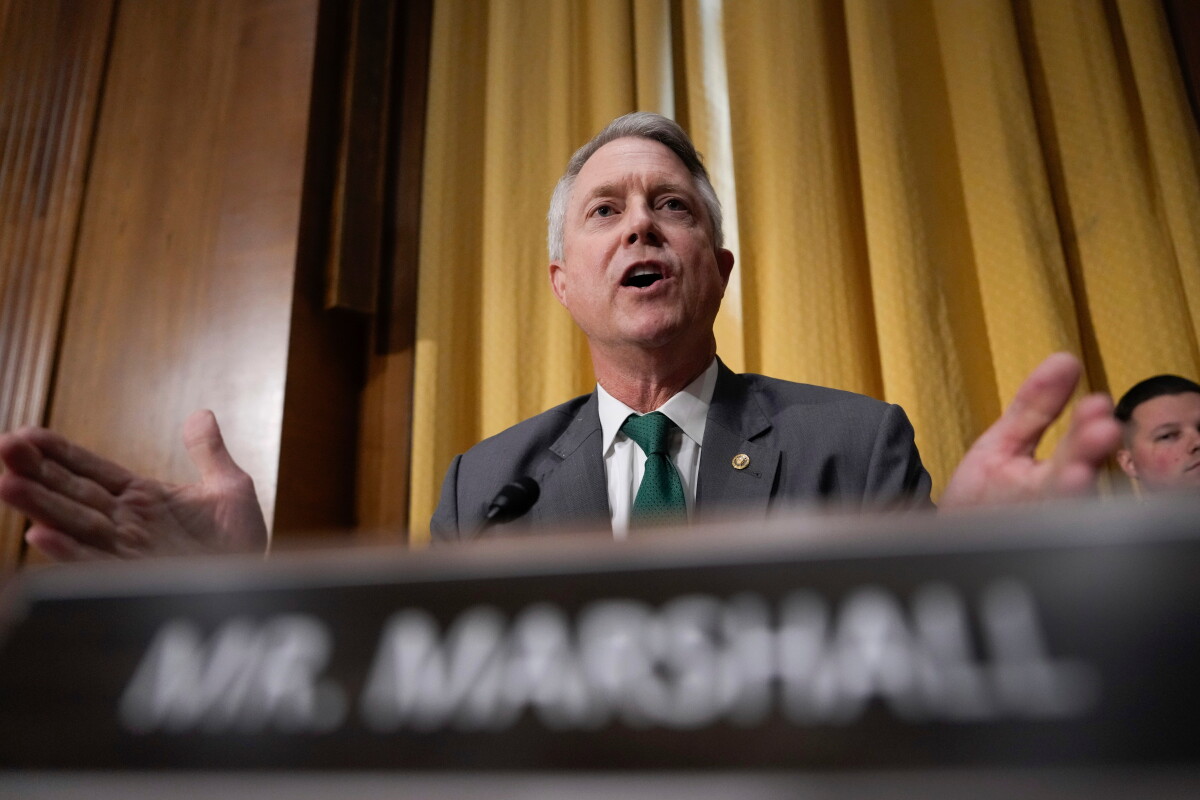
Roger Marshall has spent his Senate career attacking earmarks — the money lawmakers tuck into spending bills for pet projects back home. He has voted four times to get rid of them. He has called them a waste of taxpayer money and "not American."
But in 2024, he quietly asked for one. And it was for a project that runs right past land he owns.
The Associated Press reported this week that Marshall requested a $4.2 million earmark to help pump more water into the Quivira National Wildlife Refuge in central Kansas. What he didn't mention in the request: his own Rattlesnake Ranch sits right on the border of that refuge.
What the earmark pays for
Quivira is a cherished wildlife refuge. Every fall, hundreds of thousands of waterfowl descend on it — and hunters follow them.
The problem is water. For years, farm irrigation has pulled water out of the ground faster than the refuge can keep it. Back in 2016, Kansas's own chief engineer found that farmers pumping groundwater were taking water the refuge had a legal right to.
The fix that Kansas and the federal government settled on is a project to drill a new field of wells and push 15 to 18 cubic feet of water per second back into the system upstream of the refuge. According to AP, the water will be pumped from a different watershed, sent through a pipeline into Rattlesnake Creek — the creek next to Marshall's property — and then flow into the refuge.
Marshall's earmark request was meant to help pay for that. His request was attached to a bill that never became law. But the money got approved anyway last year, through a spending bill Marshall supported.
Whose land is next to the creek
Marshall and his family go way back in this part of Kansas. AP found that he once owned or co-owned more than 1,000 acres near the refuge and has called his land a hunting "mecca." His Senate financial disclosures show the land has made him money over the years through building rentals and oil and gas leases.
He sold off much of that land after he got to the Senate. What's left is Rattlesnake Ranch. It's registered as a business in Kansas, listed as a commercial property with a building for rent, and Marshall owns 20% of it and serves as a director. His co-owners, AP reported, are a group of hunting buddies and campaign donors.
Marshall knows exactly where his land is. Back when the Biden administration backed off its water demands, he put out a statement saying: "As a property owner along Rattlesnake Creek for three decades, protecting our local agricultural communities and the environment is something I take very seriously."
So he told the public he owned land on the creek when it helped him look like a local. He didn't mention it when he asked taxpayers for $4.2 million to send more water down that creek.
Experts: this raises the value of his land
Marshall's office says the ranch gets nothing. "All the water for this project would go into Quivira Wildlife Refuge," spokeswoman Payton Fuller told AP. "Rattlesnake Ranch would not benefit from it." She said the ranch isn't used for duck hunting. She did not answer AP's question about what the business actually does with the land. And Marshall wouldn't sit for an interview.
A water-rights expert and a government watchdog don't buy it.
Burke Griggs, a Washburn University law professor and former state water-rights lawyer who has donated to Democrats, told AP that duck hunting is "big business" in Kansas, and a steady water supply at Quivira means more birds sticking around. "That will increase the value of the land," he said. "If Quivira doesn't have water, we don't have as many ducks and waterfowl staying in that area for hunting season. That would absolutely diminish the value of the property."
Craig Holman, a registered lobbyist for Public Citizen, a government-accountability group, was blunter: Marshall "should not be involved in any legislative effort that provides a direct or substantial financial benefit to himself. He should have recused himself."
To be fair to the facts: Holman also told AP he didn't think the request broke the Senate's specific earmark rule, because the project helps the refuge and farmers too. Nobody is saying this was illegal. The point is that a senator asked for money for a project next to his own property, didn't say so, and left it to an AP reporter to find.
"Not American" — until it was his
Here's what makes this worse. Marshall didn't just vote against earmarks. He made a whole brand out of hating them.
He has said senators should have to defend every earmark on the Senate floor. He called one Democratic spending bill "full of so much pork" it was "dripping with grease." In 2021, according to AP, he told reporters: "I'm going to do everything I can to blow up the process so that no one does earmarks."
Then, in 2024, he asked for one. And in January of this year — after the money had already been approved — he voted again to strip earmarks out of a spending bill.
Vote against earmarks in public. Ask for one when it's for the creek next to your ranch.
Part of a bigger pattern
This isn't the first time Marshall has blurred the line between his job and his own wallet.
- He charged Kansas taxpayers $18,886 for 14 official trips through the part of Florida where he owns a beach house.
- His chief of staff booked campaign trips on the taxpayer dime, texting that the "primary purpose is what we say it is."
- He hid his family's pandemic stock trades for 17 months — and then asked for credit for banning stock trades.
Each one has the same shape: a rule that's supposed to keep a senator honest, and Marshall finding a way around it.
What the record shows
Roger Marshall voted four times to ban earmarks and called them "not American." In 2024 he requested a $4.2 million earmark for a water project that runs through Rattlesnake Creek, beside a ranch he co-owns with hunting buddies and campaign donors, without disclosing it. A water-rights expert told AP the project would raise the value of land like his, and a government watchdog said he should have recused himself.
Source
Sen. Roger Marshall's Kansas ranch could benefit from a $4.2M earmark he sought — Associated Press