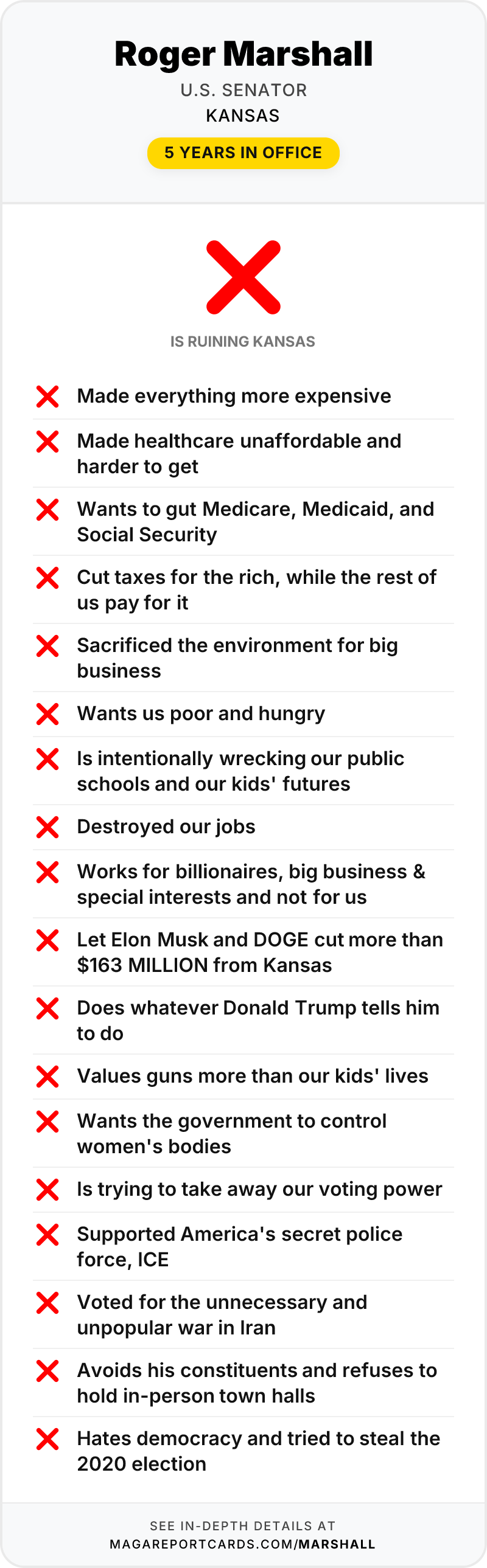
Roger Marshall wants Kansans to give him six more years in the Senate. A new investigation shows how his team treated their money the last time he asked.
On October 9, 2026, the Kansas Reflector and MS NOW published a joint investigation built on audio, photos, video, calendar entries and more than 200 text messages from 2020 — the year Marshall, then a congressman, first ran for the Senate. The outlets say the materials appear to show his office repeatedly using taxpayer money and taxpayer-paid staff for his campaign, and former staffers described an office that seemed to work more as a campaign arm than a government one.
The man at the center of it is Brent Robertson, Marshall's chief of staff then and now. Asked whether a trip was mainly official business or mainly campaigning, Robertson texted back:
"Primary purpose is what we say it is."
That is not how the rules work. And campaign-finance experts who reviewed the records said so in plain terms.
One meeting, and the whole trip becomes "official"
Congress has a simple rule about this. The Members' Congressional Handbook says that if the "primary purpose" of a trip is a non-official event, the office can't schedule an official meeting around it just to get taxpayers to pay for the travel.
According to the texts, Robertson did exactly that. He set up a single official meeting in Chicago and then told staff the whole campaign trip would now count as "Official" — which let them book Marshall's flights with taxpayer money.
He thought he'd found a loophole. About a March 2020 trip to Philadelphia, Robertson wrote that the office had "a lot more leash than even I thought," that "there is no ratio system at all," and that it would "literally need one official meeting per trip."
Experts disagreed. Brett Kappel, a campaign-finance lawyer, told the reporters that "staff do not, actually, have a long leash" — the exceptions that allow official money to touch campaign activity are "very limited, and very specific." The House Ethics Committee's own manual lays out the general ban on using official resources for campaign or political purposes.
The calendar was color-coded. The bills weren't.
Marshall's 2020 calendar used a color code to separate official meetings from campaign events. Many trips charged to his taxpayer-funded office account still included campaign stops, according to the records.
A few examples from the investigation:
- Oklahoma, September 2020. Marshall's leadership PAC paid for his flights — but Robertson booked the hotels and paid for restaurant meals with the taxpayer-funded office account.
- Dallas, October 2020. Campaign money paid for the flights. Taxpayers paid for a meal, even though the only official event on the calendar was a Zoom meeting. The same calendar marked a Cowboys–Giants game, three meetings and a fundraising dinner as political.
- Dodge City, Kansas. A staffer asked about a $170 steakhouse dinner for two. Robertson replied that "there's no statutory limit on what I can spend on meals" and told them to "approve it." There is a limit: the federal daily meal rate, which experts said was $55 for Kansas in 2020.
When staff pushed back on booking what looked like a campaign trip with government money, Robertson told them they could blame him if they were ever deposed — according to a text a former staffer sent their mother at the time.
Marshall called the "mandatory" campaign meeting himself
This wasn't only his chief of staff. On October 13, 2020, Marshall texted senior staff from both his official office and his campaign to set up a "pep talk" with "everyone." "Yes everybody," he wrote.
The next day's call showed up on official staff email calendars as a "MANDATORY ALL-STAFF CALL." Many people joined on government phones and computers. On video of the call, Marshall talks about a shortage of campaign signs, asks what door-knockers are hearing, and asks his campaign manager for "talking points" for voters worried about healthcare.
Some staff thought it was so plainly wrong that they wrote it down. His legislative director at the time texted another aide that they "objected to this illegal (activity)" and had raised it with their bosses.
Craig Holman of Public Citizen said the meeting "clearly crosses the line into illegal behavior," and called the overall record "both breathtaking and seemingly very damning of Marshall's character."
Five years, no paid campaign staff
The habits didn't end in 2020. According to Marshall's own Federal Election Commission filings through July, nobody working on his campaign had been paid in five years. Experts told the reporters that was potentially unprecedented in modern politics. Robertson told them the campaign does now have some paid staff, but declined to say how many or offer any evidence. From the start of 2025 through August, his campaign reported spending only $206,869.
His communications director shows how that works in practice. Payton Fuller draws a taxpayer-funded salary in Marshall's Senate office and also speaks for his campaign as an unpaid volunteer — answering a campaign press request from her campaign email as "communications director for Senator Roger Marshall."
Kedric Payne of the Campaign Legal Center said that if the office "used taxpayer funds for campaign activity disguised as official business, it is a clear violation of one of the most basic ethics rules," and that without "an immediate and credible explanation," a Senate Ethics investigation is needed.
Marshall's campaign didn't answer the reporters' questions. Its lawyer said the campaign has no "obligation to share campaign operations information with our opponent's reporters" and blamed "a disgruntled employee."
This is a pattern, not a slip
The investigation lines up with what was already known about how Marshall's office spends public money.
His chief of staff has his own taxpayer controversy: Politico reported that Robertson charged taxpayers $44,000 over two years to commute from his home in Lynchburg, Virginia, to Washington. The Reflector says public records now put that total above $71,000.
The 2020 texts also show Robertson telling staff to fly Marshall "from Kansas to Sarasota as a stopover in the future." We've already reported that Marshall charged Kansas taxpayers $18,886 for 14 official trips through Sarasota, where he owned a $1.2 million home.
And he's not the only Republican on this site accused of letting the line between the office and the campaign blur. Dan Sullivan used official Senate letterhead to tell Alaska communities what he'd delivered for them, and Mike Collins spent $400,000 of public money on ads that look like his campaign's.
What the records show
During his 2020 Senate run, Roger Marshall's congressional office used taxpayer money for flights, hotels and meals on trips built around campaign events, and Marshall himself called a mandatory campaign "pep talk" for his taxpayer-paid staff. His chief of staff told aides the purpose of a trip "is what we say it is." His campaign reported no paid staff for five years while a Senate aide on the public payroll doubled as its spokeswoman.
Source
Roger Marshall's complicated history of blurring the line between taxpayer dollars and campaign cash — Sherman Smith and Matt Fuller, Kansas Reflector and MS NOW, October 9, 2026