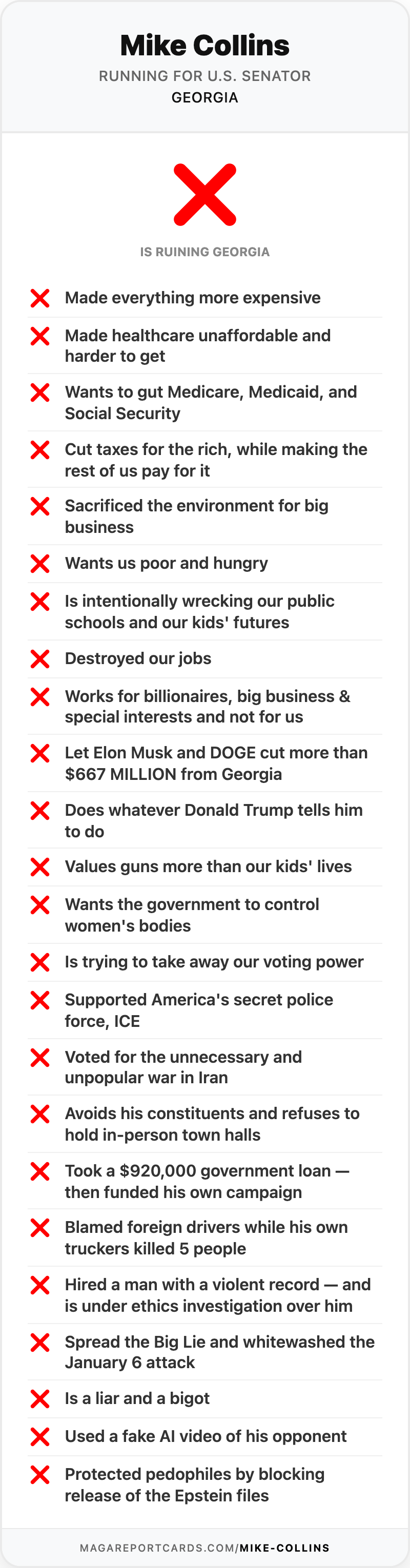
There's a simple rule in Congress: the money taxpayers give you to do your job is not your campaign piggy bank. You can use official office funds to talk to the people you represent. You cannot use them to get yourself elected.
Mike Collins, the Republican running for U.S. Senate in Georgia, appears to have blown right past that line — to the tune of more than $400,000 of our money.
Ads paid for by taxpayers that look like campaign ads
Between October 2025 and March 2026, Collins' congressional office paid a political advertising firm called Smart Media Group over $400,000 to run TV ads. To put that in perspective, the average House office spent about $33,000 on all of its mass communications during that same stretch. Collins spent more than ten times that with a single vendor. His biggest single payment was $307,160, on March 16, 2026.
So what did all that taxpayer money buy? An ad that is hard to tell apart from a campaign commercial.
The official, taxpayer-funded ad features President Trump praising Collins by name: "Congressman Mike Collins. Mike, you were fantastic." A narrator says Collins is "protecting Georgia by working with President Trump to pass the Laken Riley Act." Trump closes it out: "He loves this state and he took this very personally. Thank you, Mike." For four seconds, a small disclaimer flashes on screen: "PAID FOR WITH OFFICIAL FUNDS BY THE OFFICE OF MIKE COLLINS."
Then came his actual Senate campaign ad. It used the exact same Trump quote, paired with the same video — Popular Information called the two "substantively identical." The real difference is who footed the bill. On May 1, 2026, Collins' Senate campaign paid Smart Media Group $400,910 for an ad buy of its own.
One version was paid for by his donors. The other was paid for by you.
What the rules actually say
This isn't a gray area that requires a law degree to understand. The House has a written rulebook — the House Communications Standards Manual — for exactly this. It says taxpayer-funded mass communications:
- "should not be used for political or personal business"
- may contain "no campaign content"
- may contain "no content laudatory of a Member on a personal or political basis"
- may not use "content developed using campaign resources"
An ad built around Trump personally telling Georgians how "fantastic" Mike Collins is — and then reused, quote for quote, in his campaign — is about as clear a violation of those standards as you can imagine. The rulebook even bars sending unsolicited mass communications within 60 days of an election. Collins' official ad ran through March 18, 2026, sliding in just before the 60-day window ahead of Georgia's May 19 primary.
You don't have to take an advocate's word for any of this. The dollar figures come straight from the House Statement of Disbursements, the quarterly public record of how every office spends its money.
The rubber stamp
You might ask: doesn't someone check these ads before they run? Technically, yes. A House commission is supposed to sign off on official communications. In practice, it functions as a rubber stamp handled by commission staff, with no public record of it ever rejecting a communication. Approval is not the same as it being right — it just means nobody with the power to stop it bothered to.
That's how a sitting congressman gets to run what looks like a campaign ad on the public's dime and bill it to the office budget as official business.
This fits a pattern with Collins
If this were a one-time slip, that would be one thing. It isn't. Using other people's money to boost himself is practically Mike Collins' signature move.
- During the pandemic, Collins' trucking company received a $920,000 federal PPP loan — money meant to protect workers' jobs during the pandemic. The loan was later forgiven in full. Ahead of his 2022 primary, Collins loaned his own congressional campaign $465,000.
- His congressional office was already under an ethics cloud. The Office of Congressional Conduct found "substantial reason to believe" that Collins used congressional resources for unauthorized purposes and kept on the payroll an employee "with whom his Chief of Staff had a personal relationship" who "did not perform duties commensurate with the compensation the employee received."
See a theme? Government money keeps flowing toward Mike Collins' personal and political benefit, and the bill keeps landing on the rest of us.
Why it matters for Georgia
Collins is asking Georgians to promote him from the House to the Senate, where he'd hold that office for six years at a time. The job comes with an even bigger official budget and even more chances to blur the line between serving the public and serving himself.
He already spent more than $400,000 of taxpayer money making himself look good. He is running against incumbent Senator Jon Ossoff in a race that could decide control of the Senate. The question for voters is straightforward: if this is how he treats your money as a congressman, why would he treat it any better as a senator?
We deserve leaders who can tell the difference between the public's money and their own campaign. Mike Collins apparently cannot — or simply doesn't care.
Source
This post is based on reporting by Popular Information, built on the public House Statement of Disbursements and the House Communications Standards Manual.