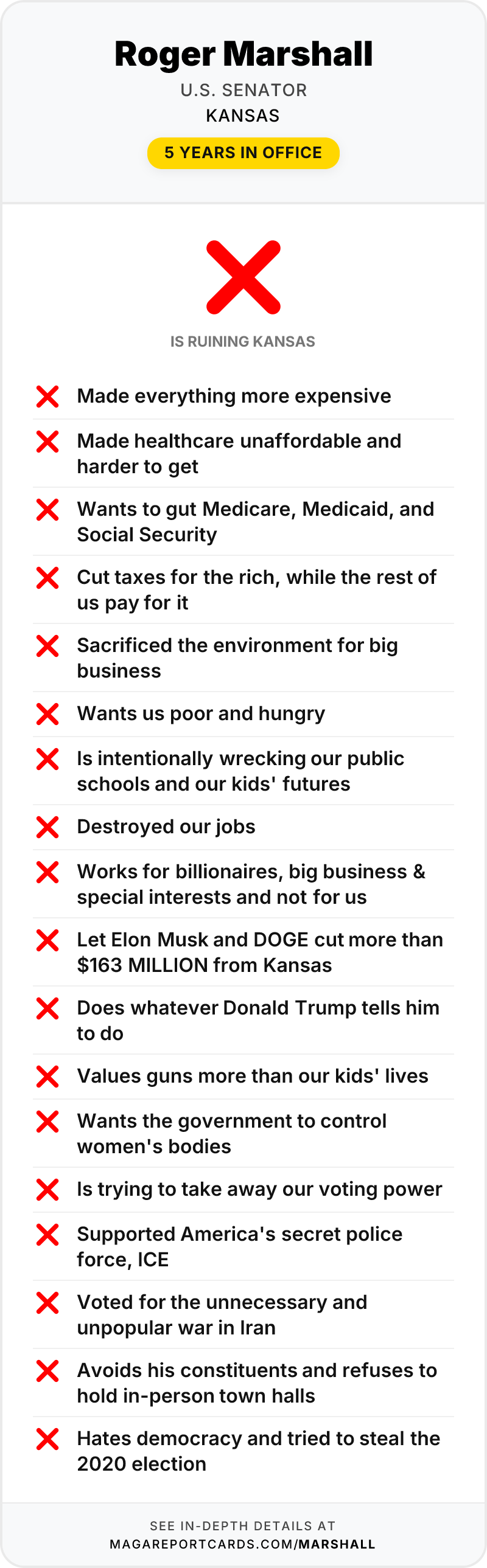
In March 2026, Roger Marshall put his name on a bill to stop members of Congress from trading stocks. Here is how he explained it:
"Hardworking Americans expect their leaders to play by the same rules that they do. This is not complicated – members of Congress shouldn't be trading individual stocks while making decisions that move markets."
He's right. It isn't complicated. So it's worth asking why Marshall didn't follow that rule himself when it counted.
The law he broke
There's a federal law called the STOCK Act — the Stop Trading on Congressional Knowledge Act. It's not complicated either. If you're in Congress, and you or your spouse or your dependent children buy or sell stock, you have 45 days to tell the public. That's it. You don't have to explain the trade. You just have to disclose it, so voters can see whether the people writing the laws are also betting on the companies those laws affect.
Roger Marshall did not do that.
As Business Insider reported in October 2021, Marshall was more than 17 months late disclosing a series of stock trades made by one of his dependent children. LegiStorm, which tracks congressional filings, found the same thing: the trades happened between February 24 and July 8, 2020, and Marshall never included them in any of the periodic transaction reports he filed as a House member that year. They only surfaced later, buried in an annual report — filed in September 2021, well over a year past the deadline.
Look at when the trades happened
The dates matter here, so read them slowly.
Between late February and early March 2020 — as the coronavirus hit the United States and the stock market went into free fall — Marshall's dependent child sold up to $15,000 of Microsoft and bought up to $15,000 each of Walt Disney and Chevron. Both of those were companies getting hammered by the shutdown. Buying them in that window was a bet that the crash would end.
Then, in July 2020, came sales of up to $15,000 each of two more: Roku, the streaming company that boomed while America sat at home, and Gilead Sciences — the maker of remdesivir, which the FDA had authorized that May and would go on to approve as the first COVID-19 treatment cleared in the United States.
That was the exact stretch when Marshall, then a congressman, was helping write and pass trillions of dollars in pandemic relief — the CARES Act alone became law on March 27, 2020. We are not saying he traded on inside information — nobody has proven that, and no one has charged him with it. But that is precisely the point of the disclosure deadline. The 45-day rule exists so the public can look at trades like these while they still matter, not a year and a half later.
Marshall's household kept those trades off the books through the 2020 election, through his win, and through his first eight months in the United States Senate.
"Unbeknownst to Senator Marshall"
Marshall's office had an explanation ready when Business Insider called:
"These trades were made unbeknownst to Senator Marshall. The moment Senator Marshall was made aware, the proper reporting was handled."
A spokesperson declined to say anything more — not who actually placed the trades, not how a family's stock activity stayed invisible to him for a year and a half, not what changed in September 2021 to finally make him aware.
Take that statement at face value for a second. It amounts to: I didn't know what was in my own family's brokerage account. That is not a defense of the disclosure law. It's an admission that Marshall wasn't doing the one thing the law requires him to do, which is keep track.
And it isn't the first time Marshall has answered an ethics question by saying he simply hadn't noticed. When the Kansas City Star uncovered how his 2008 reckless driving conviction was quietly erased by a prosecutor whose father was his business partner and across-the-street neighbor, Marshall's answer was that he "didn't even know who the prosecutor was." It's the same move: the paperwork worked out in his favor, and he says he wasn't paying attention.
Now he's the reformer
Fast forward to March 18, 2026. Sen. Pete Ricketts of Nebraska introduced the Stop Insider Trading Act, a Senate companion to a House bill from Rep. Bryan Steil, and Marshall signed on the same day as an original cosponsor — announcing it as his own.
Read what the bill does:
- It bars members of Congress, their spouses, and their dependent children from buying stock in publicly traded companies.
- It requires public notice seven to fourteen days before any sale.
- It sets a penalty of $2,000 or 10% of the investment's value, whichever is greater, plus forfeiture of any gain.
Every single one of those provisions describes the thing that happened in Roger Marshall's household in 2020. Dependent children buying individual stocks. Sales the public didn't learn about in time. A violation that, under the old rules, cost him essentially nothing.
Marshall is not proposing this as a confession. There's no mention of his own late filing in the press release — just the line about hardworking Americans expecting their leaders to play by the same rules.
Banning congressional stock trading is a good idea. It has bipartisan support for a reason. But there's a difference between a reformer and someone who got caught, faced no consequences, and then showed up years later to put his name on the fix and take a bow.
The rule Kansans live under
Here's the test we'd apply to anyone else.
If you're a nurse in Wichita and you skip a required disclosure at work by 17 months, you don't get to write the new policy manual. If you're a farmer in Barton County and you file your paperwork a year and a half late, "I wasn't aware" doesn't get you off. The whole promise of the STOCK Act was that members of Congress would face the same basic expectation of honesty that the rest of us face every day.
Marshall broke that rule. Then he wrote a press release about how hardworking Americans expect their leaders to play by the same rules that they do.
We deserve better.
Sources
The STOCK Act violation was first reported by Business Insider (Oct. 5, 2021) and independently documented by LegiStorm. Marshall's cosponsorship and quote come from his own Senate press release. Photo: Business Insider.