We should hold our leaders to high standards. That starts with a simple idea: when you break the law, the same rules apply to you that apply to everyone else.
That is not what happened to Roger Marshall.
In 2008, a neighbor called 911 and said Marshall had nearly run him down with a pickup truck. Marshall was charged with two crimes. He pleaded no contest to one of them and was sentenced. Then, on Christmas Eve, a prosecutor walked into a judge's chambers and got the whole conviction wiped out and replaced with something closer to a parking ticket.
That prosecutor's father was Marshall's business partner. He also lived across the street.
What happened on the land
The trouble started with a fight over property near Great Bend, Kansas.
On May 9, 2008, a man named Randy Suchy called 911. According to the Hutchinson News, which later obtained the recording, Suchy told the dispatcher he had "Dr. Marshall over here, trespassing." Then he added six words that would follow Marshall into politics:
"He just about ran over me."
Asked directly whether Marshall had tried to run him over, Suchy answered, "Well, yeah." He described Marshall, driving a Dodge pickup, getting "me in between the telephone poles," and said "he was spinning out."
Barton County prosecutors filed two counts against Marshall: battery, a class B misdemeanor, and reckless driving. The battery count was dismissed. In October 2008, Marshall pleaded no contest to reckless driving — unlawfully and knowingly driving a motor vehicle in disregard for safety.
He was sentenced to five days in jail, all of it suspended, plus a $150 fine and court costs.
Marshall has always denied that he hit the man.
Then it got erased
Here is the part that should bother every Kansan, no matter who you vote for.
Thirteen days after that sentence was entered, on Christmas Eve 2008, Assistant Barton County Attorney Carey Fleske went to District Judge Mike Keeley with a request. As the Kansas City Star and Wichita Eagle documented from court records in 2020, Fleske asked the judge to sign what's called a nunc pro tunc order — a narrow tool meant for fixing clerical mistakes, like a typo in a case number.
He used it to delete Marshall's reckless driving conviction entirely and replace it with "Failure to Exercise Due Care in Regard to a Pedestrian" — a traffic infraction. The suspended jail sentence went away with it.
Patrick McInerney, a defense attorney the Star asked to review the order, said that is not what the tool is for. It is "designed for situations where a 1 should have been a 2," he said. "It's not to replace a whole charge." He added that it was "interesting that the prosecutor, defense lawyer, judge would miss that big of an error, particularly the defense lawyer. That's very unusual." The lesser charge Marshall walked away with, McInerney said, is the same one you'd get for "your front wheels going over the white line in the crosswalk."
The judge who signed it didn't remember much about it. "I do not recall him appearing, having a hearing, having any arguments," Keeley told the paper. "I thought it was all stipulated to or agreed upon." And: "When it was approved by both parties, I figured they knew what they were doing, so I approved it."
The prosecutor's father lived across the street
So who was the prosecutor who made a criminal conviction disappear on Christmas Eve?
Carey Fleske's father was Leonard T. Fleske. According to the business and court records the Star reviewed, the elder Fleske lived across the street from Marshall on Quail Creek Drive in Great Bend in 2008. And Marshall and a living trust named for Fleske's wife each held a 9.4 percent ownership stake in Great Bend Surgical Properties at the time of the case.
The prosecutor handling Roger Marshall's criminal case was the son of Roger Marshall's business partner and across-the-street neighbor. And the outcome of that case was a conviction quietly rewritten into a traffic ticket, over a holiday, with no hearing the judge could recall.
Randy Suchy sued Marshall in April 2009 over shoulder and arm injuries, seeking $200,000 in damages plus medical bills. The case settled in 2010 before it ever reached a trial. The terms are confidential. The Kansas State Board of Healing Arts, which licenses doctors, took no disciplinary action.
Nothing about this was ever tested in front of a jury. It just went away.
Marshall's answer: everybody knows everybody
When the story surfaced during his 2020 Senate campaign, Marshall did not dispute the family connection. He said he hadn't noticed it.
"I didn't even know who the prosecutor was since it was such a small matter," Marshall told KWCH in June 2020. "I didn't know until it was brought to my attention this week." He went on: "In a small city, you know everybody. There's not an attorney in town who's kid I haven't delivered or played ball with, so that's life in a small city, and again, that's not the focus."
His campaign spokesman, Eric Pahls, made the same argument to the Star. "Anyone in rural Kansas can attest that when you live in a town for three decades, deliver thousands of babies, chair church board, lead Rotary Club and run businesses and charities, you're going to know most everyone." And, as Pahls put it: "It was just a traffic ticket."
But it was only "just a traffic ticket" because of the Christmas Eve order. Before that order, it was a criminal conviction with a suspended jail sentence. Marshall's defense is essentially that the favor he received is proof there was never anything to fix.
Small towns really do work that way — everyone does know everyone. That is exactly why prosecutors have conflict-of-interest rules. The rule isn't there because small-town lawyers are bad people. It's there so that when the local doctor and the local prosecutor's father are business partners across the street from each other, nobody has to wonder whether the outcome was bought with a handshake.
Why it still matters
This is not ancient history that only a rival dug up.
Marshall's 2016 primary opponent, Rep. Tim Huelskamp, put the 911 call in a TV ad. The narration was brutal: "In a violent rage, Dr. Roger Marshall almost ran down and seriously injured his neighbor and fled the scene of his crime. Lawbreakers belong in jail, not Congress." Marshall's campaign manager, Brent Robertson, called the ad "barrel scraping" and called Huelskamp "a panicked career politician."
Voters heard the attack, and Marshall beat Huelskamp anyway that August. But what voters did not have in 2016 was the Christmas Eve order and the Fleske connection. That reporting didn't come out until June 2020 — after Marshall had already served more than three years in Congress and was running for the Senate.
Roger Marshall has spent his career telling Kansans he's the outsider, the doctor, the guy who isn't part of the system. The record says otherwise. When he needed the system to do him a favor, it did — quietly, over a holiday, through a prosecutor whose father was his business partner.
We deserve better.
Sources
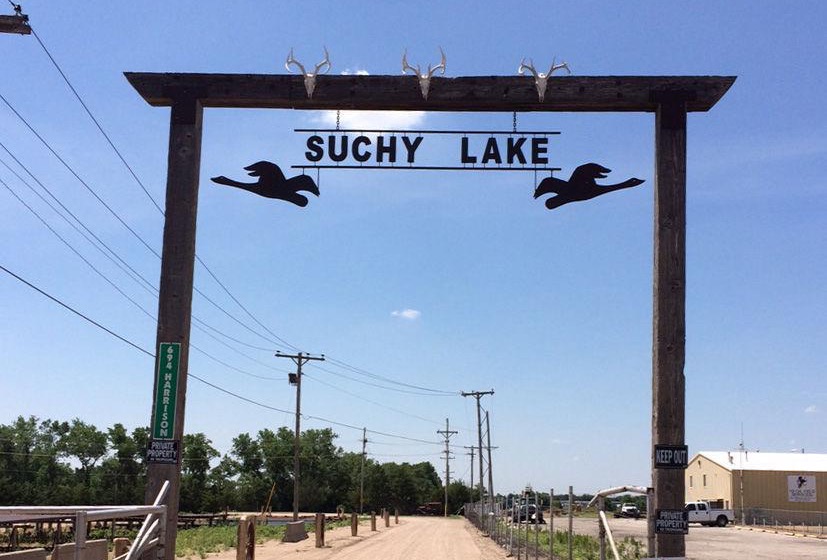
Details of the 911 call and the 2016 campaign ad come from the Hutchinson News (June 20, 2016, archived). The Christmas Eve order, the Fleske family connection, and the legal experts' assessment come from Jonathan Shorman and Bryan Lowry's reporting for the Kansas City Star and Wichita Eagle (June 21, 2020, archived). Photo: the entrance to Suchy Lake, via the Hutchinson News.