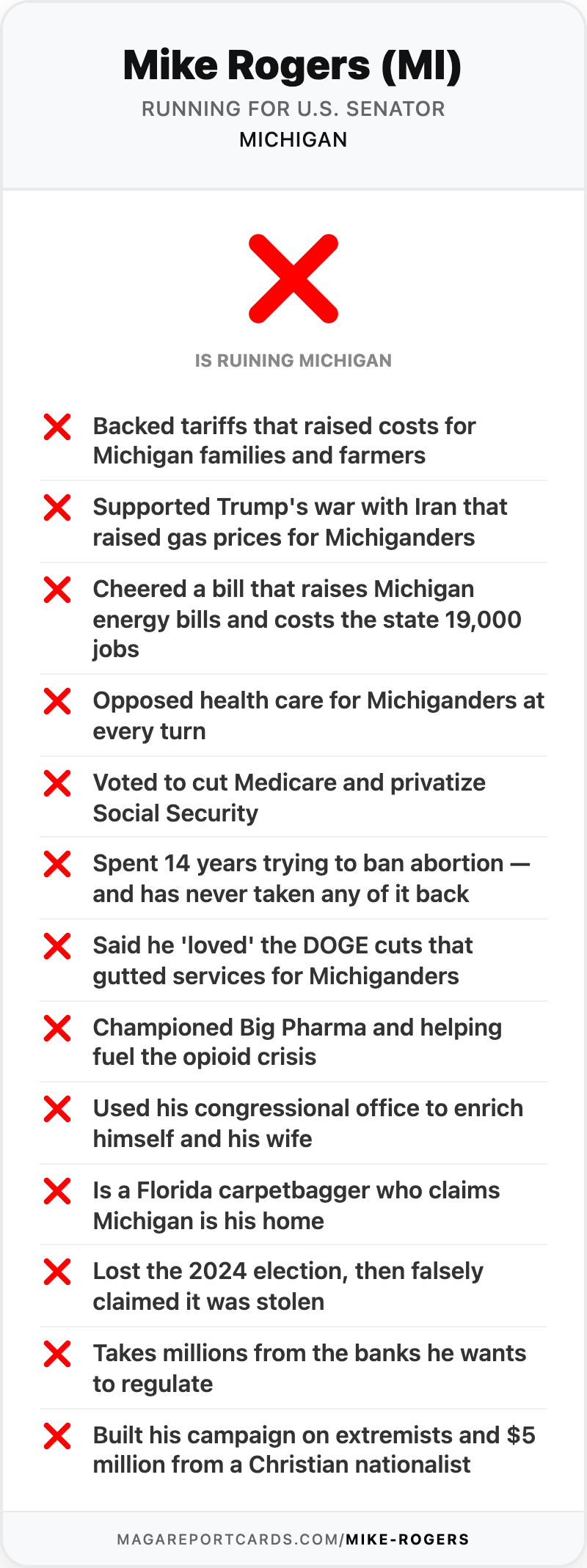
In July 2025, with the country arguing over whether the government should release the Jeffrey Epstein files, Mike Rogers (MI) went on the Brian Kilmeade Show and made the case for caution.
Some of the records should come out, he said. What happened around Epstein's island "ought to be released." But he warned that innocent people could have their reputations ruined just because their names were in the files.
"You also have to protect somebody who got on an airplane and rode with him."
Rogers said a person could have had a "legitimate business reason" to deal with Epstein. He said a "big, big, ugly vote on the House floor" was not the right way to handle it. And he waved off some of the push for disclosure as politics: "people who just want to be after Trump are just going to beat this drum all day long." In a separate podcast that same month, he said names should be blacked out if there was no evidence the person knew about or took part in Epstein's crimes.
On September 14, 2026, the Detroit Metro Times reported who some of those names belong to: people who have paid to elect Rogers.
The donors
The Metro Times checked federal campaign finance filings against the Justice Department's released Epstein records. It found at least seven donors whose names appear in the files who have given to Rogers' Senate campaign, the committees that raise money for him, his leadership PAC, or GLCF — the super PAC that has spent millions to elect him.
We pulled every one of those contributions from the Federal Election Commission ourselves. Counting each check once, here is what the filings show:
- Stephen Schwarzman, co-founder and CEO of the private equity giant Blackstone: $4,518,600. That is $4.5 million to GLCF in three checks during Rogers' 2024 race — $2 million in June, $1 million in August and $1.5 million in September — plus $18,600 to his campaign, his leadership PAC and his joint fundraising committee between December 2023 and June 2025.
- Marc Rowan, CEO of Apollo Global Management: $32,000 — $7,000 to Rogers' joint fundraising committee in June 2025 and $25,000 to GLCF that December.
- John W. Childs, a private equity investor: $62,000 — $12,000 to the joint fundraising committee in August 2025 and $50,000 to GLCF in November 2025.
- John Catsimatidis, the New York billionaire: $17,100 — $6,600 to Rogers' campaign in 2023, $7,000 in June 2025 (half of a $14,000 contribution whose other half the campaign reassigned to his wife), and $3,500 that reached his leadership PAC through a Republican joint fundraising committee in March 2026.
- Joseph Baratta, a Blackstone executive: $10,300 to the campaign, in 2024 and April 2026.
- Howard Lorber, a real estate executive: $5,693 to the campaign in June 2026.
- Ronald Lauder, heir to the Estée Lauder cosmetics fortune: $3,300 to the campaign in October 2024, passed on through a Republican Senate joint fundraising committee.
That comes to more than $4.6 million, nearly all of it Schwarzman's. The Metro Times put the total at nearly $4.7 million. The gap is money that went into Rogers' joint fundraising committee and was then passed on to his campaign, which the filings list twice; we counted it once.
You can check the smaller gifts in the FEC's database, and Rowan's are here.
Being named is not a crime
This needs to be said plainly, because the sloppy version of this story is unfair and the accurate one is bad enough. Appearing in the Epstein files is not evidence of a crime. For some of these donors, the Metro Times found, the connection is little more than being discussed in emails between other people.
How deep each connection runs is different:
- Schwarzman is mentioned in the files 23 times, The Daily Beast has reported, including a 2010 email in which Epstein called him "terrific." The Metro Times notes that past reviews found no evidence the two men wrote to each other or met, and Schwarzman has not been accused of wrongdoing.
- Rowan is a different case. DOJ-released emails show direct contact from 2013 into 2016 — starting five years after Epstein's 2008 conviction — including breakfasts arranged at Epstein's home and Epstein's office asking for details on buying Rowan's private jet, The Daily Pennsylvanian reported. Rowan's spokesperson said that "in select instances" Rowan gave Epstein information in connection with Epstein's tax work for Apollo co-founder Leon Black, and that Rowan "had neither a business nor any other relationship with Mr Epstein."
- Lauder shows up in emails describing a February 2017 meeting by Epstein's pool and tentative plans for a visit, and Epstein supervised the creation of a company that let Lauder and Black share a $25 million painting, according to The Daily Pennsylvanian. Lauder has not been accused of any wrongdoing.
- Catsimatidis was in Epstein's address book. He once offered Epstein a ride to Florida on his plane, and Epstein sent him a three-foot bottle of champagne as thanks, The Daily Beast reported. He has said he met Epstein only once.
- Lorber appears in Epstein emails too — we laid them out when he gave money to Alaska Sen. Dan Sullivan. For Baratta and Childs, the Metro Times said only that they appear in the records to varying degrees.
So the problem is not that Rogers took a check from a criminal. It is that he went on the radio, while the fight over the files was still going, and argued for protecting the people named in them — and some of the richest people named in them are paying to put him in the Senate.
The super PAC is the real money
Schwarzman did not give Rogers' campaign $4.5 million. He gave it to GLCF, a super PAC, whose spending by law can't be coordinated with the campaign.
GLCF is not a stranger to Rogers' operation, though. In FEC records it lists Team Rogers — the joint fundraising committee that also collects money for Rogers' campaign — as an affiliated committee. When Childs wrote Team Rogers a $12,000 check in August 2025, the filings show $7,000 of it passed to the campaign and $5,000 to GLCF.
GLCF has spent more than $7.8 million supporting Rogers in the 2026 race through late August, the Metro Times found. Texas oil billionaire Tim Dunn has put $10 million into it.
Schwarzman spreads his money around. He has given $3 million to the super PAC reelecting Susan Collins, and he gave Iowa Senate candidate Ashley Hinson $7,000 days after the petition to force out the Epstein files was filed — a petition she refused to sign.
The House did not take his advice
Rogers said a big House floor vote was the wrong way to deal with the files. Four months later, the House held one anyway. On November 18, 2025, the Epstein Files Transparency Act passed 427 to 1. The one no vote was Louisiana Republican Clay Higgins.
All but one member who voted decided the public deserved to see the records. Rogers, running for the Senate, had gone on talk radio that summer to worry about the people named in them.
How his campaign answered
Rogers' campaign responded to the Metro Times with anger, not an explanation. Spokeswoman Alyssa Brouillet said:
"How dare you [sic]. Mike Rogers is a former FBI agent who busted human traffickers. The insinuation that he would take money from anyone engaged in that activity is disgusting."
Then, the Metro Times reported, the campaign repeated unsupported claims tying Democratic nominee Abdul El-Sayed to "recognized terrorist organizations." Rogers has attacked El-Sayed this way before, and earned a PolitiFact Pants on Fire rating for claiming his opponent believes America deserved 9/11.
The story did not say Rogers took money from anyone engaged in trafficking. It reported that people named in the Epstein files have poured money into electing him — and that he had argued the people named in those files should be protected if there was no evidence against them.
What the filings show
In July 2025, Mike Rogers (MI) argued that people named in the Epstein files deserved protection from public exposure if there was no evidence they committed a crime. FEC records show seven donors named in those files have given more than $4.6 million to his campaign, his leadership PAC, his joint fundraising committee and the super PAC backing him — including $4.5 million from Blackstone's Stephen Schwarzman and $32,000 from Apollo's Marc Rowan, whose emails with Epstein began five years after Epstein's 2008 conviction. Four months after Rogers called a House floor vote the wrong approach, the House voted 427 to 1 to release the files.
Source
Donors named in Epstein files gave nearly $4.7 million to Mike Rogers and groups backing him by Steve Neavling, Detroit Metro Times, September 14, 2026. Contribution amounts and dates checked independently against Federal Election Commission filings. Photo: Rogers campaign via Facebook, published by the Detroit Metro Times.