Jon Husted was already holding two government jobs in 2022. He was Ohio's lieutenant governor, and he ran InnovateOhio, the state office meant to make government run better. Together they paid him $176,000 a year from taxpayers.
In March of that year, he took a third job: a paid seat on the board of directors of Heartland Bank, a Central Ohio bank. Neither he nor Governor Mike DeWine's administration announced it. The public only found out in May, when the bank did.
On Monday, September 14, 2026, the Ohio Capital Journal reported what came next. Campaign records show Heartland Bank gave $492,000 to Husted's political committee, Jon Husted for Ohio, after he joined its board.
The bank his own administration regulated
This was not just any company. Heartland was a state-regulated bank, overseen by the Ohio Department of Commerce. The director of that department is appointed by DeWine — the governor Husted ran with in 2018 and 2022.
That meant the No. 2 official in the administration was sitting on the board of a bank that the administration's own regulators oversaw. Among other things, those regulators have to approve bank mergers — something Heartland had a clear interest in.
The bank did not pretend Husted's government job was beside the point. When it announced his seat, Heartland's chairman and CEO, G. Scott McComb, said:
"Jon brings an enormous amount of knowledge, relationships and experience that will be beneficial to the board as we continue to grow our franchise throughout Ohio."
Relationships. From a sitting lieutenant governor.
At first, Husted's office would not even say how much the bank was paying him. His spokeswoman said the pay would be "reported appropriately" on his financial disclosure — which meant voters apparently would not see it until after the November 2022 election. She also said he didn't expect any conflicts but "would certainly recuse himself" if one came up.
"A great educational experience"
In July 2022, Husted finally gave a number: probably around $20,000 a year. And he told reporters the job was really about learning.
"What you do at a community bank is very micro issues. It's loans for people's automobiles, it's farmers who borrow money, it's restaurants and businesses who need capital. It's a great opportunity for me to learn about all that."
He added: "I only intend on doing it for a couple of years to get the experience, to get the understanding, and that's why I did it. I think it's a great educational experience and I would recommend it to any policymaker."
What Husted did not mention was money flowing the other way.
What the bank gave him
According to the Ohio Capital Journal's review of records from the Ohio Secretary of State:
- Heartland Bank gave $492,000 to Jon Husted for Ohio after Husted joined its board.
- The checks kept coming after he left state government. DeWine appointed Husted to the U.S. Senate in 2025, to fill the seat JD Vance left behind. Heartland was still giving to his committee as recently as June 30, when it sent $15,000.
And Husted's own finances were tied up with the bank, too. His 2025 Senate financial disclosure shows:
- He and his wife had between $250,000 and $500,000 on deposit at Heartland.
- They held $16,000 to $30,000 in stock in German American Bancorp, the Indiana-based company that is now Heartland's parent.
- Husted personally got a $57,000 "forced payout" on his restricted stock when the two banks merged.
Husted stayed on the board until early 2025 — about three years, not quite the "couple of years" he'd described — leaving as he moved to the Senate and the merger went through.
"Nearly legalized bribery"
Is any of this against the rules? In Ohio, no — and that is its own problem.
Paul Nick, who runs the Ohio Ethics Commission, told the Capital Journal that under state law, campaign contributions don't count as "a thing of value" unless there is evidence of a bribe, another crime, or fraud. In other words, a company can give an official almost half a million dollars, and the ethics law treats it as if nothing changed hands.
Catherine Turcer of Common Cause Ohio, a government watchdog group, wasn't buying it:
"We act like it's Kabuki theater when it comes to campaign contributions. It's nearly legalized bribery. People who are paying attention know that."
To be fair to Husted, the Capital Journal also asked Ohio's banking regulators for any messages between Husted's office and them about Heartland. It found no documents showing he broke his promise to stay out of the bank's business. Because the merged bank is chartered in Indiana, Ohio regulators never had to sign off on the merger.
But the question was never only whether Husted picked up the phone. It was whether a bank his own administration regulated should be putting him on its payroll — and then pouring money into his political committee.
This is a pattern, not a one-off
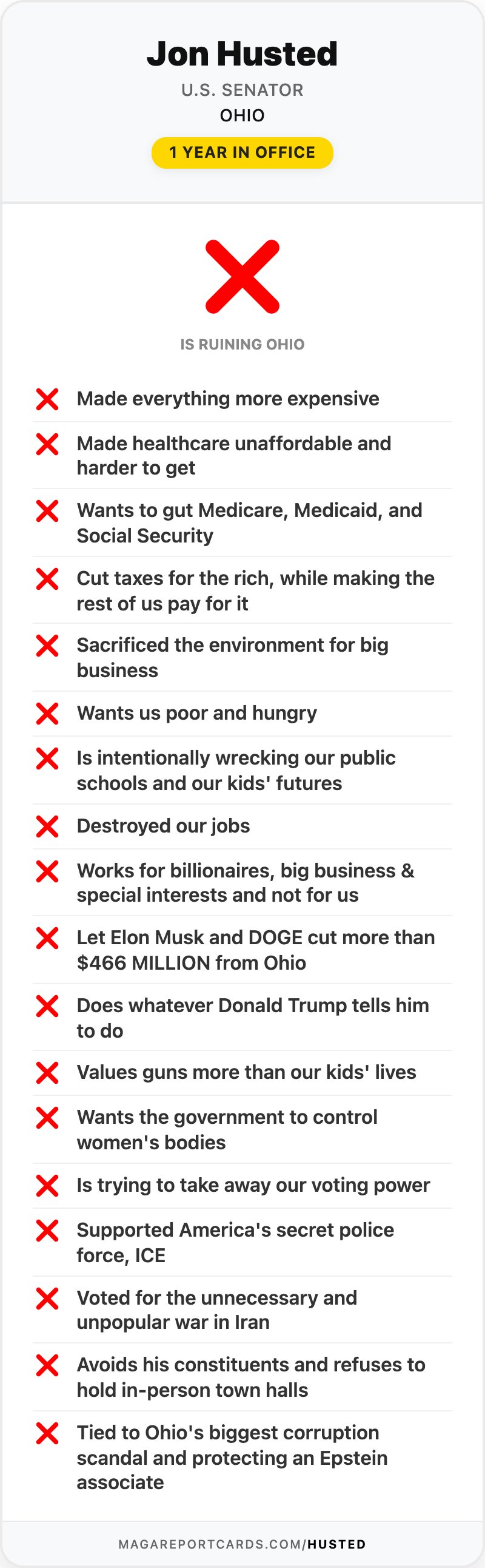
Heartland is not the first time money has followed Husted's official work.
The Capital Journal's story lays out more of his record. As a state lawmaker, he protected funding for the Electronic Classroom of Tomorrow, an online charter school that gave him $36,000 in campaign donations. It collapsed after investigations showed it had one of the worst dropout rates in the country — after taxpayers had put more than $1 billion into it. Husted also supported House Bill 6, the $1.3 billion FirstEnergy bailout at the center of what a federal prosecutor called likely the biggest bribery scandal in Ohio history. Documents from lawsuits over it said FirstEnergy executives secretly routed a $1 million donation through a dark-money group to the "Husted campaign" in 2017. Husted's spokeswoman said his campaign wasn't connected to that group.
We've documented more:
- While Husted pushed Washington to put billions into Intel, his wife owned Intel stock — and Intel's lobbyist had given his state committee tens of thousands of dollars.
- His senior adviser in the Senate took $22,652 from a lobbying firm while working in his office, and a formal ethics complaint now names Husted himself.
- He cosponsored a 2002 law that made it harder to sue nursing homes, and has since taken more than $1 million from that industry.
What the records show
While he was Ohio's lieutenant governor, Jon Husted took a paid seat on the board of Heartland Bank, a bank regulated by the administration he helped lead, and called it "a great educational experience." The bank then gave his political committee $492,000, and kept writing checks after he became a U.S. Senator — $15,000 as recently as June 30. Husted and his wife had $250,000 to $500,000 on deposit there, and he collected a $57,000 stock payout when it merged. Under Ohio's ethics law, those campaign contributions don't count as "a thing of value" unless there is evidence of a bribe or another crime.
Source
Marty Schladen, Ohio Capital Journal: "Husted political committee got nearly $500K from a bank he worked for while in office" (September 14, 2026). Photo via the Ohio Capital Journal.