The man who runs Senator Mike Rounds's political operation has two employers. One of them is you.
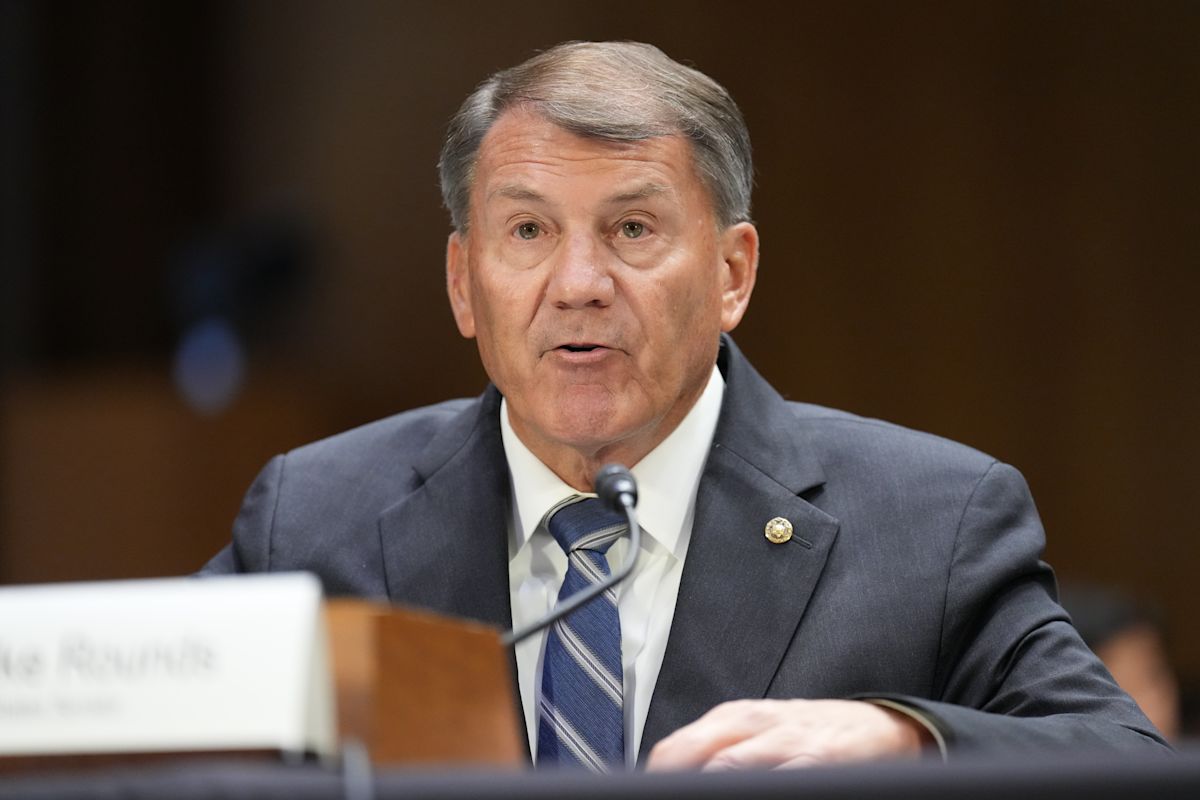
Robert Skjonsberg has worked for Rounds for more than a decade. He managed Rounds's first Senate campaign in 2014, served as his chief of staff from 2015 to 2022, and is now his senior adviser. Rounds's Senate office paid him more than $153,000 in the last 12 months on record.
At the same time, POLITICO reported on September 7, Skjonsberg has been a registered lobbyist in South Dakota — since 2023 — for more than a dozen clients. The list includes Meta, the tobacco company Altria, the conservative Freedom Foundation, the Association of Equipment Manufacturers, the South Dakota Dairy Producers and the South Dakota Pork Producers.
The records POLITICO reviewed had never been reported before.
What the Senate's rules actually say
This is not a gray area the Senate has failed to think about. The Senate Select Committee on Ethics publishes the rule in plain language on its own conflicts of interest page.
Anyone on the Senate payroll earning an annual rate of pay above $25,000, and employed more than 90 days in a calendar year, may not:
Affiliate with a firm, partnership, association, corporation, or other entity for the purpose of providing professional services for compensation;
Permit his or her name to be used by such a firm, partnership, association, corporation, or other entity;
Practice a profession for compensation to any extent during regular office hours in the employing Senate office.
The committee spells out what that leaves: an employee below the higher salary line "may provide professional service for compensation, but only as a solo practitioner, without affiliating with a professional services entity."
Skjonsberg is listed on the website of 605 Strategies, a South Dakota government affairs firm founded in 2012, as a "co-owner" and "founding member." The firm itself does not appear on his lobbying registrations; his own name does. The firm's own site, as the Daily Caller noted, credits him with guiding Rounds to victory in the 2002 governor's race, his 2006 reelection, and his Senate wins in 2014 and 2020.
There is a second, stricter tier for staff paid at or above $151,661 — the 2026 figure — which bars paid professional services entirely. POLITICO reported that Rounds's office paid Skjonsberg more than $153,000 over the last 12 months on record, but that he did not cross that threshold in calendar year 2025.
The bills that followed
The reason the rule exists is that a person cannot separate what they learn in a Senate office from what they sell in a statehouse.
Since Skjonsberg registered to represent Meta last year, Rounds has introduced several bills on artificial intelligence, including one that would create a commission to study what AI does to the American workforce.
Rounds also sits on the Senate Appropriations Subcommittee on Agriculture. This year he introduced legislation to open new grazing land for the cattle industry, and legislation to stop people and companies controlled by foreign adversaries from buying American farmland and agricultural businesses. Skjonsberg's client list in Pierre includes the state's dairy producers, its pork producers, and the Association of Equipment Manufacturers.
Nobody has shown that a bill was written to order. That is not the standard. The standard is whether the arrangement creates a conflict, and two ethics watchdogs said it plainly.
"It's wholly inappropriate for somebody who's working as a Senate staffer to be lobbying, [even if] it's only at the state level, because you can't draw this line or wall between all the kinds of information you gain," said Meredith McGehee, an independent congressional ethics expert who used to lead the watchdog group Issue One. "To me, this is pretty much a no-go, and it's an outside employment that should not be permitted."
Craig Holman, a lobbyist for the advocacy group Public Citizen, went further: "It poses the most obvious conflict of interest I can imagine. Serving a public official, you're supposed to be working on the public's behalf, but then simultaneously working as a hired lobbyist, you're now working also on some private special interest's behalf and getting directly paid for it."
What Rounds's office says
Rounds's spokesperson, Dezmond Ward, told POLITICO that the office's general counsel "consulted with the U.S. Senate Select Committee on Ethics, which provided guidance to make certain there was and is no conflict of interest," and that "Senate Ethics guidance continues to be followed today."
The guidance itself is not public, and POLITICO's account does not include it. A senior staffer for the ethics committee did not respond to POLITICO. Skjonsberg did not answer questions about the scope of his work.
Two clients moved to distance themselves. The Association of Equipment Manufacturers said it has not worked with Skjonsberg since March 2026. Meta spokesperson Andy Stone said Skjonsberg's contract ended after South Dakota's legislature wrapped its 2026 session that same month. Altria did not respond.
Rounds already takes the money directly
The lobbying arrangement is not the only place Big Tech money reaches Rounds. It reaches him through the front door too.
Rounds sits on the Senate Banking Committee, which writes the rules for banks, payments companies and cryptocurrency. His donors this cycle include $70,100 from the artificial intelligence company Anthropic — $68,600 of it from people who work there and $1,500 from its PAC — $56,400 from people at Alphabet, Google's parent, and $36,000 from people at Andreessen Horowitz. The cryptocurrency industry's super PAC spent $411,748 supporting him while he sat on the committee that writes crypto rules. Counting everything raised since 2020, only 5% of his money came from small grassroots donors, which ranks him 78th out of 100 senators.
His independent challenger, Brian Bengs, put the money at the center of the race last week. "He has taken over $215,000 American dollars from AI data center interests, and is backed with hundreds of thousands more from super PACs that support big tech interests," Bengs told South Dakota Public Broadcasting on September 3, as Dakota Free Press reported.
Update, September 12: the answer was a middle finger
After the Politico story ran, Bengs called on Rounds to back a ban on government and campaign staffers lobbying for corporations and special interests. "South Dakotans deserve to know that the people who work for them aren't using public service as a revolving door to lucrative lobbying jobs," Bengs said.
Skjonsberg answered that evening. He posted an image on X of an actor holding up a raised middle finger, tagged Bengs, and wrote: "Like you, the nonsense will be forgotten @BrianBengs."
South Dakota Searchlight asked Rounds's office repeatedly whether the senator condones the post. Spokesperson Dezmond Ward's replies did not address the question. What arrived instead was a message from Skjonsberg himself: "I did not clear the X with anyone. I can defend myself." He accused Bengs of "bullying people" and gave no examples. He repeatedly spells his opponent's name "Bangs."
Two other things came out of that reporting. South Dakota's own lobbying records show Skjonsberg is registered for 14 clients this year — Meta Platforms alongside farm groups, equipment manufacturers and mining interests. And Searchlight independently verified roughly $200,000 in contributions to Rounds's campaign from people and PACs tied to Meta, OpenAI, Anthropic and Alphabet, and to tech investors.
Ward also told Searchlight that "over four years ago, our general counsel worked with Senate Ethics to establish a structure to avoid any potential conflicts of interest," and that the office "implemented additional safeguards beyond what was recommended by Senate Ethics." Searchlight asked what that structure and those safeguards actually are. Ward did not respond.
So the public record now holds a senator's office declining to say whether it approves of its senior adviser telling a rival candidate to get lost, declining to describe the ethics safeguards it says protect the arrangement, and a $153,000-a-year aide representing 14 private clients in the state capital.
This keeps happening, and it is always the same shape
A senator's most trusted aide is worth a great deal to the industries that senator regulates — not because the aide will hand over a secret, but because the aide knows what is coming, who is movable, and how a bill gets written.
Ohio's Jon Husted has the same problem. His senior adviser and counsel collected $22,652 from a Columbus lobbying firm while working in Husted's office, which produced a formal complaint asking the Senate to investigate Husted himself.
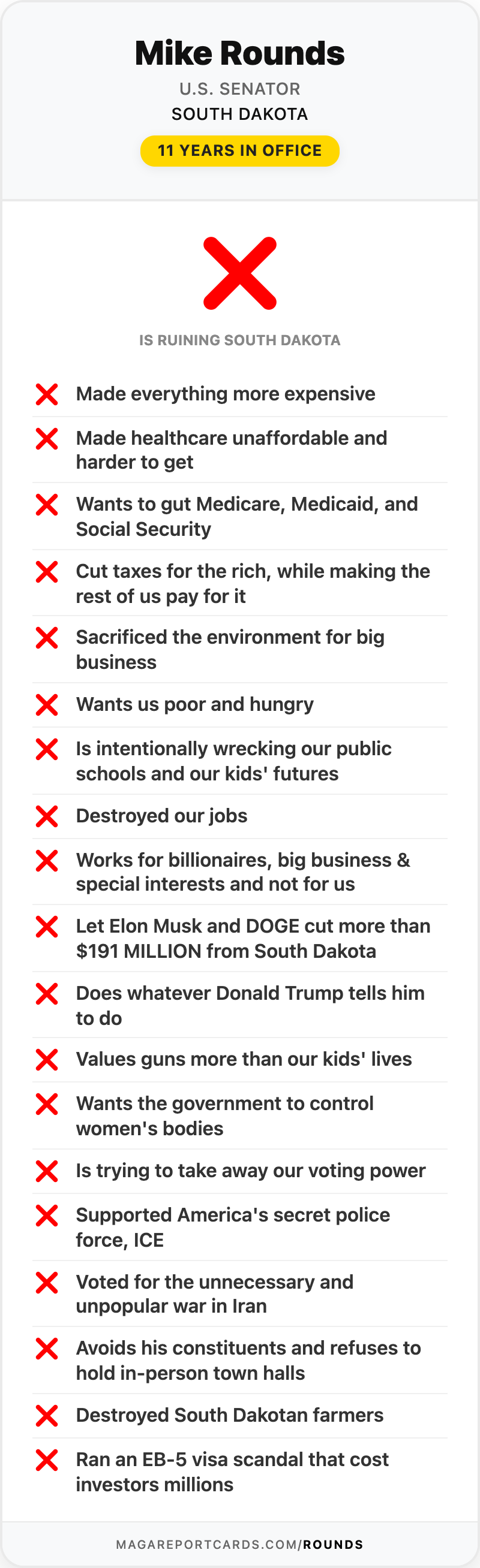
And Rounds has been here before, at the other end of his career. As governor he privatized South Dakota's EB-5 green card program, handing it to a private company owned in secret by the state employee who gave out the contract. It ended with a bankrupt beef plant, roughly $100 million of foreign investors' money gone, and a cabinet secretary dead six days before a grand jury was set to indict him.
What the record shows
Mike Rounds's Senate office paid Robert Skjonsberg more than $153,000 over the last 12 months on record. During that period Skjonsberg was also a registered South Dakota lobbyist for more than a dozen clients, among them Meta and the tobacco company Altria, and is listed as a co-owner of a South Dakota government affairs firm, though that firm is not named on his registrations. Senate rules bar a staffer at his pay grade from affiliating with such a firm or letting it use his name. Since Skjonsberg registered for Meta, Rounds has introduced multiple AI bills; from his seat on the agriculture spending subcommittee, he has introduced bills touching industries Skjonsberg is paid to represent in Pierre. Rounds's office says the ethics committee cleared it; the guidance itself has not been made public.
Source
Jacob Wendler, with Andrew Howard, Senate aide's lobbying side gig raises ethics questions, POLITICO, September 7, 2026.