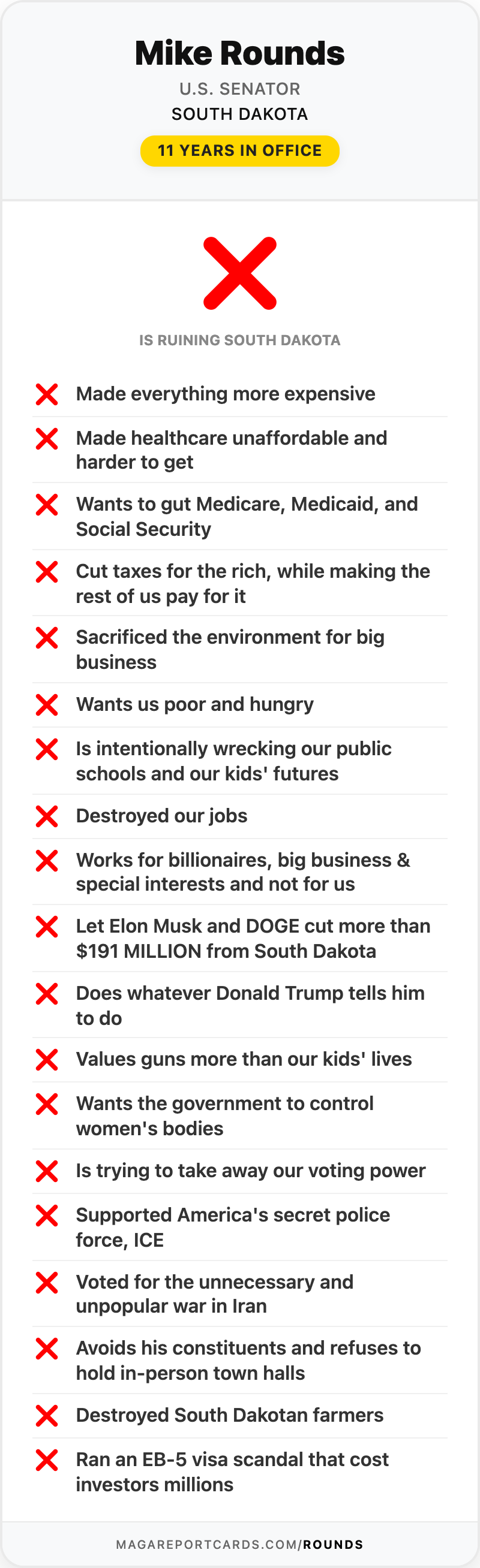
On January 22, 2026, Mike Rounds announced he's running for a third term in the U.S. Senate. In his campaign video he listed what he says he's delivered for South Dakota. One item on the list: "stronger border security."
Here's the thing about Mike Rounds and immigration. The biggest immigration program he ever personally ran wasn't at the border. It was in the governor's office in Pierre. It sold green cards to wealthy foreigners for $500,000 apiece. He turned it over to a private company. And it ended with a bankrupt beef plant, a hundred million dollars of other people's money gone, the federal government moving to shut the whole thing down, and a member of his own cabinet dead six days before a grand jury was scheduled to take up charges against him.
South Dakota's report card should include that story. So here it is.
What EB-5 is
EB-5 is a real federal program, invented in 1990. When South Dakota's scandal unfolded, a foreign national who put $1 million into a U.S. business got a visa, and after two years could get a green card — if the investment created at least ten American jobs. The price dropped to $500,000 in rural areas and places with high unemployment. That's most of South Dakota.
Much of the money is pooled through "regional centers" — usually private, and only unusually run by a state, as South Dakota's was at the start. The program is often criticized as an open invitation to corruption. South Dakota is the reason why.
The state employee who hired his own company
The man running South Dakota's regional center was a state employee named Joop Bollen.
At the beginning of 2008, Bollen created a private company called SDRC Inc. A few days later, wearing his state hat, he signed a contract to co-manage South Dakota's EB-5 program with SDRC — without disclosing that he owned SDRC. He signed a deal with himself.
SDRC didn't take the investments itself. It bundled immigrants' $500,000 checks into funds, took $5,000 off the top of each investor, and charged fees every year after that.
At the end of 2009, that private company became the state's official EB-5 operation. Bollen quit his government job to run it full time. Rounds was governor, and The Nation later reported that his administration used the state Office of Economic Development to effectively privatize the program by handing SDRC a no-bid contract. Courthouse News put it plainly: SDRC "was awarded stewardship of the EB-5 program by then-Gov. Mike Rounds in 2009."
If a public official steering business to a company they own sounds familiar, it should. It's the same shape as the nonprofit Christine Drazan founded that paid $96,000 to a consulting firm she and her husband own. The difference in South Dakota is the scale, and who got hurt.
The beef plant
The biggest thing SDRC ever funded was Northern Beef Packers, a slaughterhouse in Aberdeen.
Foreign investors put roughly $100 million into it. That's up to 200 investor families who handed over their savings and were counting on the plant to get them green cards.
The plant killed its first cows in October 2012. Nine months later it was bankrupt.
No plant, no jobs, no green cards from the project. Years later, 35 Chinese investors who lost millions took the state to the South Dakota Supreme Court — and on June 25, 2020, the court ruled they couldn't sue the state agencies involved at all. Sovereign immunity. Case closed.
The $600,000 loan Rounds signed
Now the part that is about Rounds himself.
His secretary of tourism and state development was Richard Benda. Before Benda left state government at the end of Rounds' term, he agreed to go work for SDRC — monitoring the loans to Northern Beef. Then, while still a state official, he arranged for South Dakota to give Northern Beef a $600,000 loan.
Rounds, as governor, signed off on that loan.
A state audit later said the fault was Benda's, for not disclosing the new job and not stepping aside. But on October 21, 2014 — two weeks before Election Day in his first Senate race — Rounds said he did find out about Benda's new job before he left office, right around the time he signed off on the loan. He signed anyway.
His answer to "what did you know, and when?" changed over time, as South Dakota Public Broadcasting reported that same month.
A dead man takes the blame
Benda never testified.
Investigators alleged he was directing $550,000 in state grant money toward his future employer to cover his own salary, and double-billing the state for economic development trips. A grand jury was scheduled.
On October 22, 2013, law enforcement responded to Benda's death in Charles Mix County. It was ruled a suicide. Attorney General Marty Jackley later spelled out the timing: that date was "six days prior to the scheduled grand jury". The complaint charging him with embezzlement and grand theft had been authorized. It was never signed.
The investigation his own party ran
South Dakota's legislature did look into it. Sort of.
The committee had eight Republicans and two Democrats. The Republican leadership turned down Democratic requests to use the committee's subpoena power. Instead, the key witnesses — including Rounds and Bollen — were allowed to answer questions by written correspondence. The committee's final report put all the blame on the dead man. Neither Rounds nor Bollen was found officially responsible for anything.
Rounds' position throughout was that he knew nothing improper about Benda, Bollen, or EB-5 until investigators contacted him.
Afterward, Democrats tried to bring back the state Ethics Commission, which South Dakota abolished in 1979. The Republican majority killed it 53–16. During the debate, one Republican lawmaker joked that if an ethics commission could fight corruption, then "I want a Tom Cruise commission to make us all strong and handsome."
That same year, the Center for Public Integrity graded South Dakota an F on government accountability — 56 out of 100, failing in nine of thirteen categories, 47th in the country.
A state whose money went missing decided the answer was no ethics commission. That's not an accident. It's a choice, and it's the same choice we've watched play out in Florida, where $10 million meant for poor kids' Medicaid ended up funding political ads and the attorney general who signed off never answered a single question about it.
The federal government shut the whole thing down
On September 28, 2015, U.S. Citizenship and Immigration Services told South Dakota it could no longer participate in EB-5 at all. Citing corruption and administrative blunders, the federal government moved to shut the state's program down.
That federal notice said $5 million in EB-5 money was still unaccounted for, that $1.7 million had been transferred to a holding firm in Cyprus that owns Russian railway companies, and that $3.3 million had been improperly spent.
Bollen eventually pleaded guilty — to exactly one felony count, after four others were dropped. On February 1, 2017, he got two years of probation and a $2,000 fine. No jail. A month later, his company settled with the state: $546,250 up front and $81,250 more in 2019, bringing the state's total recovery to about $1.5 million against allegations he had diverted more than $1.2 million.
The foreign families who lost $100 million got none of that.
He's still the EB-5 guy
Most politicians would never say those two letters again.
Not Rounds. On November 5, 2019, as a United States Senator, he introduced S. 2778, the Immigrant Investor Program Reform Act — 87 pages to rewrite the EB-5 program and extend it for years. He was the lead sponsor. The Rapid City Journal's headline was "Rounds doubles down on EB-5." The bill died without a vote.
Meanwhile, his Senate website says: "We must limit chain migration and develop a better, merit-based system that prioritizes granting visas to individuals who have skills that our country needs." The same page says there must be consequences for people who overstay a visa.
Set that next to what he actually built. In Rounds' program, the qualification wasn't a skill. It was a $500,000 check. The people who wrote those checks weren't screened for skills. They were handed to a company secretly owned by the state employee who signed its contract, and pointed at a beef plant that went under in nine months.
What this is really about
None of this stopped him. Rounds won the Senate seat in 2014 while the scandal was still unfolding, and he's asking for a third term now.
That's the pattern, and a recent poll found MAGA voters say they'd forgive almost any scandal you can name. Politicians read those numbers too. It's why Rounds can put "stronger border security" in a campaign video and expect nobody to bring up the years he spent selling green cards for cash.
We should bring it up.
He privatized a federal immigration program. His development secretary lined up a job with the private company, arranged a $600,000 state loan to the plant on his way out, and Rounds signed it after learning where Benda was headed. Up to 200 investor families were left without the green cards they paid for. The feds shut the program down. And when the legislature finally asked him about it, he got to reply in writing.
We deserve better than that.
Sources
- This immigration scandal drove a state official to suicide — and could give Dems the Senate — Vox, updated October 22, 2014
- South Dakota gets F grade in 2015 State Integrity Investigation — Center for Public Integrity
- Feds Kill South Dakota's Investor Visa Program — Courthouse News Service, October 21, 2015
- Revealed: A New Ethics Scandal Involving the GOP's South Dakota Senate Candidate — The Nation
- AG: Benda Suicide Came Days Prior To Possible Indictment — KELOLAND