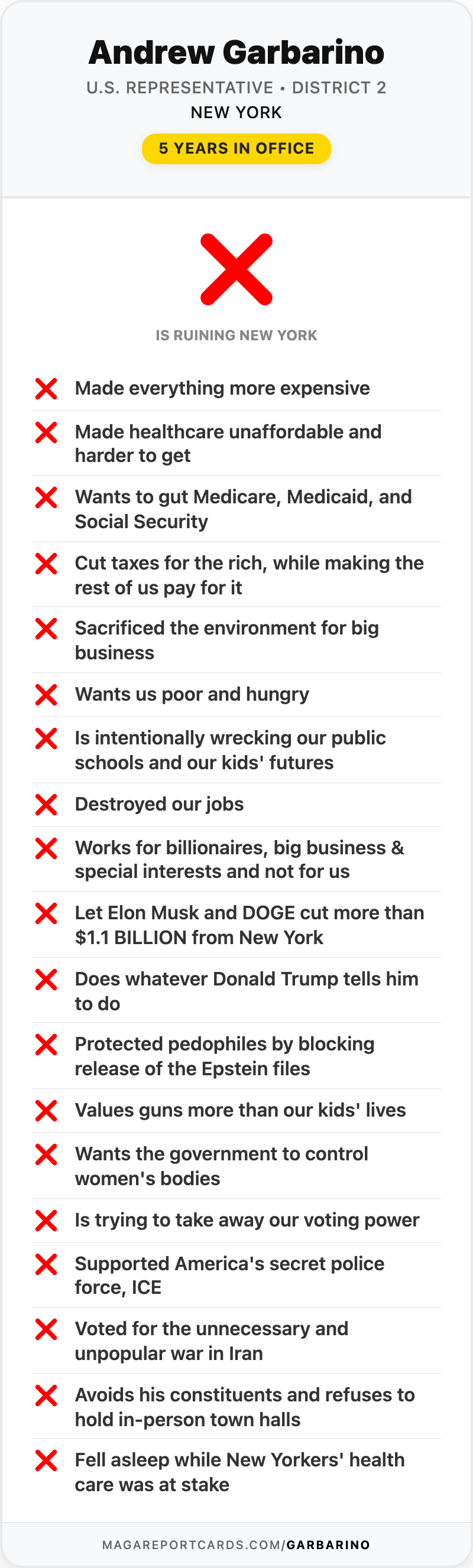
Andrew Garbarino has the job in Congress that decides how hard anyone looks at ICE.
On July 21, 2025, House Republicans picked him to chair the Committee on Homeland Security, replacing Mark Green of Tennessee, who had just resigned from Congress. The gavel came with real authority over Immigration and Customs Enforcement: what gets a hearing, who testifies under oath, what documents get subpoenaed, which contracts get questions asked about them.
Eight weeks later, three checks arrived.
The three checks
Here is what the Federal Election Commission's records show, straight from the filings of the companies' own political action committees:
- September 17, 2025 — $5,000 from The GEO Group's PAC.
- September 23, 2025 — $5,000 from CoreCivic's PAC.
- September 30, 2025 — $5,000 from Management & Training Corporation's PAC.
Three companies. Thirteen days. All of them go to Garbarino for Congress, his campaign committee.
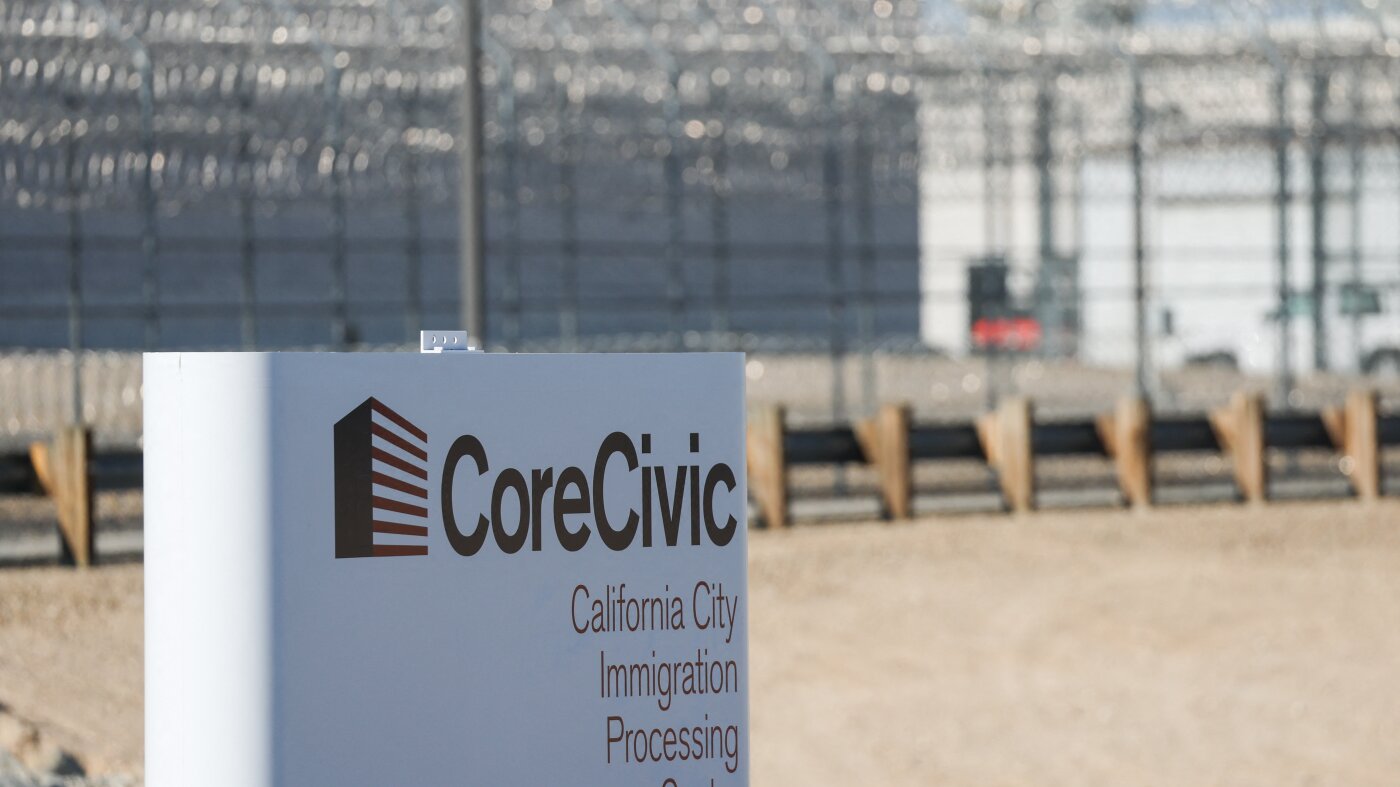
GEO Group and CoreCivic are the two largest private prison companies in America; MTC is a smaller operator in the same business. All three hold ICE detention contracts. And they had never done anything like this for him before.
What they used to give him
Garbarino was first elected in 2020. Across his first three campaigns, all three of these companies combined gave him $2,500:
- 2020 cycle: nothing.
- 2022 cycle: $1,000, from GEO Group's PAC — and not even to his campaign. It went to his joint fundraising committee.
- 2024 cycle: $1,500, from GEO Group's PAC.
CoreCivic had never given him a dollar. Neither had MTC.
Since he took over the ICE oversight committee, the three of them have given him $30,000 — twelve times what he got in six years of not running the committee. Ten thousand dollars from each, the maximum a PAC can give across a primary and a general.
And they kept going after that first round. GEO Group added $2,500 on January 30, 2026 and another $2,500 on April 21. MTC added $5,000 on April 15. CoreCivic added $5,000 on April 22.
Nobody else in Congress got close
We pulled every disbursement these three PACs made in the 2026 election cycle. After the party committees — the NRSC, the NRCC and the RNC, which together took $240,000 through the end of June 2026 — Garbarino is the single largest recipient among members of Congress.
Not by a little. No other candidate's committee received more than $10,000 from these three PACs this cycle. Garbarino got triple that. He is also the only member of Congress all three companies decided to fund.
You can check this yourself: the FEC posts every disbursement GEO Group's PAC made, searchable by who got the money.
Why $30,000 is cheap
Because of what they're getting back.
Since January 20, 2025, ICE has obligated, according to the federal government's own spending database:
- $1.20 billion to The GEO Group, Inc.
- $548 million to CoreCivic, Inc.
- $368 million to BI Incorporated — the GEO subsidiary that runs the ankle-monitor and check-in program ICE uses to track people who aren't in a cell. GEO tells its own investors that "our BI subsidiary" has held that contract since 2004.
- $59 million to Management & Training Corporation.
That's over $2.1 billion in eighteen months, to three companies that spent $30,000 on the chairman who oversees the agency writing the checks.
For GEO Group, ICE is about half the business. Its founder's influence operation and its detention windfall were laid out in July by the Florida Bulldog, which reported that ICE contracts now account for 48% of GEO's total revenue, that the company's 2025 revenue hit $2.6 billion, and that first-quarter 2026 revenue jumped 17% to $705.2 million.
We've written before about what that boom looks like from the investor side: $1.4 billion in a single quarter for GEO and CoreCivic together, and a $1.6 billion sale of four CoreCivic facilities to the Department of Homeland Security that worked out to $307,000 per bed — after which the government paid CoreCivic to keep running the buildings it had just bought from them.
MTC's version is smaller and more direct. Last summer it bought a shuttered state prison outside Marana, Arizona for $15 million. On February 25, 2026, ICE published a notice that it intended to hand MTC a no-bid, two-year contract to fill it with up to 513 detained men. MTC's PAC wrote Garbarino its second $5,000 check seven weeks after that notice went up.
This is legal. That's the problem.
Federal law bars government contractors from giving money to federal candidates. The FEC says it plainly: campaigns "may not accept or solicit contributions from federal government contractors."
But there's a door in that wall. Under 11 CFR 115.3, a contractor may spend its own corporate money "to establish, administer, and solicit contributions to any separate segregated fund" — a company PAC. The company can't write the check. The PAC the company pays to run can.
So nobody here broke a law. Three companies holding $2.1 billion in ICE contracts routed money to the man who oversees ICE, through the one channel Congress left open for them. That is the arrangement working exactly as designed.
What Congress got for it
Garbarino has not been a bystander on this.
On June 9, 2026, the House passed the Secure America Act, funding ICE and CBP for three more fiscal years. It passed 214 to 212 — a two-vote margin in which every single Republican yes was a deciding vote, and not one Republican voted no. Garbarino voted aye. He and Rep. Michael Guest put out a statement the same day taking credit for it.
In the two months before that vote, all three private prison PACs had made their second round of contributions.
The bigger money came earlier. Trump's 2025 budget bill set aside $45 billion over four years for immigration detention, which the Brennan Center calculated as a 400% increase in ICE's annual detention budget — enough to detain potentially more than 100,000 people a year. Nearly 90% of the people already in ICE custody are held in for-profit facilities.
That is the money these three companies are dividing up. And Garbarino chairs the committee that is supposed to be watching them spend it.
Who is in those beds
As of July 11, 2026, TRAC at Syracuse University counted 65,765 people in ICE detention. Of those, 46,436 — 70.6% — had no criminal conviction of any kind.
Not a reduced charge. Not a plea. No conviction.
Seven out of every ten people filling the beds these companies are paid to maintain have been convicted of nothing.
At least 32 people died in ICE custody in 2025 — the most in any year since 2004, according to the Tucson Sentinel reporting on the Marana facility linked above.
The pattern on his own committee
Garbarino is not the only member of the Homeland Security Committee taking money from the industry his committee oversees. We wrote yesterday about the CoreCivic money flowing to Matt Van Epps, a Tennessee freshman on that same committee — $5,000 from CoreCivic's PAC plus checks from both its outgoing and incoming chief executives, arriving as he became one of Congress's loudest voices for funding ICE.
The difference is that Van Epps is a first-term member with one vote. Garbarino holds the gavel.
And we have already documented what he does with it. In January he requested testimony from ICE and CBP leadership after federal agents killed two American citizens in Minneapolis. In February, ICE told his committee that 6,000 more body cameras were being deployed. In June he voted to hand ICE three more years of money. Then on July 7, ICE agents in Houston shot and killed Lorenzo Salgado Araujo — and the agents had no body or dashboard cameras. The chairman's response was to ask ICE for a briefing that, by its own terms, would not cover the shooting.
The same thing is happening one committee over, on a much bigger scale. Eleven days after Trump's budget bill passed, GEO Group sent $250,000 to a dark-money group whose president is Jim Jordan's former chief of staff — and Jordan chairs the Judiciary Committee, the other panel with oversight of ICE. GEO had given Jordan's campaign $12,500 total across 2022 through 2024. The donation only became public because an affiliated super PAC disclosed it by accident.
What we're saying and what we're not
We can't prove anyone told Garbarino what to do. There's no memo. There doesn't need to be one.
Here is what the public record shows, in order:
- He got the gavel over ICE oversight on July 21, 2025.
- By the end of September, all three of the biggest ICE detention contractors — two of which had never given him anything — had written him checks.
- Over the cycle they gave him $30,000, more than any other member of Congress, while collecting $2.1 billion from the agency he oversees.
- He voted to give that agency three more years of funding by a two-vote margin.
Garbarino's own funding tells you who he answers to before any of this. Only 5% of his money comes from small grassroots donors — ranking him #357 out of 440 House members — while 48% comes from PACs. And an in-person town hall — the place a constituent might get to ask him about any of this out loud — is not something he offers. In the spring of 2025, organizers booked a 1,000-seat Patchogue theatre for a visiting Maryland Democrat instead, saying it was held in place of any in-person town hall by Garbarino or his neighboring Republican. His own town halls are held by telephone.
An estimated 2,000 people showed up outside his Patchogue office in April 2025 to try anyway. GEO Group, CoreCivic and MTC didn't have to stand outside. They just had to file a form.
Source
Reporting on GEO Group's political spending and detention revenue: "GEO Group's immigration detention windfall follows millions in pro-Trump political spending" by Dan Christensen, Florida Bulldog, July 16, 2026. Photo: Florida Bulldog.
Contribution figures in this post were pulled directly from Federal Election Commission filings by the GEO Group PAC (C00382150), CoreCivic PAC (C00366468), and Management & Training Corporation PAC (C00208322) for the 2020, 2022, 2024 and 2026 election cycles. Contract totals are from USAspending.gov, covering ICE obligations from January 20, 2025 through August 11, 2026.