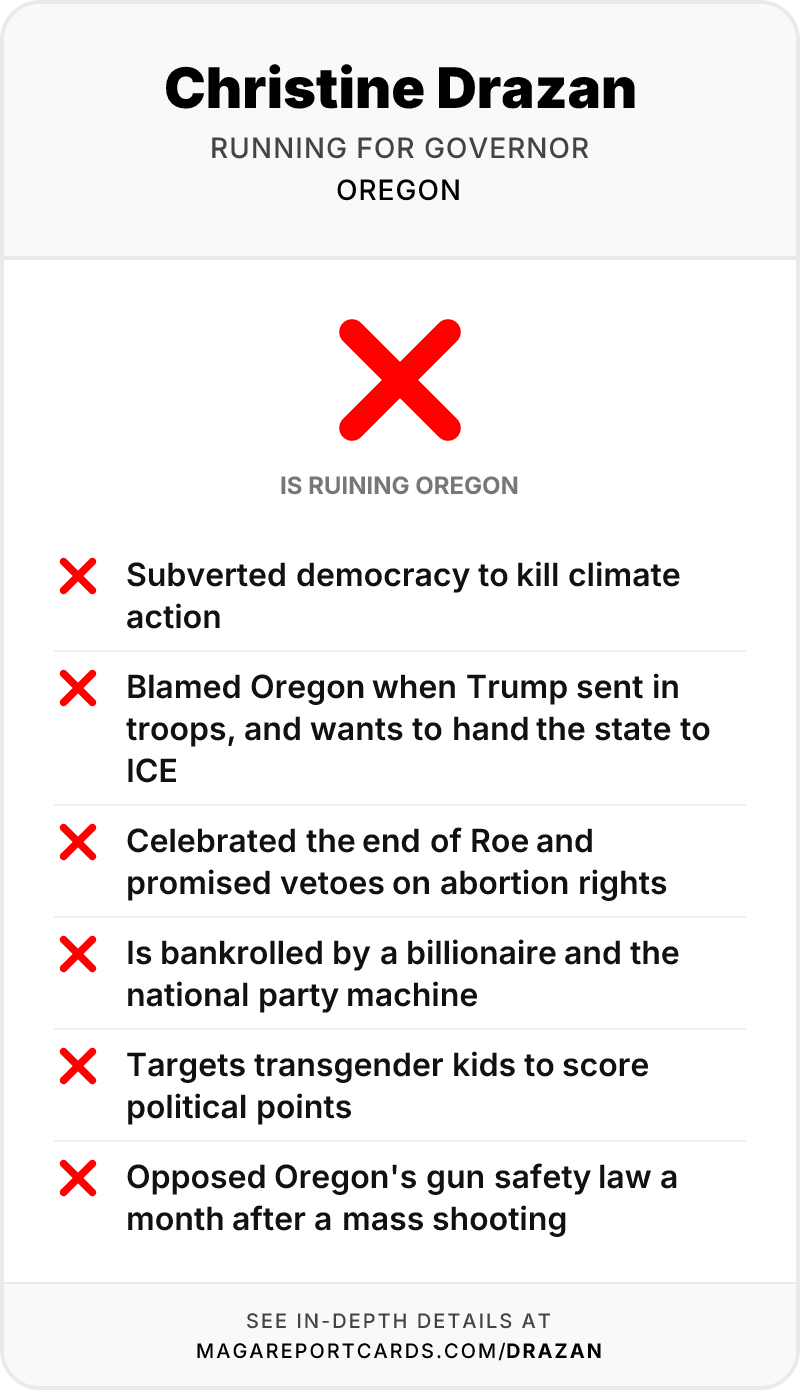
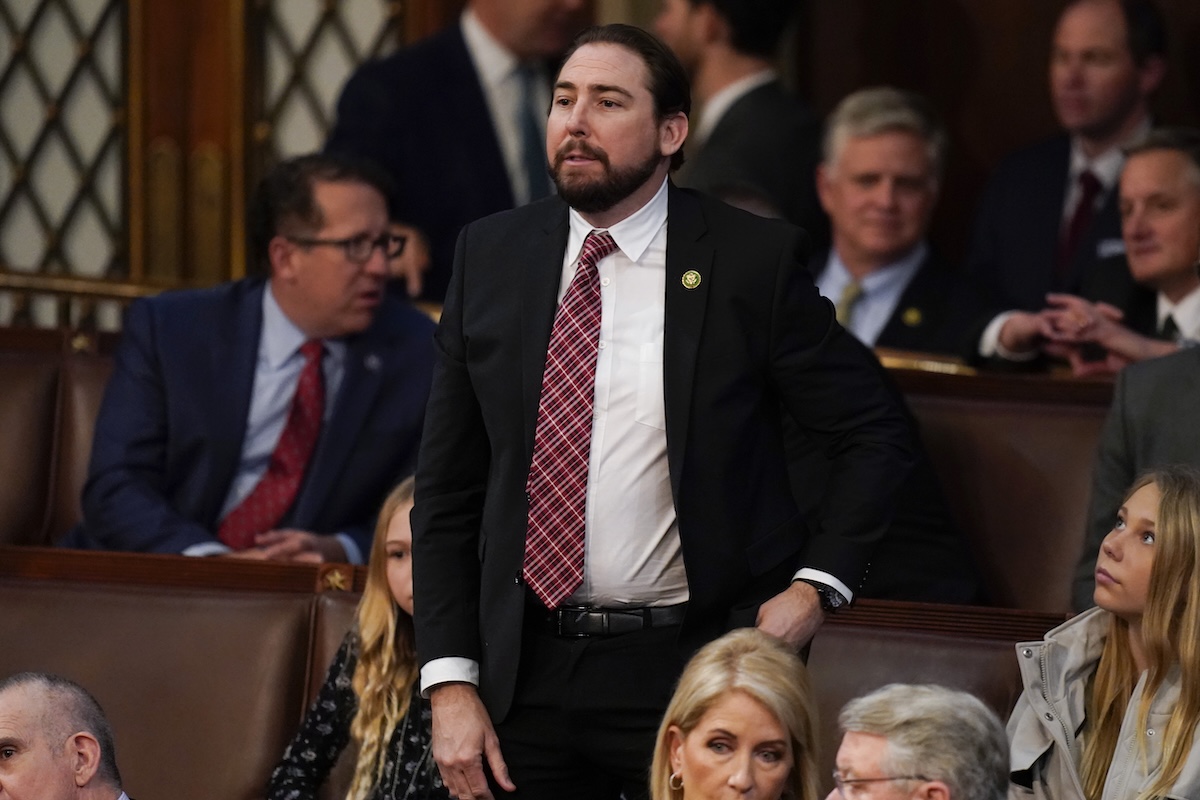
After losing the 2022 race for Oregon governor by fewer than four points, Christine Drazan started a nonprofit.
She said A New Direction would push for "policies and ideas that make Oregon a safer, more affordable place to live and raise a family, strengthen checks and balances, improve transparency, empower Oregonians and support the next generation."
Over the next two years, the group paid $96,000 to a consulting firm owned by Drazan and her husband. It had no conflict of interest policy in either of those years.
That reporting comes from Shaanth Nanguneri at the Oregon Capital Chronicle, working from state business filings and federal tax records. Drazan is now the Republican nominee for governor.
The money
The numbers are specific. A New Direction, based in Wilsonville, made two payments to Drazan Group LLC of Oregon City: $54,000 in 2023 and $42,000 in 2024. Both were described as being for "stakeholder engagement."
State records show Drazan created that LLC in June 2023. That same year, her husband — Portland attorney Daniel Drazan, who is the firm's legal representative — served as president of the nonprofit that was writing the checks.
So: she founded the nonprofit. She and her husband own the company. Her husband ran the nonprofit. The nonprofit paid the company.
The organization's own tax forms didn't hide the relationship — the payments are listed under a section for "interested persons," with the reason given as "married." The board says Daniel Drazan "at no point" voted to approve them.
What was missing
None of this is illegal. Federal law does not bar a nonprofit from paying a business owned by its own insiders, and there's no evidence anyone broke a state or federal law.
But the IRS recommends a specific set of steps precisely so that a group in this position can prove the deal was fair: document a conflict of interest policy, record a board vote on the payments, and get competing cost estimates for comparable services. The point is to avoid excise taxes on "excess benefits" — the penalty for paying an insider more than is "reasonable."
A New Direction's federal tax forms show it had no documented conflict of interest policy in 2023 or 2024. Those are the two years it paid the Drazans' firm.
The Capital Chronicle asked the campaign and the nonprofit for the basic questions any board would be able to answer: who decided to hire the consultant, whether other consultants were considered, how they determined this was the best service at the best price. Neither provided that information. Drazan declined a phone interview through her campaign. Her husband did not return a call or a voicemail.
Susan Gary, professor emerita at the University of Oregon School of Law, was the one who laid out those questions.
"It would be interesting to know the structure of the 501c4. Who are the trustees or directors who are making the decisions about hiring a consultant? Did they consider other consultants to hire? What was the process for determining who would provide the best service for the best price?"
Gary noted that "self-dealing itself isn't necessarily bad," but said Drazan's situation presents a "heightened concern."
David Atkin, senior attorney at the Center for Nonprofit Law in Eugene, put the general principle more bluntly:
"Whenever a nonprofit organization engages in any transactions and decisions that will have a financial impact on its insiders – directors, officers, founders and leaders – or their families and businesses, there is an opportunity for corruption and a kind of insider self-dealing."
The timing tells the story
Here is the detail that reframes everything else.
A New Direction's last social media post with original content went up on March 1, 2024. Four days later, Drazan announced she was returning to state politics to run for the Oregon House. There has been no Instagram post since. The last post on X was in July 2024.
The group's 2025 tax filing explains it this way: "Due to decreased activity in the entity, we didn't have financial resources to pay full time staff."
An organization founded to advance long-term policy goals for Oregon fell silent the week its founder went back into electoral politics.
Kate Titus, executive director of Common Cause Oregon, called A New Direction what it looks like: a "shadow campaign organization." She described a broader pattern of Oregon candidates running a "shell game" of money moving between entities.
"When there's money passing from one entity to another, it raises a question, 'Well, why?' If this is just an extension of your campaign, when you're doing the work of your campaign and you're raising money, why do you need to do that through another entity?"
There's a reason that question matters here specifically. A New Direction is a 501(c)(4) — a "social welfare" group of the kind that exploded after Citizens United, and which critics call dark money because it doesn't have to disclose who funds it.
A campaign has to tell Oregonians who is paying for it. A 501(c)(4) does not.
Who else is in the room
The people around A New Direction are not neutral parties.
Its current board includes Rep. Shelly Boshart Davis, a former treasurer of the nonprofit who is also a chair of Drazan's campaign, and Portland agricultural attorney Tim Bernasek, who is a Drazan campaign donor. Rebecca Wright, Drazan's 2022 deputy campaign manager, signed the 2025 tax filing as the nonprofit's president.
Wright resigned this spring as an aide to former Secretary of Labor Lori Chavez-DeRemer after an inspector general complaint alleged she helped coordinate the secretary's personal travel with professional trips.
The nonprofit's board, its president, its treasurer and a donor are the same people as the campaign's leadership and its donors. That is not a separate organization advancing the public interest. That is a campaign with a different tax status.
The standard she asked to be held to
Oregon holds its elected officials to stricter ethics rules than ordinary residents. Drazan was not an elected official in 2023 or 2024 — she was between offices, which is precisely why the strictest rules didn't apply.
Records from the Oregon Government Ethics Commission show she never asked the commission for advice on any of this. Its current executive director declined to comment, saying she "cannot give an opinion on events that have already occurred."
Titus of Common Cause argued the technical gap is beside the point:
"Our expectations should be that anyone who is elected or is running to be elected, at any given time, doesn't have conflicts, is working in the public interest, and is keeping all of their incentives and the funding and all that completely above board. I think we've lost that expectation in this state."
Drazan's campaign spokesperson, Ashley Quinton, defended her record leading "mission-driven organizations that create lasting change," pointing to her 2011–2018 tenure at the Cultural Advocacy Coalition of Oregon. The A New Direction board said it "followed all applicable IRS rules and regulations" and operated "with complete transparency."
Complete transparency is a strong claim from an organization that wouldn't say who decided to hire the founder's own company, or whether anyone else was ever considered for the job.
Drazan wrote the mission statement herself. It said the group would strengthen checks and balances and improve transparency. Oregonians are entitled to ask why the one place those standards didn't get applied was to her own paycheck.
Sources
- "How Drazan's consulting firm pocketed nearly $100K from her nonprofit with little oversight" — Shaanth Nanguneri, Oregon Capital Chronicle, August 4, 2026
Photo: Laura Tesler / Oregon Capital Chronicle.