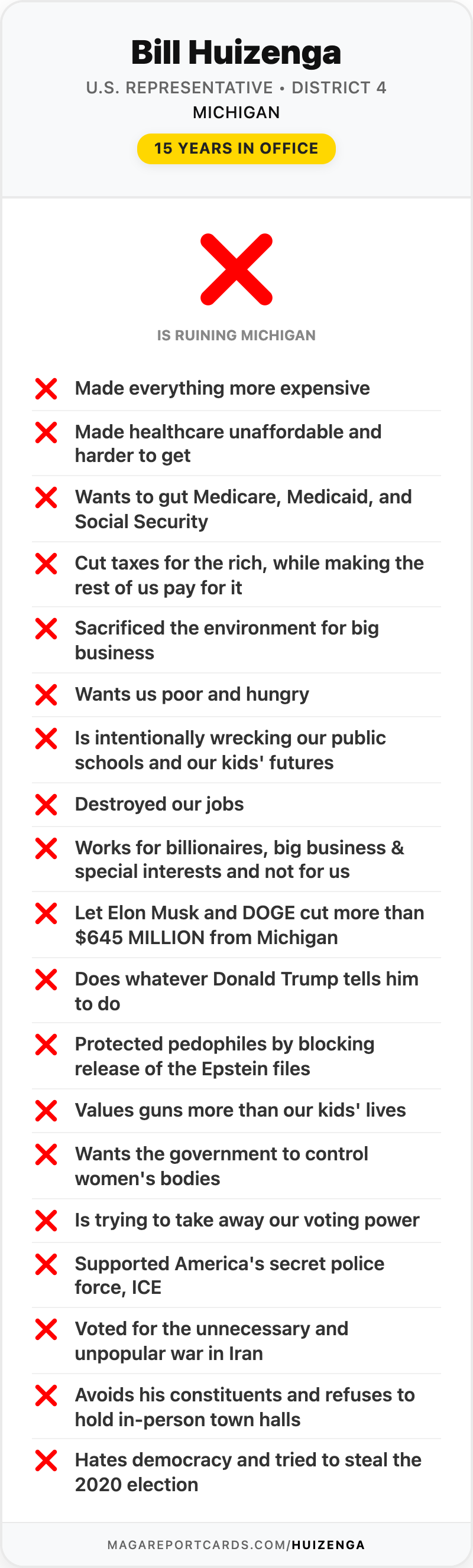
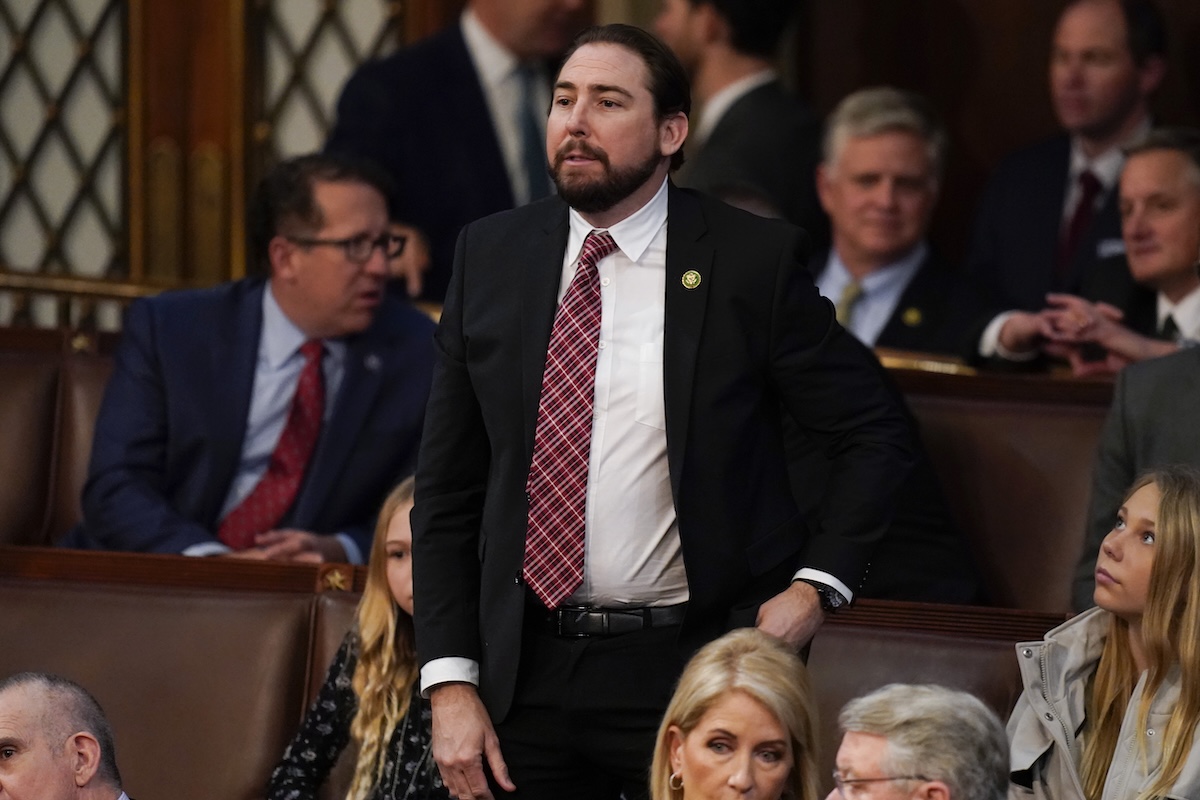
A group called the Alliance for Economic Freedom is spending nearly $1 million on ads praising west Michigan's congressman for backing a ban on congressional stock trading. Its new television ad says Bill Huizenga voted to ban members of Congress from trading stocks.
The vote is real. What the ad leaves out is Huizenga's own record — which includes years of owning individual stocks while sitting on the committee that oversees the stock market, a vote against making members sell the stock they already hold, and a purchase he disclosed to the House 57 days after the deadline.
The Detroit Metro Times went through his financial disclosures and found that they do not match what his campaign says about him.
The vote the ad is about
On July 22, 2026, the House passed the Stop Insider Trading Act, 232 to 198. Huizenga cosponsored it and voted for it.
It is not a ban on members of Congress owning stock. It stops them from buying new individual stocks. Anything they already own, they keep. They can sell it later, as long as they announce the sale somewhere between seven and fourteen days in advance.
That distinction is the whole story, because on the very same day, the House voted on a motion to swap in a version that would have gone further — one that banned members and their families from owning individual stocks at all and required them to sell what they had. Huizenga voted against it. It failed, 211 to 218.
So the honest description of the vote the ad is celebrating is this: he voted for the rule that let him keep his holdings, and against the rule that would have made him sell them.
He also did not sign a bipartisan discharge petition filed in December 2025 that would have forced a vote on legislation banning members from both trading and owning individual stocks. Members of both parties signed it. He did not.
We covered the other half of that July vote separately: Virginia Foxx wrote the rule that welded a national voter ID requirement onto the stock trading ban, so members casting a yes on ethics were also casting a yes on voter ID. Huizenga's spokesman told the Metro Times that 198 Democrats voted against the bill. That is true, and it is also true that the bill they voted against contained a voting restriction that had nothing to do with stocks.
What he said in 2022
Huizenga has not always been for this.
In 2022, when members of both parties were pushing for tougher trading restrictions, he told The Detroit News he had "mixed feelings" about a ban and wanted to be sure Congress was not engaging in "an overreaction." He wondered aloud how members with family businesses or publicly traded investments would comply.
In that same story he said something more specific. He said he had sold off his stock portfolio before he joined the House Financial Services Committee, because he thought it was important to avoid even the appearance of a conflict of interest.
His campaign now says something slightly different — that he stopped buying individual stocks after joining the committee and gradually wound down what he already had. "When Congressman Huizenga joined the House Financial Services Committee, he went above and beyond what was required of him to avoid even the appearance of a conflict of interest," spokesman Calvin Moore said. Moore added that Huizenga "has made zero stock purchases since."
His disclosures are hard to square with either version.
Seven years of stock on the committee
Huizenga joined the Financial Services Committee almost immediately after arriving in Congress in 2011. His own office put out a release in January 2011 noting he was attending his first full committee hearing, and noting that the panel had jurisdiction over "securities and exchanges."
His annual disclosures show he reported owning Johnson Controls stock from 2010 through 2017 — which is to say, through his first seven years on that committee. Depending on the year, the holding was worth somewhere between $1,001 and $50,000. His disclosure covering 2017, filed in August 2018, still listed between $15,001 and $50,000 of it, and reported no transactions that year.
The same filing shows he also still held between $15,001 and $50,000 in Gentex Corp., a Zeeland, Michigan company that makes technology for the auto, aerospace and fire-protection industries. He had reported owning Gentex shares since at least 2010, and the reported value climbed from the $1,001–$15,000 range when he entered Congress into the $15,001–$50,000 range by 2016.
Those holdings overlapped with matters in Washington that touched the company:
- In 2012, while reporting Johnson Controls stock, he led a letter to Treasury Secretary Timothy Geithner raising national security concerns about a Chinese company's proposed purchase of the bankrupt battery maker A123 Systems. Johnson Controls had tried to buy much of A123 itself before losing out to China's Wanxiang Group. His office says he led a bipartisan group of Michigan lawmakers on it.
- In 2017, while still reporting Johnson Controls stock, the company was in federal court challenging a Department of Energy testing rule for central air conditioners and heat pumps.
None of that proves the stock drove the letter. It does mean that for seven years, the man now being advertised as the scourge of congressional stock ownership was a congressional stock owner, on the committee with jurisdiction over securities — and that at least once he took an official action that touched a company he held.
The 2021 purchase, filed 57 days late
Then there is the part that is hardest to reconcile with "zero stock purchases since."
On March 19, 2021, Huizenga filed a Periodic Transaction Report disclosing a December 7, 2020 purchase of between $1,001 and $15,000 in Grey Cloak Tech Inc., a publicly traded company that later renamed itself Healthy Extracts Inc. The form lists it as jointly owned. It does not say who initiated it — but the STOCK Act required him to report it either way.
He reported it late. House ethics rules require members to disclose a qualifying transaction by whichever comes first: 30 days after they learn of it, or 45 days after it happens. His own form says the trade happened December 7 and that he was notified January 29. That put the deadline around January 21. He filed March 19 — roughly 57 days past it.
Huizenga is one of the 45 Republicans on this site who have broken the STOCK Act's disclosure deadlines. The late fee starts at $200, and members can ask the Ethics Committee to waive it.
The 2019 vote almost nobody took
One more item from the record. In 2019, the House passed the Insider Trading Prohibition Act, which would have written a clear definition of insider trading into federal securities law. It passed 410 to 13.
Huizenga was one of the 13 no votes. He had offered an amendment that failed, and said he opposed the final bill because he thought its definition of insider trading was too broad.
That bill was not about members of Congress. But it is a data point about a man whose campaign is now running on the subject.
Why this ad, and why now
Huizenga is in a real race. He is facing Democratic state Sen. Sean McCann in Michigan's 4th District, a seat national Democrats are targeting — the DCCC has put McCann in its Red to Blue program, and the Cook Political Report rates the race Lean Republican.
Asked directly whether Huizenga now supports making members of Congress sell individual stocks they already own, his campaign did not directly answer.
This is a familiar shape. Rob Bresnahan sold up to $130,000 in Medicaid company stock, voted a week later to cut Medicaid, and then took a victory lap on the same July trading-ban vote — a ban that would not have stopped anything he did.
What the filings show
An outside group is spending nearly $1 million praising Bill Huizenga for voting to ban congressional stock trading. He voted for a bill that stops future purchases and lets members keep what they have, voted the same day against the version that would have made them sell, and declined to sign a bipartisan petition to force a vote on a full ban. His own disclosures show Johnson Controls stock through his first seven years on the Financial Services Committee — the panel with jurisdiction over securities — and a stock purchase he reported to the House about 57 days after the deadline, years after his campaign says he stopped buying. His campaign did not directly answer whether he thinks members should have to sell.
Source
Detroit Metro Times, "Ads praise Huizenga for stock-trading ban. His disclosures show years of stock ownership", by Steve Neavling. Photo: official congressional portrait via Wikimedia Commons.