There is a committee in the House of Representatives most people have never heard of, and it decides almost everything.
The Rules Committee doesn't write laws about health care or taxes. It writes the terms on which every other bill reaches the floor: how long members may debate, which amendments they may offer, and — increasingly — what text is simply deemed to have been adopted without anybody voting on it separately.
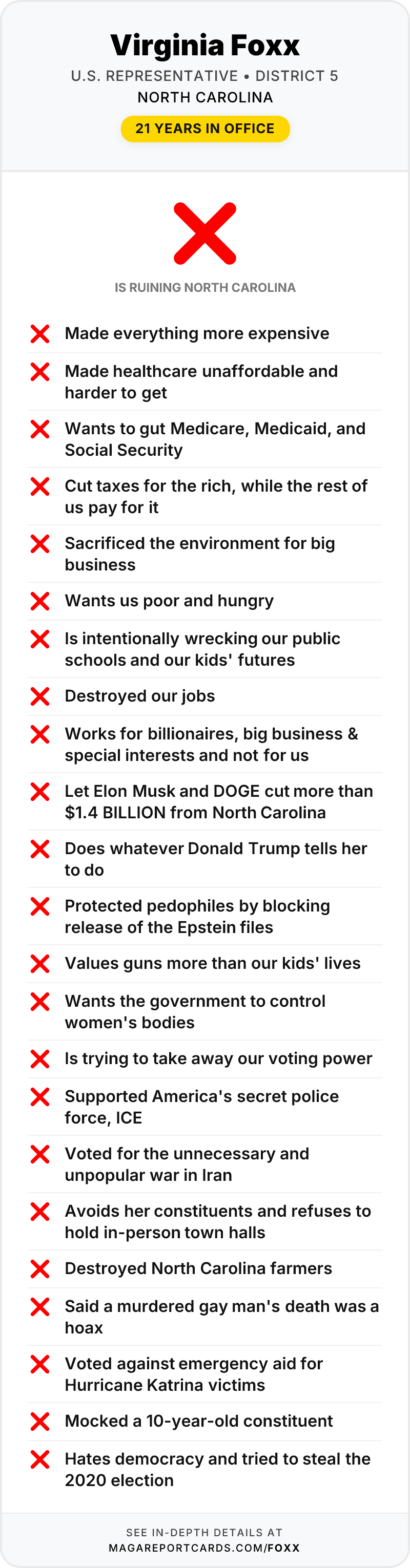
Virginia Foxx chairs that committee. Speaker Mike Johnson gave her the gavel in 2025.
In July 2026, she used it to do something worth understanding, because it explains a lot about how Congress actually works now.
Two bills go into a room. One bill comes out.
Two separate bills had come out of the House Committee on House Administration.
One was the Stop Insider Trading Act, H.R. 7008 — the congressional stock-trading bill, the one members had spent a year promising voters they'd pass.
The other was the Voter ID Act, H.R. 9368 — a bill introduced by Rep. Bryan Steil in June 2026 that would bar election officials from handing a federal ballot to anyone who doesn't present a narrow list of government photo IDs.
They have nothing to do with each other. One is about members of Congress buying stock. The other is about whether you get to vote.
On Monday, July 20, 2026, Foxx's Rules Committee met in H-313 of the Capitol and made them one bill.
The committee's own record for H.R. 7008 lays it out plainly. It produced Rules Committee Print 119-38, described on the committee's page as "Showing the text of H.R. 7008, as reported by the Committee on House Administration with modifications, and H.R. 9368, as reported by the Committee on House Administration with modifications."
Then the rule they wrote — H. Res. 1438 — did three things to that merged text:
- "Closed rule for H.R. 7008." No amendments. Not one. Nobody on the floor could move to strike the voting provisions out of the stock bill.
- The merged text "shall be considered as adopted" — meaning the House never took a separate vote on whether to attach a voter-ID mandate to an ethics bill. It was simply deemed done.
- "Waives all points of order" against the bill, so nobody could even object on procedural grounds.
The Rules Committee approved it by a record vote of 8-4 the same day. And the committee's page names the two members who managed the resolution on the House floor: "MANAGERS: Foxx/McGovern." She didn't just preside over the committee that wrote it. She stood on the floor and argued for it.
The rule passed the House 214-211 on July 21. Foxx voted Aye.
What the merged bill actually does
The next day, July 22, the combined bill passed 232-198. Foxx voted Yes.
Here's the part that matters. The "ban" is not a ban.
The Campaign Legal Center, a nonpartisan group that works on government ethics, wrote to every House member the same day the Rules Committee met, urging a NO vote on both bills. Their objection to the stock half was blunt:
"SITA does not actually ban congressional stock trading... The legislation continues to permit lawmakers to sell stocks they own, subject to a negligible public notice period."
And:
"SITA does nothing to limit lawmakers' ability to use their official actions to benefit the stocks they own, even if no trading occurs. This is because the bill allows members of Congress to keep and continue profiting from their existing assets, rather than requiring divestment or the transfer of their holdings to a qualified blind trust."
So: members can't buy new individual stocks. They keep everything they already own. They can still sell. And the exceptions, the letter says, "swallow the rule" — cryptocurrency, commodities, bonds, and industry-specific exchange-traded funds all stay fair game.
Roll Call reported that Democrats also faulted it for not extending beyond Congress to the president.
A bill that lets you keep what you have, sell what you want, and buy sector funds instead is not a divestment law. It is a press release.
Why the voter ID half kills it
Attaching the Voter ID Act didn't make the package stronger. It made it dead.
Bolting a photo-ID voting mandate onto an ethics bill guaranteed the Senate would stall it. Republicans said so themselves. Texas Republican Chip Roy, who called the underlying measure a "good bill," said, according to Roll Call:
"Obviously, voter ID is attached to it, so I'm not sure what that means for getting it through the Senate. I wish we hadn't done that."
The ranking Democrat on House Administration, Joseph D. Morelle of New York, called the voter ID provision a "poison pill" on the floor and said Republicans had "corrupted their so-called stock-trading bill with a decaying piece of the SAVE America Act corpse."
Foxx's committee is where that pill was inserted, behind a closed rule that made it impossible to remove.
Meanwhile the voting provisions themselves are not minor. The Campaign Legal Center's letter says the Voter ID Act's list of acceptable documents is "unreasonably narrow — and significantly more restrictive than almost every state voter ID law currently in place." It excludes student IDs, employee IDs, and public-assistance IDs. It requires Tribal IDs to carry a photo and an expiration date, which most don't, because Tribal citizenship doesn't expire. And if you show up without qualifying ID, your provisional ballot only counts if you come back within three days — or sign an affidavit that covers exactly one excuse, a religious objection to being photographed.
Citing an analysis by the Institute for Responsive Government, the letter says the requirements would force at least 35 states that already have photo-ID rules to change their election laws, and 14 states plus D.C. to overhaul their procedures entirely — with no money and no time provided, months before the 2026 midterms.
We've written before about how Foxx sells this policy in public. The day before the floor vote on the rule, she and Steil were comparing voting to buying an unlimited-pasta pass at Olive Garden. That pitch was made at the very Rules Committee hearing where the two bills were fused together.
And then there's her portfolio
A member who writes the rule for an ethics bill invites an obvious question: what does the bill do to her?
Foxx's own filings with the Clerk of the House answer it.
Her 2025 annual financial disclosure, signed May 15, 2026, lists holdings in Alliance Resource Partners — a coal producer — valued at $15,001 to $50,000, which paid her between $15,001 and $50,000 in capital gains and partnership distributions that year alone. The same filing lists Energy Transfer, Pembina Pipeline, FLEX LNG, American Electric Power and Duke Energy.
Schedule B of that filing shows she wasn't holding those coal units quietly. She traded them: bought in February 2025, sold part in March, bought again in May, again in August, sold part in September, bought twice more in November.
She kept going into 2026. A periodic transaction report she signed on June 2, 2026 discloses a purchase of Alliance Resource Partners units on May 15, 2026. A second report, signed July 10, discloses a partial sale of those units on June 18, 2026, worth $15,001 to $50,000.
That sale was 34 days before she voted for the bill she'd written the rule for. Under that bill, everything she already owns stays hers, and selling remains permitted.
Foxx has a 0% score from the League of Conservation Voters for 2025 and a 4% lifetime score. She votes the way a coal shareholder would vote. She is, per her own filings, a coal shareholder.
WRAL, which analyzed the North Carolina delegation's trading for its coverage of the July vote, found Foxx's disclosed ranges implied potential 2025 profits of up to $107,000. It also reported that she did not respond to its questions about why she supported the bill or whether she would follow its rules even if it doesn't become law.
None of this is illegal. That's the point. The bill she helped push through the House is designed so that none of it would need to change.
The pattern
Foxx is not the only member who voted for a stock-trading bill that wouldn't have touched their own conduct. Rob Bresnahan took a victory lap on the same vote after dumping Medicaid stock and then voting to cut Medicaid. Blake Moore broke the stock disclosure law more than 70 times in his first six months and paid a $200 fine.
What makes Foxx's case different is the gavel.
Every other member could only vote on the package they were handed. Foxx chairs the committee that decided what was in it, decided nobody could amend it, decided the merger would be "considered as adopted" without a vote of its own — and then went to the floor to manage it.
She has represented North Carolina's 5th District since 2005. She has not held an in-person town hall since 2010, and told Fox News in 2025 that town halls are "just an opportunity for people to yell at their member of Congress."
So there is no room in her schedule to be asked about any of this. There is, apparently, room to trade coal.
We deserve better.
Source
House Committee on Rules, H.R. 7008 – Stop Insider Trading Act (rule text, committee action, and managers), with roll call votes from the Office of the Clerk and financial disclosures from the Clerk of the House. Photo: official congressional portrait via Wikimedia Commons.