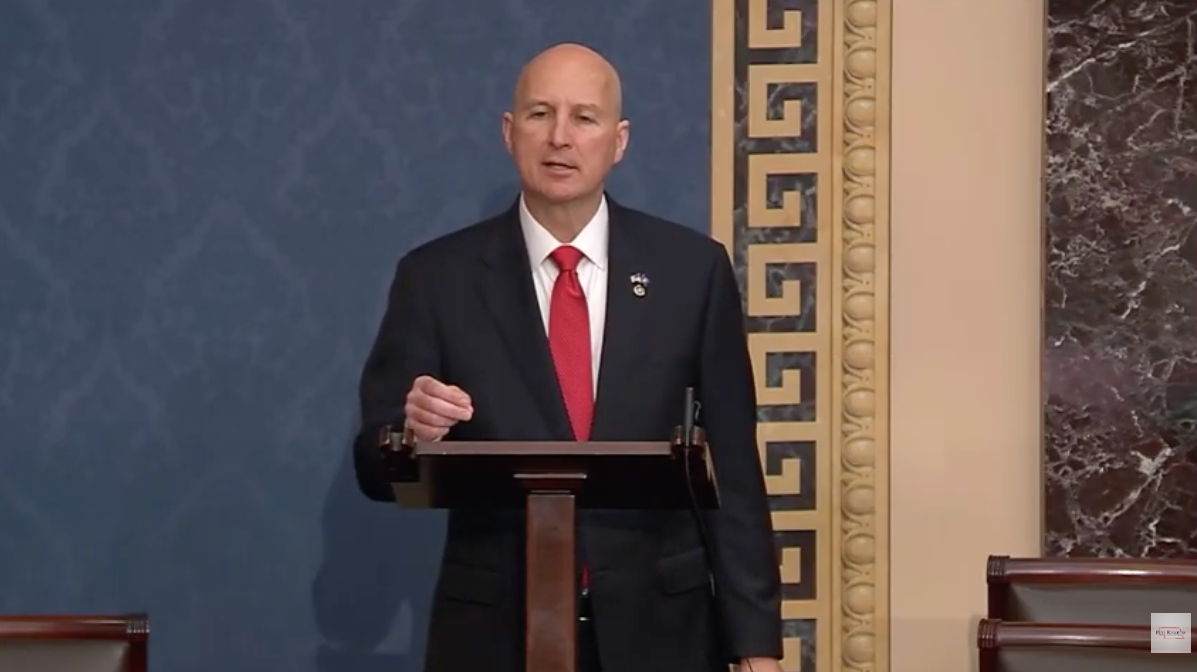
On July 29, 2026, Pete Ricketts stood on the Senate floor and asked his colleagues to pass H.R. 7008 — the House-passed bill that contains the Stop Insider Trading Act — by unanimous consent. No debate, no roll call, just done.
"Clearly Americans are not trusting this institution on this issue," he said, in remarks covered by KLKN. "We have an opportunity to course correct."
He has been at this all year. In March he introduced the Senate companion to a House bill written by Bryan Steil of Wisconsin. He wrote a weekly column about it. He went on CNBC to call it "common sense legislation." And he has a good story to tell with it, because Congress trading stocks on what it learns in closed briefings is a real scandal that both parties have refused to fix for a decade.
So we did the thing nobody does with a bill named after a good idea. We read it.
What the bill actually says
Here is the operative sentence of S. 4134, the Senate companion Ricketts introduced. It is also, word for word, the operative sentence of the House bill he asked the Senate to pass:
"Except as described in subsection (c), no covered individual may purchase a covered investment."
Purchase. That is the whole prohibition. Members of Congress, their spouses and their dependent children may not buy individual stocks while in office.
The bill says nothing about what they already own. There is no divestiture requirement anywhere in the text. A member who walks into the Senate holding $50 million in individual stocks walks back out holding $50 million in individual stocks, and everything those stocks earned in between.
The rest of the bill confirms it. Selling isn't banned — it is permitted, subject to filing a public notice seven to fourteen days beforehand. The one place the bill forces a sale is when a member breaks the rule and buys something they shouldn't have; then they have to unwind that specific purchase. The enforcement section is a fee schedule: $2,000 or 10% of the transaction, whichever is larger, plus any gain.
Two more exclusions matter. Investments held in a trust don't count as "covered investments" at all, so long as the member can't direct the trust's decisions and the trustee isn't an immediate family member. And "excepted investment funds" — diversified funds — are outside the ban entirely.
This is not a hidden loophole. It is the architecture of the bill. It restricts a member's future trading. It does not touch a member's existing wealth.
Which matters quite a lot, if you are Pete Ricketts
Ricketts is a billionaire. His family founded TD Ameritrade. He did not build a stock portfolio on a senator's salary and he does not need to buy anything.
Three days before that floor speech, Quiver Quantitative estimated that Ricketts made $8.6 million in the stock market in a single month — as we wrote at the time, money that arrived passively, while he was doing his job, in an amount that makes his Senate salary a rounding error.
Every dollar of that would be untouched by his own bill. He wasn't buying. He was holding.
That is the gap between what the Stop Insider Trading Act sounds like and what it does. It reads as a ban on lawmakers getting rich off their office. It functions as a ban on lawmakers newly buying individual stocks — which constrains a member who actively trades a modest account far more than it constrains a member who inherited a fortune and simply sits on it.
Ricketts is the second kind. He is leading the Senate push for a rule that regulates the first kind.
There is a version that would reach him
This is not a hypothetical objection or a design nobody thought of. It is the exact line that divides the serious stock-ban bills from the symbolic ones.
Back in July 2024, Josh Hawley, Gary Peters, Jeff Merkley and Jon Ossoff announced a bipartisan agreement on a stock trading bill that did three things Ricketts's does not: it covered the President and Vice President as well as Congress, it barred both buying and selling of covered assets, and it required elected officials, their spouses and their dependent children to divest starting in 2027.
Divest. Sell what you hold. Ricketts had that model available to him and put his name on a different one.
The unanimous consent request that was never going to work
There is a second thing worth knowing about the July 29 speech.
Two days earlier, on the night of July 27, Ashley Moody of Florida had already tried the same maneuver and it had already failed. Alex Padilla of California objected, calling the bill "nothing more than a political gimmick that was never truly intended to become law," and he gave two reasons. The first was that it exempts the President and the Vice President from the trading ban. The second was what else is in it.
The version the House passed on July 22 — by 232 to 198, roll call 280 — did not arrive clean.
Open the House-passed text and Section 3 is titled "Requiring voters to provide photo identification." It rewrites the Help America Vote Act so that an election official "may not provide a ballot for an election for Federal office to an individual who desires to vote in person unless the individual presents to the official a valid physical photo identification."
It reaches mail ballots too. Vote by mail and your ballot cannot be accepted unless you enclose a photocopy of a photo ID, or the last four digits of your Social Security number plus a sworn affidavit that you couldn't get one, or a notary's signature.
That is a national voter ID mandate, bolted onto a financial ethics bill.
You can think voter ID is good policy and still see what happened here. A bill passes by unanimous consent only if literally no senator objects. Attaching a contested, party-line election measure to it guarantees an objection. Ricketts stood up on July 29 and demanded unanimous passage of a bill that had drawn an objection on that same floor 48 hours earlier. Padilla objected again, in the same terms: "This measure contains two giant poison pills."
He got the objection. He also got the clip.
"Public service is a privilege, not a profit center"
That is Ricketts's own line, from the press release announcing the bill in March. He added: "Trust in Congress remains at an all-time low. To fix that, we need to prove we are playing by the same rules as everyone else."
Nebraskans are not playing by the same rules as Pete Ricketts, and his bill would not change that by a dollar.
He is not the only one who found this a comfortable bill to sponsor. We wrote earlier this month about Roger Marshall, who hid his family's pandemic stock trades for 17 months and is now a cosponsor of this same legislation — a bill whose provisions read like a description of what happened in his own household, offered without a word about it.
What Nebraskans should take from this
Ricketts is in a competitive race this fall. He has held one open round of town halls, in April 2025, where constituents in Kearney booed him over DOGE cuts, tariffs and the budget. Since then his most visible act of reform has been a bill that regulates a kind of wealth he does not have and leaves alone the kind he does.
The question to ask him at the State Fair debate isn't whether Congress should stop insider trading. Everyone says yes to that. The question is why the bill he wrote asks nothing of a senator whose portfolio earns more in a month than most Nebraskans will earn in a lifetime.
Source
"Sen. Ricketts asks Senate for unanimous vote on the Stop Insider Trading Act," KLKN-TV, July 31, 2026. Photo via KLKN-TV.