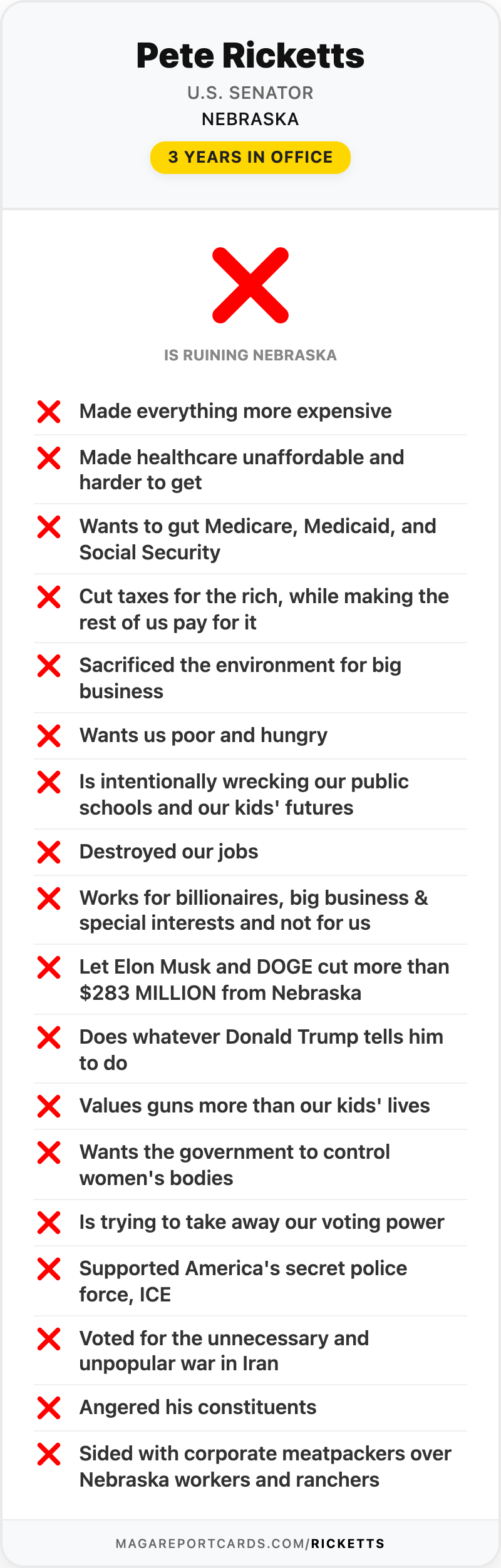
While Nebraskans spent last month watching grocery prices and worrying about their health insurance, their junior senator's portfolio went up by an estimated $8.6 million.
He didn't work for it. He didn't earn it at a job. It's what happens when you already have $128 million in the stock market and the market goes up.
Pete Ricketts is not a normal senator with a normal financial life. According to Quiver Quantitative, which tracks lawmakers' disclosed holdings, he's worth an estimated $215.4 million — the 7th highest net worth in Congress.
A note on the numbers: Quiver's net-worth figures are estimates built from financial disclosures, and the firm says plainly that the data "may be inaccurate or incomplete." The disclosures themselves report holdings in broad ranges, not exact amounts. So treat $8.6 million as an estimate of the scale, not a bank statement. The scale is the point.
He isn't funded by billionaires. He is one.
Most politicians who serve the wealthy at least have the decency to take their money first. Ricketts skipped that step.
He is, in The American Prospect's words, "a literal billionaire, the son of the founder of brokerage firm TD Ameritrade." By Quiver's estimate, only six members of Congress are worth more. When we say he votes for the billionaire class, it isn't a figure of speech — he's voting for himself.
His top contributing organizations — money from the companies' employees, owners and PACs, not corporate checks — look like his portfolio: Union Pacific Corp, Apollo Global Management, Tenaska Energy, Charles Schwab Corp.
And his fundraising tells the same story. Ricketts disclosed $6.0 million raised in the second quarter of 2026 — the 6th largest Q2 haul Quiver tracked this year. Just 7.8% of it came from individual donors.
What he did with that seat
Here's the part that matters for Nebraska.
He voted to let the ACA tax credits expire. In November 2025, Ricketts told KOLN that Republicans would "come back with a plan" of their own. On December 11, he voted against advancing a bill to extend the credits, and they lapsed. Marketplace premium payments rose an average of 58%; many people bought down to higher-deductible plans, and those with the steepest increases dropped coverage at higher rates. The American Prospect's assessment of what his votes meant for his state was blunt: "Nebraska's Billionaire Senator Voted for Hospital Carnage."
He voted himself a tax cut, then wrote a column celebrating it. Ricketts backed the Republican tax law and published a weekly column praising it as "a win for taxpayers." A man worth an estimated $215 million voting for tax cuts tilted toward the very wealthy is not representing Nebraska. He's doing personal financial planning with a Senate vote.
He has a 3% environmental score. The League of Conservation Voters gave Ricketts a 3% score for 2025 and a lifetime score of 2%.
Nebraskans already told him
Give Ricketts this much: unlike a lot of his colleagues, he actually held open town halls in April 2025 — in Kearney, Valentine, and Scottsbluff — bucking GOP leadership's directive to hold them virtually.
It did not go well for him.
At the Kearney town hall, a crowd of about 200 people — in a Republican stronghold — booed him repeatedly. Constituents pressed him on DOGE cuts, tariffs, and the budget, and the crowd turned rowdy. He even told the crowd he had warned Cabinet members about the tariffs: "You're hurting Americans, and specifically Nebraskans, if you don't fix this."
So he heard it directly. Nebraskans told him, to his face, that his agenda was hurting them.
Then he went back to Washington and kept voting the same way.
The gap
That's the whole story, really.
In one month, Pete Ricketts' investments gained an estimated $8.6 million. That happened passively, while he was doing his job — a job whose salary is a rounding error in his finances.
In that same stretch, Nebraskans who buy insurance on the marketplace were absorbing higher premiums because he voted to let their tax credits expire. Nebraska hospitals were absorbing cuts he voted for.
A senator this insulated from the consequences of his own votes has no particular reason to notice them. When the ACA credits lapse, nothing changes at his house. When the tax law passes, quite a lot changes at his house — in his favor.
The bottom line
There's nothing illegal about being rich, and nothing wrong with a senator having investments. The problem is the pattern of decisions.
Ricketts voted to raise health care costs for working Nebraskans. He voted for a tax law that benefits people in his own bracket, then wrote a column calling it a win for taxpayers. He has a 2% lifetime environmental record. His constituents booed him in a Republican stronghold and he didn't change course.
And last month, without lifting a finger, he made an estimated $8.6 million.
He's not out of touch with Nebraska by accident. He's out of touch because nothing he votes for ever reaches him.
Source
Net Worth Update: Senator Pete Ricketts Made an Estimated $8.6M in the Stock Market Last Month, Quiver Quantitative, July 26, 2026.