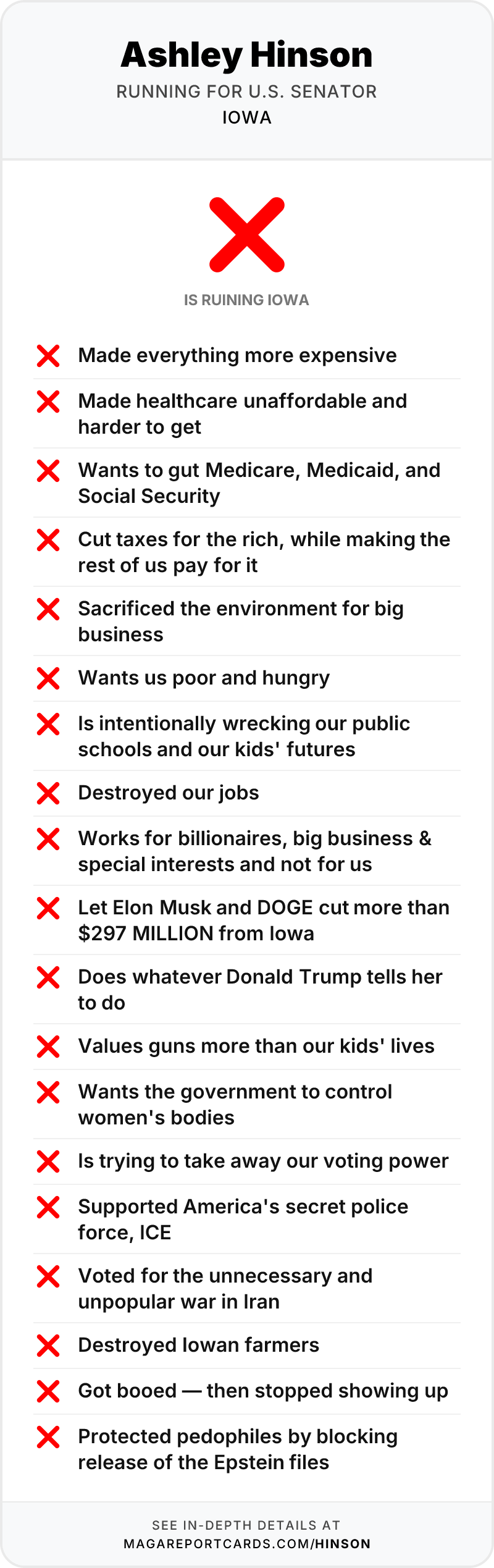
Ashley Hinson is running for Joni Ernst's open Senate seat in Iowa, and her campaign website says she is "laser focused on lowering taxes for working families."
In April 2025, she signed a letter asking the chairman of the House's tax-writing committee to protect a tax break that goes almost entirely to private investment managers.
Mother Jones reported the letter on September 4, along with the money that has followed.
What the tax break does
Private equity managers get paid two ways. They take a fee for managing a fund, and then they take a cut of the profits when the fund's assets are sold. That cut is called "carried interest."
The management fee is taxed like a paycheck. The cut of the profits is not. It is taxed at the lower rate reserved for long-term investments, even though it is compensation for doing a job.
Oscar Valdés Viera of Americans for Financial Reform put it plainly to Mother Jones. If you get a bonus at work, he said, you pay tax on it at the rate for your income. Fund managers should be no different.
The Congressional Budget Office has projected that closing it would raise about $13 billion over ten years.
This is not a partisan question among people who study taxes. Jonathan Choi, a law professor at Washington University in St. Louis, surveyed American tax law professors and got 167 replies. On carried interest, 143 said it should be taxed as ordinary income. Ten said it should not. He calls it "the single policy on which tax professors are most strongly agreed."
It is not much of a partisan question among presidents, either. Obama tried to close it. Biden tried to close it. Trump tried to close it in 2017 and again in 2025 — he once said private equity executives were "getting away with murder."
What Hinson signed
In 2025, Trump signaled again that he wanted it gone. House Ways and Means Chairman Jason Smith said all options were "on the table."
Hinson joined a few dozen other House Republicans in a letter asking Smith to leave it alone.
"We recognize that the issue of carried interest has been heavily politicized and frequently mislabeled as a loophole."
The letter called it "a critical, longstanding investment management tool beneficial to our nation's economy," and warned that closing it would "harm millions of partnerships in real estate, private equity, and venture capital by disincentivizing entrepreneurial risk-taking and investment, potentially jeopardizing jobs in every state and district."
Choi's response to that argument is worth quoting in full, because he does not really disagree with the wording:
"The funny thing is, in some sense, I agree with the letter — it's not a loophole. It's not a loophole anymore because Congress has considered it and decided to leave this terrible policy on the books so many times. At this point, it's intentional malfeasance on the part of Congress."
The letter also argued that America would fall behind other countries if the break went away, and named the United Kingdom. This year the United Kingdom moved carried interest into its income tax system, taxing it as trading profit rather than as an investment gain.
Republicans on the Ways and Means Committee dropped the idea. The break survived.
Who is paying for her Senate campaign
Hinson's race against Democrat Josh Turek is close, and the money behind her is not coming from Iowa.
A hybrid super PAC called Fight On Iowa has raised $1.77 million to boost her. $1.5 million of that came from a single donor: Ken Griffin, the hedge fund billionaire. The second-largest contributor is a California hedge fund manager who gave $100,000. The third-largest individual donor is a banker from Connecticut.
Mother Jones found that none of that $1.77 million came from anyone living in Iowa, and none of it from named individuals outside the financial services industry.
Griffin has also given $10 million to the Senate Leadership Fund, which is running ads for Hinson. He is one of the biggest Republican donors of this cycle, with a reported $40 million spent on the midterms so far — the same donor who put $10 million into a PAC backing Byron Donalds in Florida's governor's race.
Her own donations tell the same story. Democrats have criticized her for taking $30,000 from Apollo Global Management's chief executive Marc Rowan and other Apollo employees — the private equity firm that owns a group of struggling Iowa health care facilities. She took $26,500 from Blackstone co-founder Stephen Schwarzman, who once compared Obama's attempt to close this very loophole to Hitler's invasion of Poland, and later apologized for it.
Across her three previous campaigns, Hinson raised more than $1 million from people and PACs tied to the securities and investment industry.
We have written before about the nearly $90,000 she and her PACs took from billionaires named in the Epstein files, Schwarzman among them — $30,500 of it while she was refusing to sign the petition that would force those files into the open.
The contrast she set up herself
Six months after arriving in Washington, Hinson ran an online video ad asking for grassroots donations. Democrats, she warned, "believe that with their outside money, and their deep-pocketed donors, they can spend their way to a victory."
Her own Senate super PAC has raised $1.77 million and $1.5 million of it came from one hedge fund billionaire who does not live in Iowa.
This is a pattern on her record rather than a single episode. Her first Senate ad promised she would take on big insurance — and her husband, it turned out, had arranged the insurance lobby's meeting with Iowa's House delegation, including her. Her 2025 financial disclosures show he owned between $1 million and $5 million in privately held stock in High Street Insurance Partners, a private equity-backed insurance brokerage.
She has also backed major cuts to the Securities and Exchange Commission, which polices Wall Street, and to the Consumer Financial Protection Bureau, which handles complaints about scams and bad financial products.
What the record shows
Ashley Hinson campaigns on lowering taxes for working families. In April 2025 she signed a letter asking House Republicans to preserve a tax break that lets private investment managers pay the investment rate on money they earn for doing a job — a break the Congressional Budget Office says costs about $13 billion a decade, and that surveyed tax law professors said should be taxed as income by 143 to 10. The committee killed the repeal. A hedge fund billionaire has since put $1.5 million into the super PAC boosting her Senate campaign, which raised that $1.77 million without a dollar from anyone in Iowa.
Source
Ashley Hinson Fought to Save Private Equity's Favorite Loophole, Mother Jones, September 4, 2026.