On July 16, 2026, James Comer introduced a bill to take the District of Columbia's tax code away from the people who live there. Six days later his committee advanced it on a party-line vote.
He said at that markup what it was for. Not a budget crisis, not any particular tax — the next set of people D.C. voters had just elected. The bill, Comer said, "enhances Congress's constitutional oversight authority over D.C. to restrain irresponsible policies pursued by future socialist and ultra-progressive D.C. Democrats." A month before he filed it, D.C. Democrats had picked a democratic socialist, Ward 4 Council member Janeese Lewis George, in a primary she is expected to win in November.
Nine days before he filed it, the D.C. Council had voted to add a 20-cent fee to third-party food deliveries. Twenty cents. Not a tax on income, not a tax on property. Two dimes on a burrito. DoorDash — a company with an $81 billion market capitalization and $14 billion in annual revenue — had fought that fee at the Council and lost, with a petition, social media ads, a commissioned poll and a mobile digital display parked outside the Wilson Building.
So when Comer's bill reached markup, DoorDash wrote in to back it, and Comer entered the company's letter into the official record.
What the Bill Actually Does
Right now, when the D.C. Council changes a tax, the change takes effect after a 30-day window unless Congress votes to stop it. Congress already has a veto. It just has to bother using it.
Comer's bill flips that around. Under H.R. 9720, no tax or fee change in the District could take effect at all unless a joint resolution approving it passed both chambers of Congress within 60 days and was then signed into law by the president. Debate would be capped at one hour per chamber.
Think about what that means in practice. A city government would need the U.S. House and the U.S. Senate to stop what they're doing and hold a vote before it could adjust a parking fee.
D.C. Council Chair Phil Mendelson wrote to Comer to point out the part Comer's own framing leaves out: the bill applies to decreases as well as increases. It would, Mendelson wrote, "straightjacket the District because it would paralyze our tax code," and would "also freeze our General License Law." He warned it would likely trigger a downgrade of the District's bond rating.
At-Large Councilmember Robert White put it more plainly:
"It would let a Congress that can't even keep its own government open decide whether D.C. can fund its own police, schools, and services. … It's a veto over our own city … We've balanced our budget more than 30 years running. We've earned the right to run our own city."
The bill was also opposed by AFSCME, which said it "endangers public services in D.C.," and by the League of Women Voters, which called it "the latest in a long line of attacks on DC's democracy and the stability of its finances."
The Oversight Committee reported it out 23–18 on July 22.
The Company That Wrote In to Back It
Comer framed the bill, on the day he filed it and again at the markup, as a fight against ideology:
"Radical D.C. Democrats want to solve their spending problem by reaching deeper into taxpayers' pockets and driving further on the path to socialism."
But the loudest voice on the bill's side isn't a taxpayer. It's a corporation with a delivery-fee problem.
DoorDash's head of North American policy, John Horton, sent Comer a letter on July 22 backing H.R. 9720 — and Comer entered it into the committee record. Horton's letter described the bill as requiring congressional approval "before the District of Columbia can impose or increase a tax or fee."
That description leaves out the half that Mendelson flagged in his own letter to Comer. The bill reaches everything in title 47 of the D.C. Code — taxation, licensing, permits, assessments, and fees — in both directions. A tax cut would need the same act of Congress as a tax hike.
Horton is a lobbyist. Before DoorDash, he lobbied for the vaping company Juul and for Lyft, after working on Capitol Hill for a House committee chairman.
Residents noticed. The group Free DC launched a campaign asking people to delete the DoorDash app and post screenshots of their cancellations. Horton, in a statement to WUSA9, said DoorDash supports D.C. Home Rule — while his letter backing a bill to override home rule sat in the committee record.
Comer Helped Blow the Hole He Says D.C. Should Have Fixed by Cutting
Here is the part that makes this more than a bad bill.
Comer's argument is that D.C. has "a spending problem" and, as he told the Washington Times the day he filed the bill, that "the D.C. Council has rejected necessary spending reforms and is instead now considering tax increases that would punish residents, burden businesses, and further weaken the District's economy." The District does have a budget hole of more than a billion dollars. But the reason it opened up is not a mystery, and Comer had a hand in it.
D.C. lost about 22,356 net federal jobs in 2025, jobs that carried $3.66 billion in annual pay, according to federal personnel data reviewed by WTOP. Federal workers make up roughly a quarter of D.C.'s workforce, against about 1.4 percent nationally. The city's chief financial officer projected D.C. would lose more than $1 billion in revenue compared with earlier estimates, and forecast a mild recession in the District.
Those cuts were DOGE. And Comer wasn't a bystander to DOGE — he was its partner in Congress. As Oversight chairman he told his committee in February 2025:
He created a subcommittee dedicated to working with DOGE — the one that later spent a hearing on the exhibit labels at a Smithsonian museum — and in June 2025 his committee held a hearing titled "Locking in the DOGE Cuts: Ending Waste, Fraud, and Abuse for Good."
Mayor Muriel Bowser made the connection when the committee advanced Comer's bill. The D.C. Taxing Authority Review Act, she said, "would render the District incapable of recovering from the debilitating impacts of COVID, federal remote work and DOGE."
That's the sequence. Help cut tens of thousands of federal jobs out of a city's tax base. Watch its revenue fall. Then introduce a bill to stop it from replacing the revenue, and call the shortfall a spending problem.
Nobody He's Regulating Can Vote Against Him
The residents whose tax code this bill would freeze have no vote in the House or the Senate. That's the whole point of the D.C. House Voting Rights Act, a bill that would have given D.C. a voting House member — it passed the House in 2007 and the Senate in 2009 and still never became law.
So there is no accountability loop here at all. Comer represents Kentucky's 1st District. If D.C. residents think this bill is an outrage, there is nothing they can do about it at the ballot box, and Comer knows it.
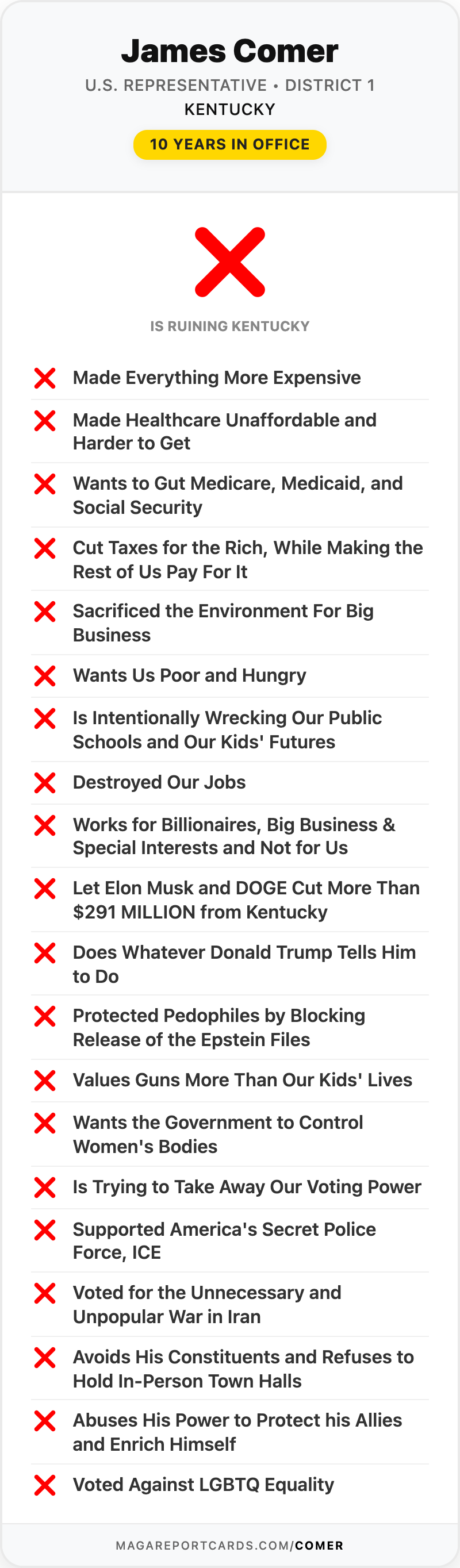
Compare that to how he treats the constituents who can vote against him. When Kentuckians in his district organized a town hall in July 2025 and reached out to his office eight times looking for a date, Comer neither attended nor sent a staffer. When protesters showed up outside his Paducah office in chicken suits asking him to face voters, his spokesperson said he "does not plan on holding therapy sessions for left-wing activists suffering from Trump Derangement Syndrome."
He won't hold a public meeting in Paducah. He will hold a markup on Paducah's behalf about a fee on burritos in Washington.
What It Costs Us
It is easy to file this under "D.C. problem" if you don't live there. It isn't one.
The precedent is the point. A city government's power to set its own taxes and fees becomes something Congress hands back one vote at a time. The bill would not even undo the 20-cent fee — it applies only to acts D.C. sends to Congress after it becomes law. It reaches every tax and fee that comes after.
And look at who turned up for it. A corporation with $14 billion in revenue lost a 20-cent argument at a city council, and two weeks later was writing to a congressional committee to endorse taking that council's taxing power away. It did not have to ask anyone for the bill. The bill was already there.
Comer chairs the committee that is supposed to guard the public against exactly that kind of influence. He put the company's letter in the record.
Source
Washington City Paper, "House Committee Advances the D.C. Taxing Authority Review Act" (July 23, 2026); Hill Heat, "DoorDash Declares War on DC Home Rule Over A 20-Cent Fee" (July 22, 2026); The Washington Times, "Comer moves to give Congress veto power over D.C. tax hikes" — Mary McCue Bell, July 16, 2026; and NOTUS, "House Committee Advances Bill Limiting D.C.'s Ability to Raise Taxes" and "That Food Delivery Is Soon Going To Cost You a Little More in D.C." — Martin Austermuhle, July 22 and July 8, 2026. Bill text: H.R. 9720.