Here is the setup, and it's worth getting the order of events right.
Congressional Republicans passed a budget bill that cut federal health care funding. California, like every state, has to figure out what to do about the hole that leaves. A union — the Service Employees International Union-United Healthcare Workers West — is pushing a ballot measure called the Billionaire Tax Act for this November. It would charge California's 200-plus billionaires a one-time 5% tax on their net worth, and use the money to backfill those cuts for middle-class and low-income Californians.
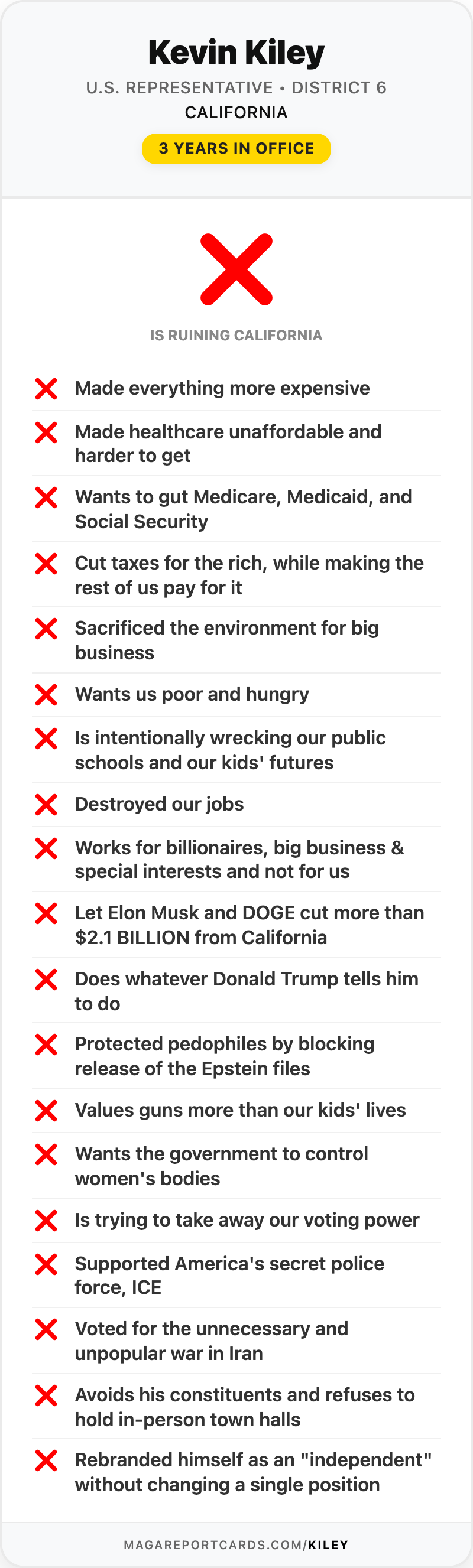
Kevin Kiley voted for the budget bill that made the hole. Now he has written federal legislation to stop California from filling it.
The bill, and why he says he wrote it
Kiley's measure is called the "Keep Jobs in California Act of 2026." It would prohibit any state from levying taxes retroactively on people who no longer live there — which is the mechanism the Billionaire Tax Act relies on to keep billionaires from simply moving out before the vote: it applies to billionaires who were California residents as of January 1, 2026.
He was direct about what prompted it. He said he drafted the bill in reaction to reports that several of California's most prominent billionaires — including Meta CEO Mark Zuckerberg and Google co-founders Larry Page and Sergey Brin — are planning to leave the state ahead of the tax.
His argument:
"California's proposed wealth tax is an unprecedented attempt to chase down people who have already left as a result of the state's poor policies. Many of our state's leading job creators are leaving preemptively."
And on the House floor:
"A wealth tax is not merely the taxation of earned income, it is the confiscation of assets."
Call that what you want, but be clear about who it protects. The one-time 5% tax applies to people with a billion dollars. There is no version of this bill that helps a nurse in Roseville or a rancher in Alpine County. It exists so that a specific, named group of the richest people on Earth can leave California without paying it.
"Confiscation of assets"
That phrase does a lot of work, so let's look at it.
Kiley did not use the word "confiscation" about the Trump budget bill he voted for — the one that, according to the Congressional Budget Office and independent analysts, is projected to leave millions more people without health coverage. Losing your Medicaid coverage is also, in a real sense, having something taken from you. It just isn't a yacht.
The emergency arrived with reports that three billionaires might move.
He wrote it as a Republican, and the independence didn't change it
Kiley is the only independent in the House. He introduced this bill on February 20, 2026, as a Republican. Two and a half weeks later he dropped the "R" after redistricting made his seat harder, told NPR he wasn't changing any of his positions, and got his three committee assignments back from Republican chairs a month later — including the Judiciary Committee, where this bill was sent.
The label changed. A bill written for Mark Zuckerberg is still his.
Who is paying for the campaign
You don't have to guess at whose interests Kiley is representing. It's in the filings.
More than $600,000 has been spent on his behalf by super PACs, which face no limit on what they can spend. According to FEC-derived data, only 17% of his money came from small grassroots donors, while 70% came from PACs, super PACs, and large donors. Among the outside spenders:
- Morning in America PAC spent $96,000 supporting him — a super PAC funded almost entirely by $5 million from Las Vegas billionaire Robert Bigelow.
- A super PAC calling itself "A Strong Innovation Economy Requires Strong IP Protection" spent $241,649 on his behalf, funded entirely by the Council for Innovation Promotion, the patent lobby.
- Americans for Prosperity Action — the Koch network's super PAC — spent $182,471.
- Google's NETPAC gave to him directly, while he sits on the Judiciary Committee that writes the rules for tech platforms.
That last one deserves a second read. Kiley wrote a bill triggered by reports that Google's two co-founders might leave California, and Google's political action committee is among his donors, and he sits on the committee that regulates Google.
And the billionaires are not sitting this out. The Los Angeles Times reported, citing a disclosure reviewed by the New York Times, that Sergey Brin is donating $20 million to a California political drive to defeat the wealth tax. Kiley's bill and Brin's $20 million are aimed at the same target from two directions.
What California is actually deciding
The Billionaire Tax Act may pass or fail in November. Reasonable people disagree about wealth taxes — Sen. Bernie Sanders held a rally for it, Gov. Gavin Newsom has opposed it, and it has split California Democrats.
That argument belongs to California voters. Kiley's bill is an attempt to take it away from them — to use federal law to block the ballot measure's key element before anyone gets to vote on it.
For a congressman who has since rebranded himself as the guy who works "for the country, not one political party or the other," it's a revealing bill to keep standing behind: helping three of the richest men in the world get out the door before the bill for his own vote comes due.
We deserve better.
Source
"Rep. Kevin Kiley measure would block key element of proposed California wealth tax," Los Angeles Times, February 18, 2026.