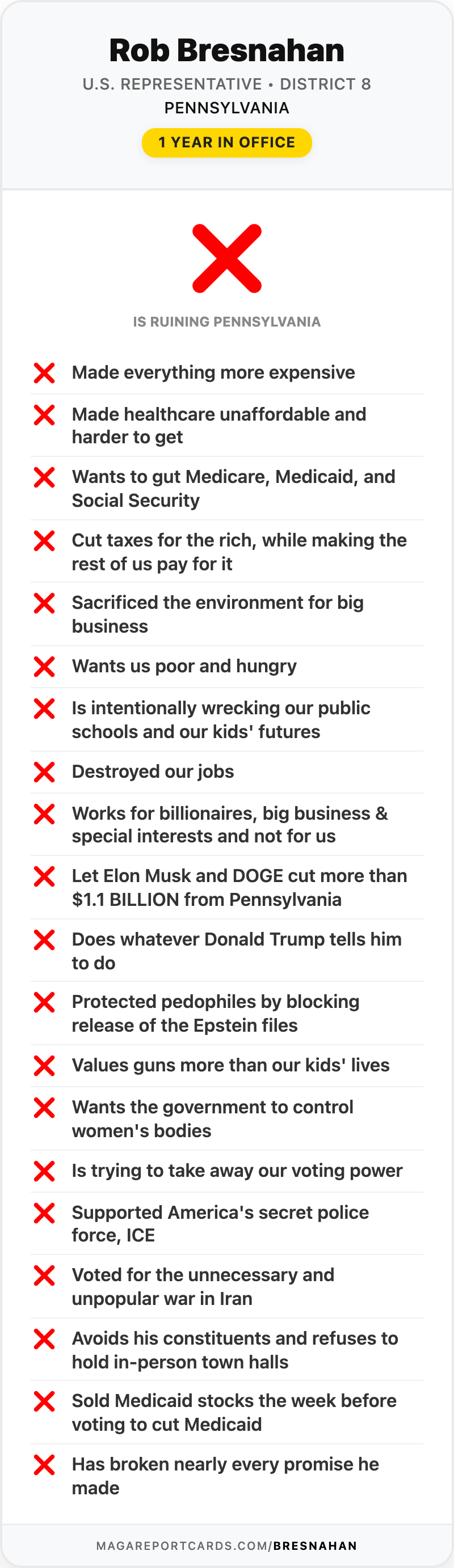
Back in March, Scranton Mayor Paige Cognetti went on The Contrarian and made a blunt accusation about the congressman she's running against: he is "clearly trading on his votes."
That's a serious charge. So we checked it — not against her word, but against the disclosure forms, the roll calls, and the reporting.
It holds up. And what Rob Bresnahan has done since is arguably worse than the trades themselves.
He ran against this exact thing
Bresnahan didn't stumble into this issue. He campaigned on it. In a March 2021 op-ed in a local paper, he wrote that if elected he would co-sponsor legislation to ban stock trading in Congress.
"Some of the most prolific traders in the country serve in Congress," Bresnahan wrote. "Whether or not they have done something wrong, the idea that we can buy and sell stocks while voting on legislation that will have a direct impact on these companies is wrong and needs to come to an end immediately."
On the 2024 campaign trail he went further, calling it "sickening" that politicians make big money while in office.
Then he got to Washington and started trading. A lot.
By June 2025 — five months into the job — Business Insider had counted more than 530 trades. By the end of the year he'd made almost 650 individual stock trades. Capitol Trades, which tracks lawmaker disclosures, now logs 653 trades across 320 different issuers, totaling $8.51 million — the issuers including municipal bonds and Treasury notes alongside the stocks.
Last November, NBC News noted he still ranked as the seventh-biggest trader in all of Congress by number of trades, according to the same tracker. In his first year. As a freshman.
The nine days in May
Here's the part that should stop you.
On May 6, 2025, Bresnahan introduced his own bill to ban congressional stock trading and announced he was moving his holdings into a blind trust. "I have never traded my own stocks, but I want to guarantee accountability to my constituents," he said in a press release that day. "I want the people I represent to trust that I am in Congress to serve them, and them alone."
That same month, he disclosed about 100 stock trades — roughly three a day, in the very month he introduced the ban.
On May 15, 2025 — nine days later — he sold up to $130,000 worth of stock in Centene, Elevance Health, UnitedHealth and CVS Health. Those four companies, NBC News reported, oversee roughly half of all Medicaid managed care organizations in the country.
On May 22, 2025 — seven days after that — he voted for Trump's budget bill, which cut Medicaid by nearly $1 trillion.
He sold the Medicaid companies. Then he voted to gut Medicaid. In between: one week.
And the blind trust? Business Insider found that 40 trades worth at least $166,000 were made after the May 6 announcement, and his spokeswoman said in June it was still "in the process" of being finalized. By November he was telling NBC News that the blind trust process, generally, is "not suited for the realities of today."
That same mid-May window, he was also buying. A purchase of Lockheed Martin stock was reported on May 15, John Bowden wrote for The Independent — about a month before Israel and the United States began striking Iran. Lockheed is a major defense partner of the Israeli government.
Buy the bombs, sell the health care.
It wasn't a one-off pattern, either. He also bought stock in Credo Technology, a data center supplier, while advocating for data centers on Capitol Hill — an issue Cognetti calls a big one in Northeastern Pennsylvania right now, cutting across party lines.
"I do not have any dialogues with my financial advisers"
Bresnahan's defense has always been that none of this is him. His office said flatly that he "does not trade his own stocks" and that "all stock trades are and have been made by a financial advisor without his involvement, and he does not know what is traded or when." He told NBC News he "never instructed my financial advisors on what to buy, sell, or hold."
About two months after that spring radio appearance, he said: "the trades that are being executed on my behalf, I do not have any dialogues with my financial advisors."
Then the tape showed up.
In March 2026, audio surfaced from The Bob Cordaro Show on WILK-AM in Wilkes-Barre, recorded the previous spring, in which Bresnahan said something rather different:
"I mean, I meet with my financial advisor. We talk about, you know, what different positions are coming up."
Both things cannot be true. Jim Greenwood — a Republican who represented Pennsylvania in Congress for more than a decade — called on him to resign, saying Bresnahan's "own admission that he discusses his stock positions with his financial adviser is a red line that should never be crossed by a public official and a clear abuse of power."
Bresnahan's campaign spokesman said the congressman had been "referring to 30,000-foot investment strategy and not about stock trades," and compared it to "a routine annual 401(k) meeting." Cognetti called the audio "sickening."
This is the same pattern we've seen from him before. He told voters he'd never back a bill that "guts the benefits my neighbors rely on," then voted for one. He sells himself as a blue-collar guy from Northeastern Pennsylvania while flying his own helicopter and chartering $23,000 private jets.
Then the trading just... stopped
Something changed in 2026.
After a year of headlines and an opponent hammering him at every stop, Bresnahan's stock trading went to zero. NOTUS reported in May that he had disclosed no individual stock trades at all this year — just four municipal and state bonds and government securities. Capitol Trades tells the same story: his most recent filings are a school district bond, the Pennsylvania Turnpike, the City of Philadelphia, a Treasury note.
His spokeswoman wouldn't say what prompted the change, or whether Bresnahan told the advisor to stop. Which is its own kind of answer. If he genuinely had no say in any of it — if he didn't even know what was traded or when — how did it stop the moment it became a campaign liability?
Craig Holman, a government affairs lobbyist at Public Citizen, read it the same way. Bresnahan's about-face, he told NOTUS, amounts to an admission: "It clearly is an issue that could be a political liability for Congressman Bresnahan, which he recognizes, and has now taken a position supporting a ban on stock trading activity. It's a recognition that there is a problem."
The victory lap
On July 22, 2026, the House passed the Stop Insider Trading Act 232–198. Bresnahan voted yes. The next day he put out a statement taking credit, saying members of Congress "should never be allowed to trade their own stocks and profit off the information they are entrusted with."
Case closed, apparently.
Except look at what that bill actually does. Per CNBC, it bars members from buying individual stocks — but it does not make them sell what they already own, and it lets them keep selling as long as they announce it seven days ahead. It exempts the president and vice president entirely. And House Republicans bolted a set of strict new voter ID rules onto it — which is why the overwhelming majority of Democrats voted no.
Now apply that bill to Bresnahan's own record. The thing he is most criticized for is selling Medicaid stocks a week before voting to cut Medicaid. Under this "ban," that sale would still be legal. He'd just have to post a notice a week beforehand.
Rep. Seth Magaziner, who has pushed for a genuine ban, put it plainly: "I'm very disappointed in it. It's a stock trading ban that still allows stock trading. It's a weak bill."
Before final passage, Democrats moved to send the bill back to committee. Bresnahan voted no. That motion failed 211–218 — by seven votes.
What it actually cost his district
While Bresnahan was moving money around, his constituents were losing coverage. An estimated 26,242 people in Pennsylvania's 8th District are projected to lose health insurance from the Republican cuts to Medicaid and the Affordable Care Act — 20,242 of them off Medicaid, the other 6,000 off ACA coverage. His own office had counted more than 200,000 Medicaid recipients living in the district.
Cognetti described what that looks like on the ground: a Meals on Wheels subsidy in Scranton dropping from $6 to $4 a meal, and a hospital in rural Wayne County announcing it could no longer sustain its trauma unit.
NOTUS put the contrast bluntly: Bresnahan is a multimillionaire — median net worth north of $34 million — representing one of Pennsylvania's poorest congressional districts.
He isn't the only Pennsylvania Republican with a portfolio problem — Dan Meuser's family bought SpaceX stock while he chairs the subcommittee that oversees the SEC. But Bresnahan is the one who ran on cleaning it up.
And it may cost him. He beat Democratic Rep. Matt Cartwright by about 6,000 votes in 2024, and the Cook Political Report now rates the race a toss-up.
The bottom line
There is no evidence Bresnahan personally placed these trades, and he denies it. But that defense got a lot harder to make once audio surfaced of him describing conversations with his advisor about "what different positions are coming up."
Here is what isn't in dispute. He called this practice wrong and promised to end it. He then became the seventh-most active trader in Congress. He announced a blind trust, kept trading through it, dumped Medicaid stock nine days later, and voted to cut Medicaid a week after that. He stopped only when it started costing him politically. And he is now claiming credit for a ban that wouldn't have touched the trade everyone is angry about.
That's not reform. That's closing the barn door and asking for a medal.
Source
This post is based on Paige Cognetti's interview with Jen Rubin on The Contrarian, March 19, 2026, with the underlying claims verified against reporting by NBC News, NOTUS, Business Insider, PoliticsPA, The Independent and CNBC, and against the official House roll calls.