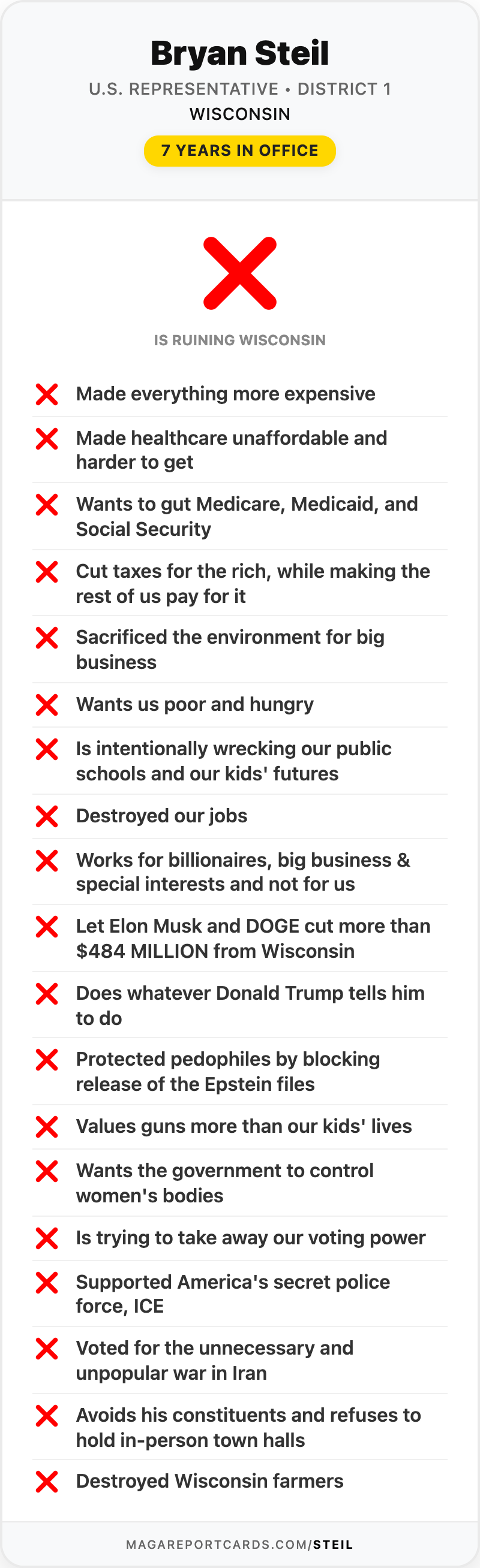
On July 22, the U.S. House passed a bill with a clever trick built into it. On the outside, it looked like a crackdown on members of Congress trading stocks — something almost everyone wants. On the inside, it carried a set of new voter ID rules that critics say would make it harder for millions of Americans to vote.
The man who bolted those two things together is Bryan Steil, the Republican congressman from Wisconsin's 1st District who chairs the committee that oversees federal elections.
The bill passed 232–198. Every Republican voted yes, along with 13 Democrats and independent Kevin Kiley. Steil now gets to go home and say he voted to ban congressional stock trading — while hoping nobody reads the fine print.
The "stock trading ban" that isn't one
Let's start with the part Steil wants you to see. His bill, the Stop Insider Trading Act, says members of Congress and their families can't buy certain stocks and have to wait before selling.
But Democrats say it's full of holes. A Democratic amendment to swap in a tougher, more comprehensive ban failed. Rep. Pramila Jayapal called Steil's version a "so-called stock trading ban that literally does nothing of the sort." — a bill that "lets Members of Congress hold onto existing stocks and act on legislative matters that directly increase the value of those stocks."
The Congressional Black Caucus said the bill "would allow Members of Congress to continue owning, selling, and, in some cases, purchasing individual stocks" — while making it harder for regular people to vote. In other words: a weak leash for the powerful, a tighter one for the rest of us.
What the voter ID rules actually do
The real payload is the voter ID section. Here's what it would do:
- Cut the list of acceptable IDs. You'd need a state driver's license or ID, a passport, a military or veteran ID, or a tribal ID. Not much else counts.
- Bar student IDs. College IDs would not be accepted — even in Wisconsin, where state law currently lets students use them.
- Squeeze mail voting. To vote absentee, you'd have to attach a photocopy of your ID to your ballot — or, failing that, the last four digits of your Social Security number plus a sworn statement that you couldn't get a copy, or a notarized statement that you marked the ballot yourself. House Democratic Whip Katherine Clark said this "would functionally eviscerate mail voting."
- Drop help paying for IDs. Republicans removed a provision that would have covered voters' costs of getting the required ID. So the ID is mandatory — but you're on your own to pay for it.
Democrats also faulted the bill for going further than the voter ID laws in Florida and Wisconsin, which are already considered among the strictest in the country.
Steil's excuse for blocking student votes
The most telling moment came at the House Rules Committee on Monday, July 20. Rep. Joe Neguse asked Steil why his bill bans student IDs when Wisconsin — the state Steil represents — already lets students use them under one of the nation's strictest ID laws.
Neguse pointed out that Steil's own constituents at colleges and universities across his district vote right now using their student IDs. "But their congressman is championing a bill that would tell them that they can no longer do that," Neguse said.
Steil's answer? He claimed universities "issue IDs to noncitizens" and "issue IDs to illegal immigrants."
That's the whole game. Instead of defending why a real American student shouldn't be able to vote with a real university ID, Steil reached for immigrants. The people who lose their vote under his rule aren't noncitizens — they're students, older voters, and people who vote by mail, many of them his own constituents.
Part of a bigger push
This bill didn't come out of nowhere. It's part of President Trump's drive to take federal control of elections. His preferred bill — the SAVE America Act — would go even further, demanding passports or birth certificates just to register. Senate Majority Leader John Thune has admitted there aren't enough votes to pass it.
So Steil's version is the workaround: take the popular idea (banning congressional stock trading), water it down, and use it as a wrapper to smuggle voter suppression through the House. House Speaker Mike Johnson even bragged that "probably in excess of 9 out of 10 Americans support both measures" — betting that the popular half will carry the unpopular half across the finish line.
The bill now faces long odds in the Senate, where 60 votes are needed. But the House Republicans who passed it — led by Bryan Steil — have told us exactly what they think elections should look like: fewer people voting, and the well-connected still trading.
Source
This post is based on reporting by Ashley Murray for the Arizona Mirror, with the vote recorded at Roll Call 280 and additional reporting from CBS News and Roll Call.