Should members of Congress be allowed to buy and sell stocks while they write the laws that move those stocks up and down? Most Americans say no. 86% of Americans want a ban.
So on September 30, the Senate voted on whether to take up a bill called the Stop Insider Trading Act. The vote failed, 53 to 47. It needed 60 votes to move forward.
Every Republican voted yes, and every Democrat and both independents voted no. So Republicans are now telling everyone that Democrats love insider trading.
That isn't the whole story. Republicans built this bill to fail.
Trick #1: The "ban" doesn't make anyone sell
Here is what the bill actually does, according to Roll Call:
- Members of Congress and their families can't buy new stocks.
- But they can keep every stock they already own.
- And they can keep selling those stocks. They just have to give notice 7 to 14 days ahead.
- If they break the rules, the fine is $2,000 or 10% of the trade, whichever is bigger.
So a senator sitting on millions of dollars in stock gets to keep all of it, and keeps deciding when to sell. The bill also doesn't cover the president, vice president or cabinet at all.
Even Republican Sen. Josh Hawley, who has his own tougher bill, said this one was "not nearly as robust as I would like."
Trick #2: A voter ID law was glued to it
When the House passed this bill in July, Republican Rep. Bryan Steil attached a strict voter ID law to it. That part has nothing to do with stocks. Here is what it would do, according to the Arizona Mirror:
- Fewer kinds of ID would count. You'd need a driver's license or state ID, a passport, a military ID or a tribal ID.
- College student IDs would not count.
- Voting by mail gets harder. You'd have to mail a copy of your ID with your ballot. If you can't, you'd have to fill out extra sworn papers instead.
- No help paying for an ID. Republicans took out the part that would have helped voters pay for one.
Senate Democrats have blocked this kind of voter ID law every time it has come up. Republicans knew that. Putting it in the stock bill meant Democrats had to pick: vote yes on a law that makes voting harder, or vote no on a stock ban.
Democratic leader Chuck Schumer said the bill was "as ineffective as a screen door on a submarine" and "would make voting more difficult in every state than it is now."
A Republican said the quiet part out loud
You don't have to take the Democrats' word for it. Republican Rep. Thomas Massie of Kentucky posted on X the day the House passed it in July that Republicans added the voter ID part to get Democrats to vote against the stock trading ban, "so they can use it in the Nov. election." He called the whole thing "political theater cooked up by 25-year-old staffers."
Massie also said a plain stock ban, with nothing else attached, could have passed with lots of votes from both parties.
Republicans run the Senate. They could have held a vote on a clean ban any day they wanted. They didn't. Majority Leader John Thune said Democrats "can't take yes for an answer." But Republicans are the ones who made sure the bill came with a catch.
The Republicans on this site who voted to advance the package
All 15 of these senators voted yes on moving it forward. Several of them have stock trading problems of their own, which a real ban would actually touch:
- Alabama — Tommy Tuberville, who was late reporting about 130 stock trades, including trades in the Chinese tech giant Alibaba
- Alaska — Dan Sullivan, who sold up to $100,000 of his family's stock after private COVID briefings, two weeks before it fell by a third
- Arkansas — Tom Cotton
- Florida — Ashley Moody, who wants voter ID on everything
- Idaho — Jim Risch
- Kansas — Roger Marshall, who hid his family's pandemic stock trades for 17 months
- Maine — Susan Collins, who helped write the law that makes members report their trades, then failed to report up to $395,000 in trades
- Mississippi — Cindy Hyde-Smith
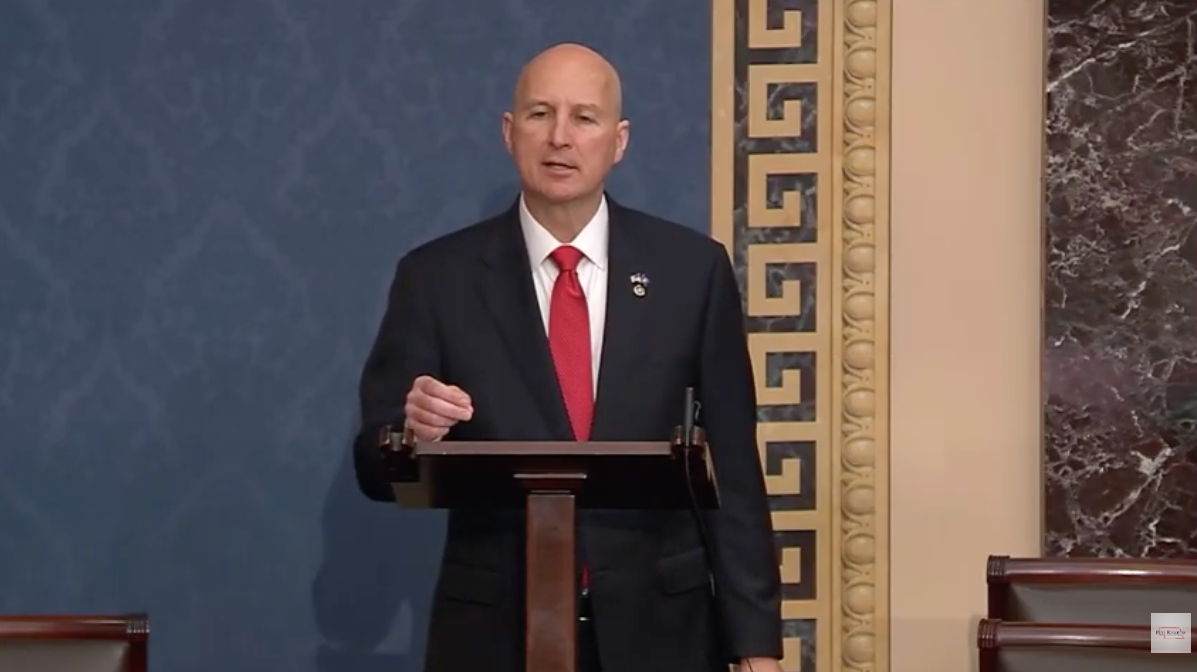
- Nebraska — Pete Ricketts, who stood on the Senate floor and demanded this bill pass, and whose stocks went up an estimated $8.6 million in one month. Under this bill, he wouldn't have to sell any of it
- Ohio — Jon Husted, whose wife owned Intel stock while he pushed Washington to put billions into Intel
- South Carolina — Darline Graham
- South Dakota — Mike Rounds
- Tennessee — Bill Hagerty and Marsha Blackburn
- West Virginia — Shelley Moore Capito
Hagerty, Rounds, Tuberville, Sullivan, Marshall and Collins are all on our list of Republicans who broke the stock trading reporting law.
If these senators really wanted to stop Congress from trading stocks, they could bring up a clean ban tomorrow. Instead they voted to advance one that lets them keep their stocks and was built to fail.
How they voted
- The official vote: Senate Roll Call Vote 253, September 30, 2026
- Roll Call: Lawmakers' stock trading bill falls short in Senate
- Latin Times: Senate Democrats Blocked a Bill Banning Congressional Stock Trading — Why Republicans Counted on That
- Arizona Mirror: House passes GOP bill tying new voter ID rules to congressional stock trading restrictions