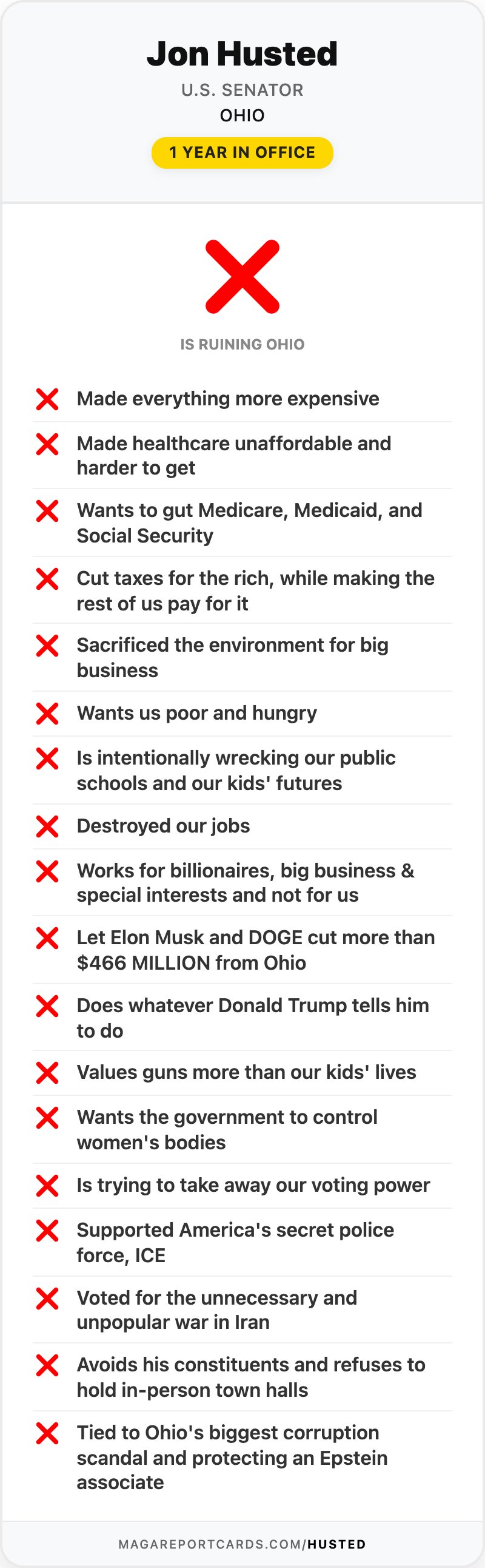
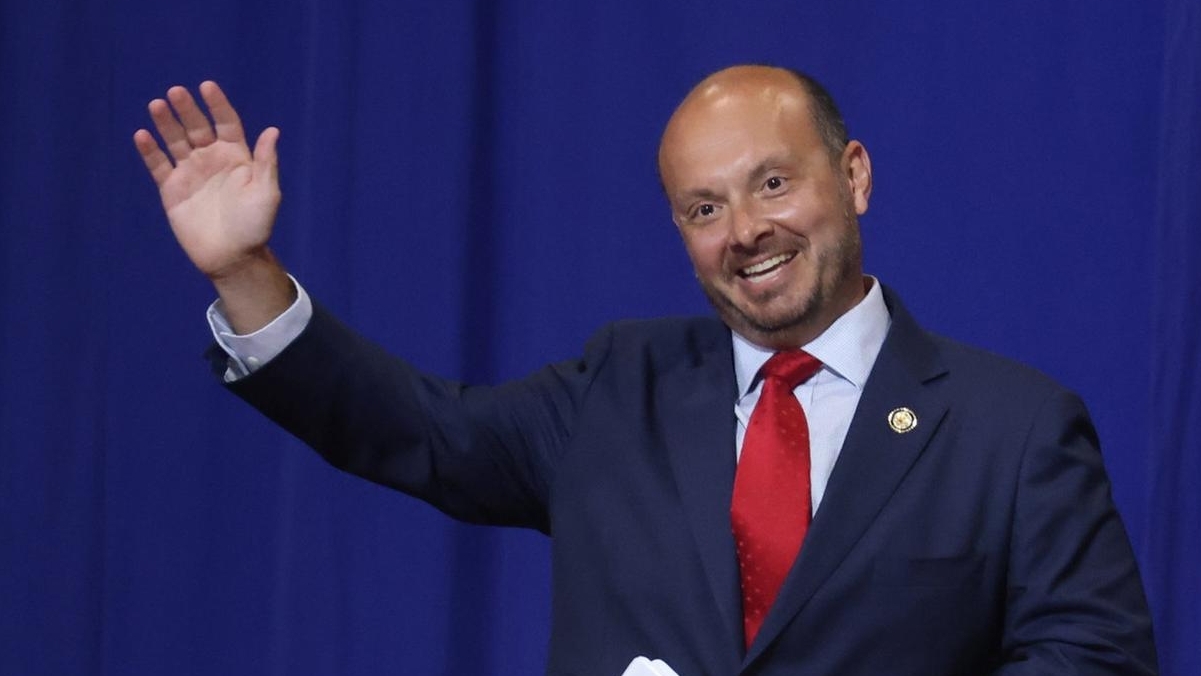
Jon Husted is Ohio's junior U.S. Senator. He was not elected to the job. Governor Mike DeWine appointed him at the start of 2025 to fill the seat JD Vance left when he became vice president.
On Friday, August 28, 2026, the Ohio Capital Journal reported something Husted has never volunteered: while he was working to rescue Intel's troubled factory outside Columbus, his wife owned as much as $15,000 of Intel stock.
His office was asked about it. His office did not answer.
What the disclosures show
Husted's Senate filings show that as of January 21, 2025 — the day he was sworn in — his wife owned up to $15,000 in Intel common stock. His most recent financial disclosure, covering all of 2025, shows the same holding.
That is the entire period in which he was pushing the company's Ohio project forward.
Husted says he personally lobbied the Trump administration to put federal money into Intel. In August 2025, the government took a roughly 10% stake in the company, buying 433.3 million shares for about $8.9 billion. Critics said Washington was picking winners and losers. Intel's stock went up.
Husted's reaction, to The Columbus Dispatch, was not the reaction of a bystander:
"It's foundational. It's a big deal. It's the perfect relationship. And they had no relationship before. It's something I've been working on and hoping for for some time."
Three times he knew first
The Ohio Capital Journal found three occasions where Husted was privy to Intel developments before they were public, and where the news moved the stock his family owned.
- August 2025. The federal government announced its stake. Intel shares rose 6%. Husted said he had been working on it.
- May 2026. Husted told the Dispatch he had discussed a preliminary chipmaking deal between Intel and Apple. Intel would not confirm it. After Trump posted about the deal, the stock rose 10%.
- July 2026. Husted told the Dispatch that Intel had informed him of a possible partnership with the South Korean firm SK Hynix. Shares jumped nearly 9% when the news broke — even though SK Hynix denied there was a deal.
Nobody has shown that Husted's family traded on any of it. That is not the point. The point is that a sitting senator's household held a position in a company that was calling him with market-moving news, and he saw nothing worth fixing about that.
The lobbyist who paid him
The Intel connection does not stop at the stock.
Josh Rubin signed on as a lobbyist for Intel in 2022 — the same year DeWine and Husted announced the Ohio plant. That year Rubin and his wife gave nearly $15,000 to Husted's state political committee. The year before, they gave at least $20,000. Rubin has given $60,000 to DeWine's committee over the years, according to the watchdog group Transparency USA.
In September 2023, DeWine appointed Rubin — an active Intel lobbyist — to chair the board of JobsOhio.
JobsOhio is the state's private economic development arm. It is funded by the state liquor business, which Ohio leases to it for far less than it is worth. It has handed out more than $2 billion. It is exempt from most of Ohio's ethics and transparency laws. And it gave Intel more than $27 million.
Lobbying records show Rubin was registered to lobby JobsOhio for Intel — the agency whose board he ran — until the end of 2025. JobsOhio would not say whether he ever declared a conflict or stepped back from a funding decision. Intel declined to say how much it paid him. Rubin did not respond. DeWine's press secretary said there was no conflict.
Husted was Ohio's second-ranking executive for all of this. The state gave Intel more than $600 million.
Catherine Turcer of Common Cause Ohio put the problem plainly to the Ohio Capital Journal: "The problem has to do with how very cozy everything is." When you own stock in a company, she said, "it's very hard to look just at economic policy."
The project Ohioans were sold
The reason any of this matters to people who do not own Intel shares is what Ohio bought.
The plant was announced in 2022 as a $20 billion investment that would bring chipmaking back to America. The state pledged $2 billion in incentives. JobsOhio pledged $150 million more.
Then Intel delayed construction at the start of 2024, citing weak chip sales. In July 2025 the company laid off 24,000 people worldwide, walked away from two European projects, and pushed Ohio back again. The factory was supposed to be making chips by the beginning of this year. The earliest it will now make anything is 2030.
Ohioans are still on the hook for the incentives. Husted's family was on the upside of the stock.
The ban he won't take a position on
There is a straightforward fix for this, and Congress has been circling it for years: ban members and their families from trading individual stocks.
Bipartisan bills to do exactly that were filed in both chambers last year. One passed the House this summer — but only after Republicans welded an unrelated photo-ID voting mandate onto it, which cost it Democratic support. We wrote about who built that trap: Virginia Foxx's Rules Committee wrote the closed rule that fused the voter ID mandate to the stock ban and barred every amendment.
In February, Husted would not take a position on a trading ban, Columbus television station WCMH reported. His office did not answer the Ohio Capital Journal's question about it either.
Husted is not the only Republican with a stock problem. John James of Michigan reported his wife's purchase of SpaceX stock the day it went public while sitting on the committee that oversees the agency regulating Starlink.
Nor is Intel the only industry money question around him this summer. His campaign has taken $69,750 from the tech and utility companies at the center of Ohio's data center fight — the same fight over who pays for the electricity those companies use.
What the filings show
Jon Husted's wife held as much as $15,000 in Intel stock through the entire period in which he pushed Washington to put about $9 billion into the company and was told in advance about three developments that each sent Intel's share price up between 6% and 10%. Intel's own lobbyist and his wife had given Husted's state political committee nearly $15,000 in 2022, the year the plant was announced, and at least $20,000 the year before. The Ohio he helped run gave Intel more than $600 million and JobsOhio gave it another $27 million, for a factory that will not make a chip until 2030 at the earliest. Asked whether members of Congress should be allowed to trade individual stocks, his office said nothing.
Source
Marty Schladen, Ohio Capital Journal: "As he worked to advance the Intel project, an Ohio senator's wife was invested in it" (August 28, 2026). Photo by Graham Stokes for the Ohio Capital Journal.