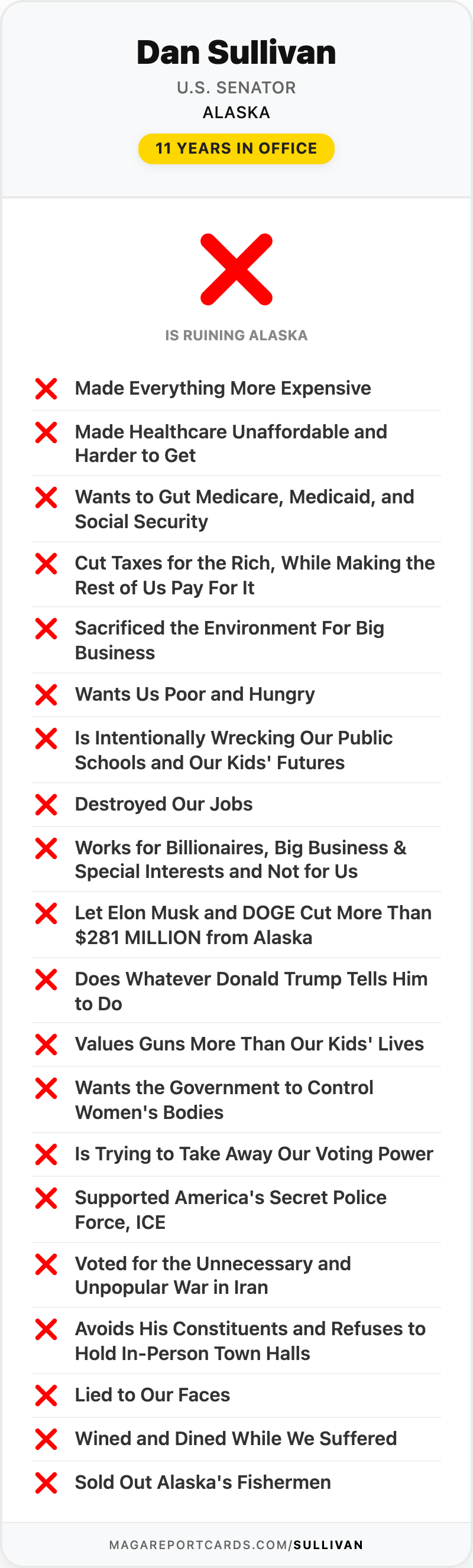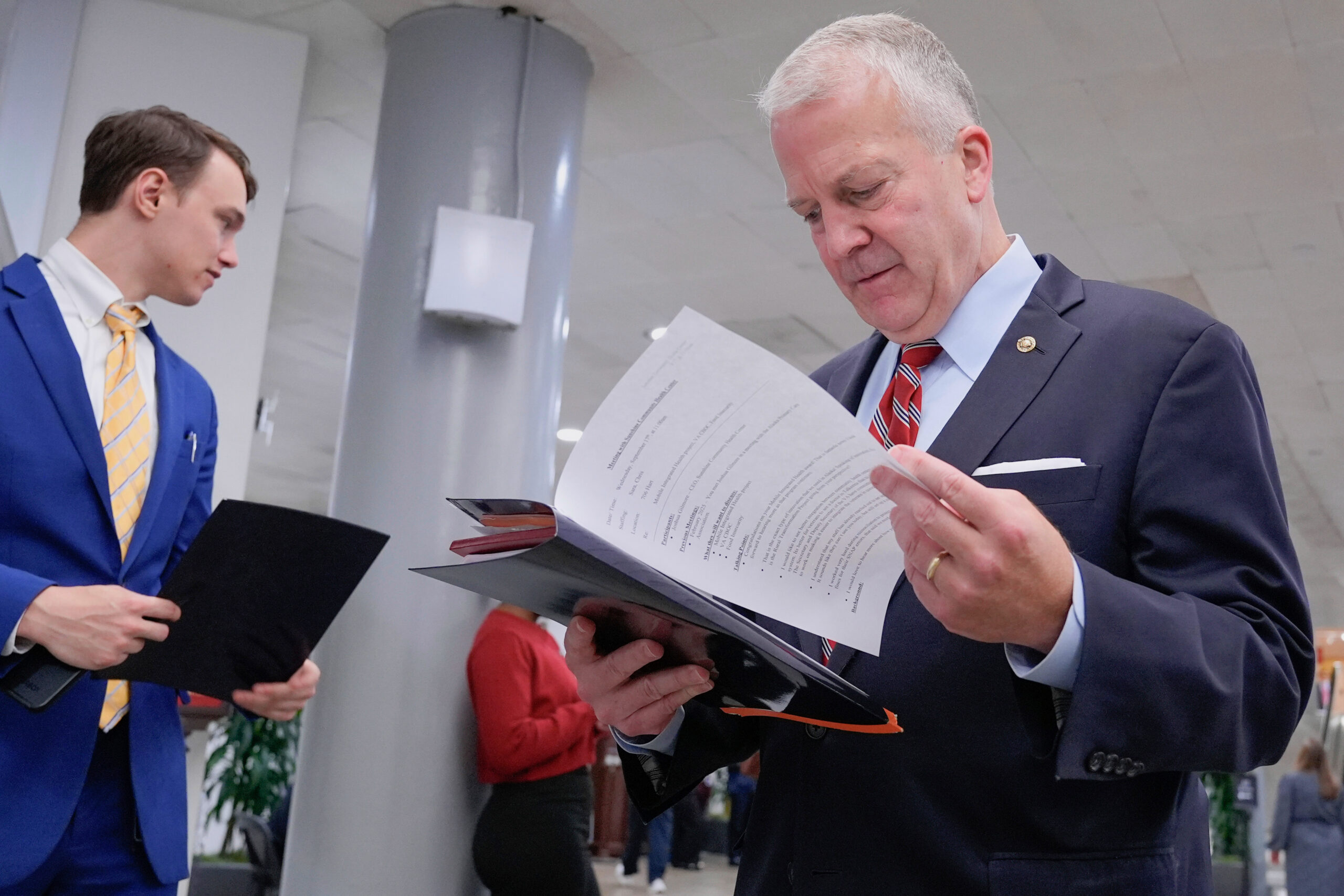
In early 2020, before most Americans understood what was coming, U.S. senators were getting closed-door briefings from federal health officials about COVID-19. Dan Sullivan was in those briefings. On social media, he was telling Alaskans not to panic and pointing the blame at China.
On February 27, 2020, he sold up to $100,000 in stock.
About two weeks later, the pandemic shut down the global economy and that stock — RPM International, the multi-billion-dollar chemical company his family owns — fell by roughly a third.
That is one of four suspiciously timed trades identified in a new review of Sullivan's Senate financial disclosures by The Alaska Current.
Four sales, four convenient moments
Here is what the disclosure records show, according to that review:
- February 27, 2020 — sold up to $100,000 in RPM stock, after meeting with Centers for Disease Control and Prevention officials about COVID-19 preparedness, and at a time when RPM itself was publicly signaling steadiness or growth. The crash came about two weeks later.
- September 25, 2018 — sold up to $15,000 in RPM shares one week before the company released weaker-than-expected earnings that pushed the stock down.
- November 30, 2022 — sold up to $50,000 in RPM stock one month before the company reported "tepid" earnings, sending the price down about 6%.
- March and May 2018 — two RPM sales that were not officially reported until late July 2018, well past the 45-day deadline the law allows.
Sullivan has sold roughly $800,000 worth of RPM stock during his time in the Senate. He still holds up to $5 million of it.
The 2020 briefings were not a secret scandal that only he had
Sullivan was not alone. In April 2020 the Campaign Legal Center reviewed congressional stock trading in the weeks before the crash and counted at least 227 Senate transactions, worth up to $98.3 million, by 12 senators. Sullivan is one of the 12 named in its table, with two transactions ranging up to $200,000. CLC accused none of them of insider trading — it wrote that these transactions "have not been tied to allegations of insider trading," unlike Richard Burr's — and argued that the volume of it was the problem on its own.
What the Campaign Legal Center's report did not capture is the part that makes his case worse than most: the stock he was selling was his own family's company.
RPM International was founded by Sullivan's grandfather. It is run today by his brother, Frank C. Sullivan, as chairman and CEO. We've written before about what else that company has done — RPM paid nearly $61 million in 2013 to settle charges that it cheated the federal government, and kept winning federal contracts anyway, while Sullivan profited the whole time.
So the man selling ahead of the crash was not an ordinary investor reading the news. He was a sitting senator, in closed-door briefings from federal health officials, holding up to $5 million of stock in a company his brother runs.
He was already caught once, and used the same excuse twice
Sullivan was publicly identified in 2022 as having violated the STOCK Act — the 2012 transparency law that requires members of Congress to report their trades within 45 days, so the public can see them while they still matter.
His explanation then was that his stock managers hadn't told him about the trades in time.
The new review shows he had used that same excuse before. The March and May 2018 RPM sales weren't reported until late July 2018, and in a comment attached to one of those late filings Sullivan again said his stock managers didn't notify him until after the deadline had passed.
Two sets of late filings, four years apart, same explanation. The law does not have an exception for that. Members of Congress are responsible for their own disclosures — that is the entire design. He is not the only one who has tested it: Susan Collins helped write the STOCK Act and then failed to report up to $395,000 in trades, and Sheri Biggs was months late on more than 170 trades worth up to $13.6 million.
The rest of Alaska's delegation doesn't do this
The comparison inside his own state is the sharpest part of the record.
Over the past decade, Sullivan is the busiest stock trader in Alaska's congressional delegation — an estimated $2 million in trades while in office. Republican Rep. Nick Begich, in his first term, has reported up to $550,000 in transactions, including up to a $500,000 investment in a venture capital fund.
Sen. Lisa Murkowski, former Rep. Mary Peltola, and the late Rep. Don Young all reported no trades at all while in office.
Sullivan's own assets, meanwhile, have grown to a disclosed range of $4.1 million to $12.3 million. Federal disclosure forms let filers report ranges instead of exact numbers, which is why every figure here is a "up to."
His business dealings are now a central issue in his re-election. Peltola, who finished seven points ahead of him in Alaska's open Senate primary, is running an ad whose line is that "Dan Sullivan is really good at looking out for Dan Sullivan."
What the filings show
Dan Sullivan's Senate disclosures record four well-timed sales of stock in the company his brother runs — including up to $100,000 unloaded on February 27, 2020, after closed-door COVID-19 briefings and about two weeks before that stock fell by roughly a third. Two more sales landed just ahead of disappointing earnings reports. Two others were filed months late, and when he was caught he blamed his stock managers, the same explanation he gave when he was caught again in 2022. He has traded an estimated $2 million while in office. Three of the four other Alaskans who have held those seats over the same period traded nothing.
Source
Matt Acuña Buxton, Dan Sullivan's time in the US Senate has been marked by well-timed stock trades, The Alaska Current, August 27, 2026.