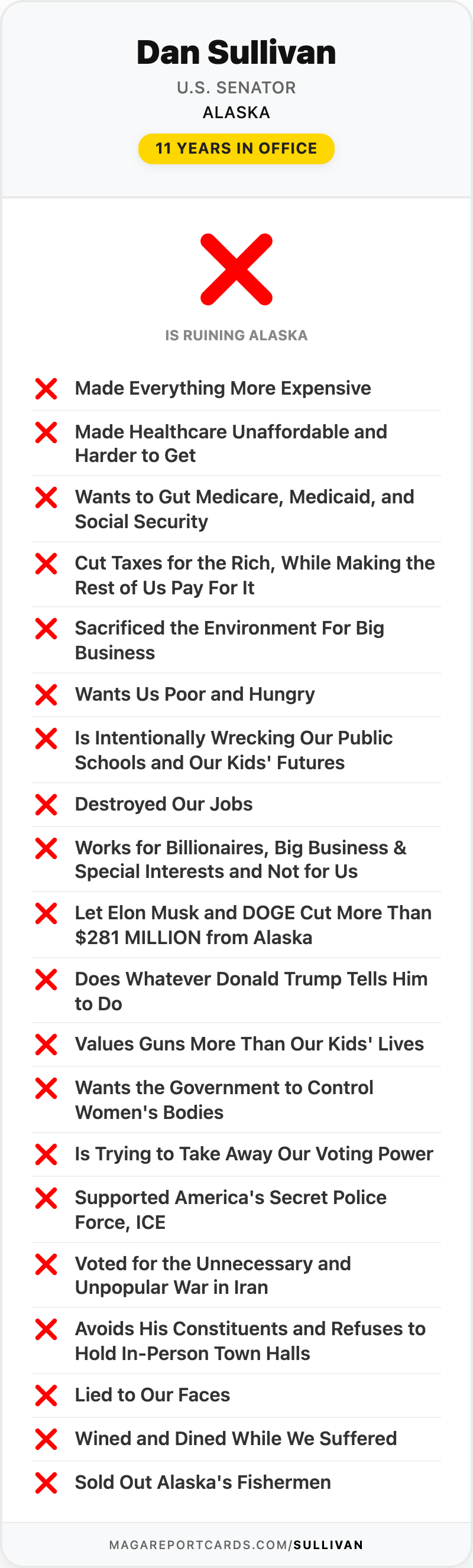
Senators love to talk about cracking down on "waste, fraud, and abuse." Dan Sullivan is one of them. He has spent the last year selling Alaskans on Trump's budget law by promising it would root out fraud in programs like Medicaid.
So here's a fair question: what about the fraud in his own portfolio?
Sullivan's single largest asset is up to $5 million in stock in a company called RPM International. It is not some random investment. RPM was founded by his grandfather, and today it is run by his brother, Frank C. Sullivan, who serves as chairman and CEO. The Sullivan family fortune is built on this company.
And RPM has a history Sullivan doesn't bring up at his fundraisers.
A $61 million fraud settlement
In 2013, RPM and its subsidiary Tremco Inc. agreed to pay nearly $61 million to settle a federal lawsuit brought by the U.S. Department of Justice. The charge: cheating the government on roofing contracts.
According to the Justice Department, Tremco failed to give the federal government the same price discounts it handed to its other customers. It also steered government buyers toward expensive products while hiding the fact that cheaper versions of the same materials were available. In plain English, taxpayers got overcharged.
The full cost to RPM, once legal fees were counted, topped $65 million.
The case didn't come out of nowhere. It started with a whistleblower — a former Tremco vice president named Gregory Rudolph, who had spent more than 20 years at the company before he resigned and blew the whistle. For exposing the scheme, he received more than $10.9 million as his share of the recovery. That is how seriously the government took it.
Sullivan profited before, during, and after
The settlement was finalized in 2013. Sullivan was elected to the U.S. Senate the very next year, in 2014. The whole time, he has held his RPM stock and collected the income from it.
Think about the timeline. A company gets caught allegedly defrauding the federal government. It pays tens of millions to make the case go away. And the man who owns up to $5 million of its stock then gets elected to the body that writes the rules for that exact government — and keeps cashing in.
It gets worse. Even after the fraud settlement, RPM kept winning new federal contracts — millions of dollars' worth. The company that overcharged taxpayers wasn't shut out. It stayed on the government payroll. And the senator from Alaska kept profiting from it.
This fits a pattern with Sullivan
If this were a one-off, maybe you could call it bad luck about who your relatives are. But it isn't.
Sullivan has voted again and again to advance RPM's interests. As we've documented on his report card, he voted to block an EPA amendment that would have let the agency crack down on cancer-causing pollutants — a vote that lined up neatly with the interests of the chemical and coatings company his family owns.
And RPM isn't the only stock that's gotten him in trouble. Sullivan secretly traded shares of Mowi — the world's largest farmed-salmon company and a direct competitor to Alaska's own fishermen — and failed to disclose those trades for months, breaking the STOCK Act, the law meant to keep members of Congress from trading on inside information.
His stock portfolio has outperformed the market by double, making him one of the best-performing investors in all of Congress. For a "regular Alaskan," he sure does win a lot on Wall Street.
The hypocrisy is the point
Here's what makes this more than just an awkward family story.
Sullivan went around Alaska telling people that Trump's budget law — the one that cuts Medicaid and food assistance for working families — was about stopping "waste, fraud, and abuse." He pointed the finger at the people who rely on those programs, as if struggling Alaskans were the problem.
But most fraud in programs like Medicaid isn't committed by the people getting help. It's committed by corporations and contractors — companies exactly like the one that made the Sullivan family rich.
When a poor Alaskan needs Medicaid, Sullivan calls it waste. When his own family's company allegedly cheats the government out of tens of millions and keeps the contracts flowing, he says nothing at all. One rule for us, another rule for him.
We deserve a senator who works for Alaskans — not one who lectures us about fraud while quietly profiting from it.
Source
This post is based on reporting by American Journal News, confirmed against the U.S. Department of Justice settlement announcement and contemporaneous business reporting.