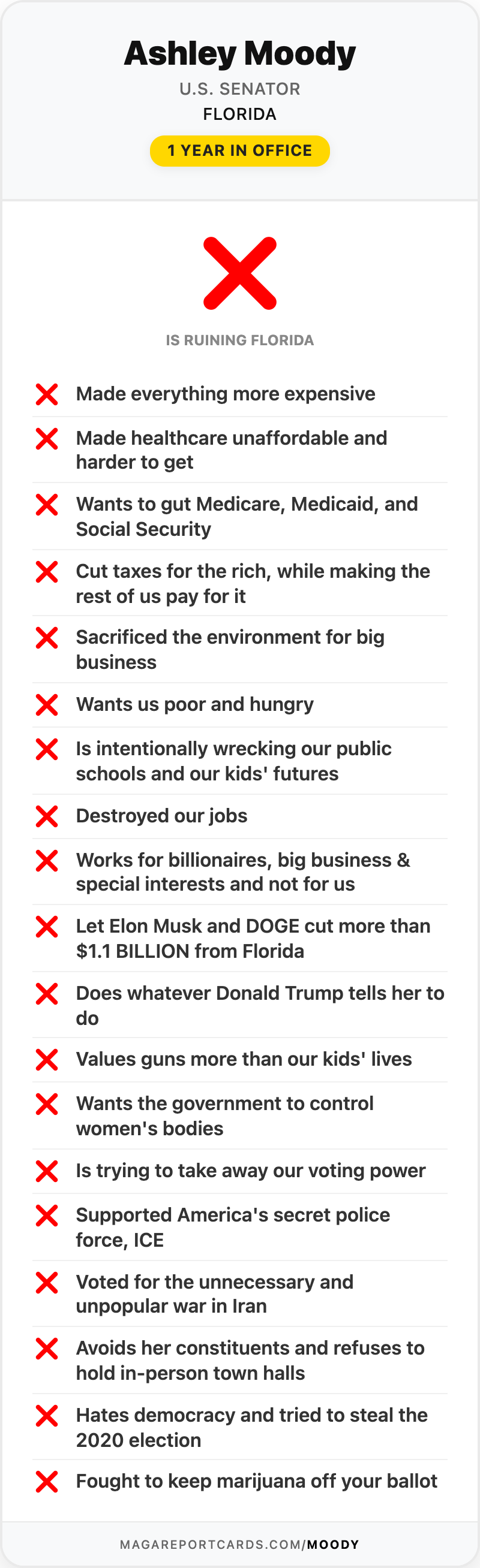
Here is a simple story about $10 million.
The money came from a healthcare company that had been overbilling Florida's Medicaid program — the program that pays for medical care for poor kids. Florida was owed that money back. Instead of all of it going to the state, $10 million was routed to a charity. Within days, that charity moved the entire $10 million to political committees. And that money was used to defeat a ballot measure Governor Ron DeSantis wanted defeated.
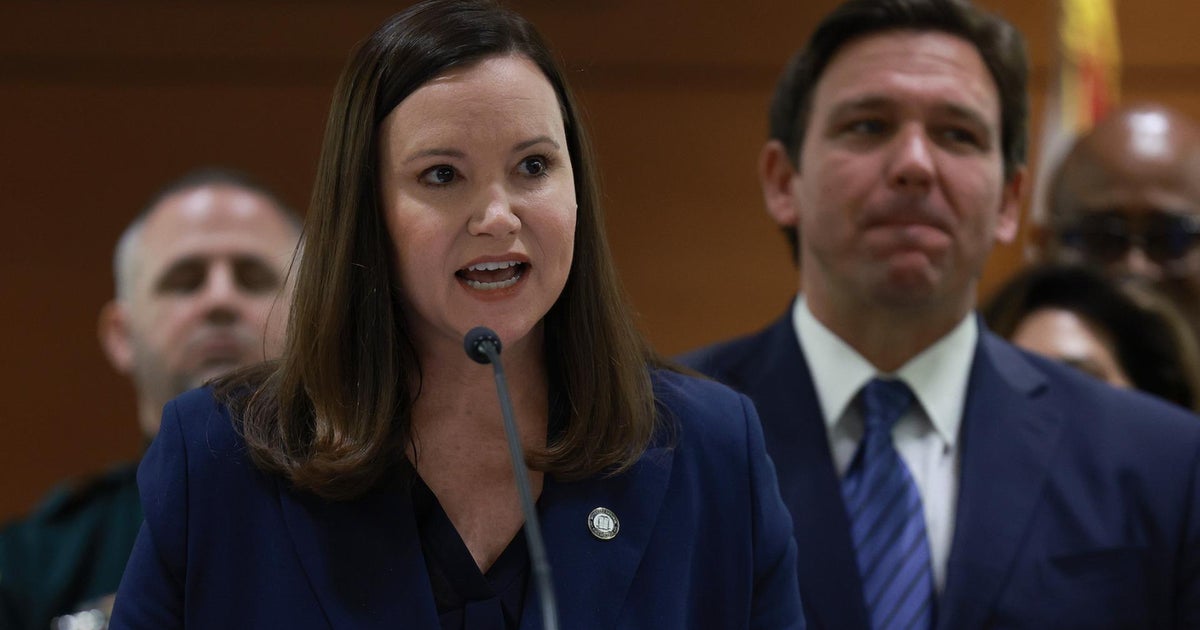
The office that approved this was the Florida Attorney General's office. The attorney general at the time was Ashley Moody.
Two months after the ballot measure went down, DeSantis appointed Moody to the United States Senate.
She has never answered a single question about any of it.
What DeSantis said out loud
When DeSantis announced he was putting Moody in Marco Rubio's Senate seat in January 2025, he listed his reasons. He said she'd be tough on immigration. He said she was a law-and-order stalwart. Then he added one more:
"She was also a staunch opponent and helped us defeat Amendments 3 and 4 in the most recent November election."
Amendment 3 would have legalized marijuana in Florida. Amendment 4 would have restored abortion rights. Both failed. DeSantis publicly credited Moody with helping kill them — and then handed her a Senate seat.
So it's fair to ask exactly how she helped.
The money trail
This started in 2020, when an Alabama law firm called Liston and Deas figured out that the giant healthcare company Centene had been overbilling states for prescription drugs under Medicaid. The firm went state to state telling attorneys general they were owed refunds. It has since represented 20 states and negotiated close to a billion dollars in settlements.
The firm calculated Florida's share at $67 million and drew up a draft agreement returning all of it to the state.
Then, in 2022, Moody fired the law firm and said Florida would represent itself.
For the next two years, nothing happened. A records review by the Miami Herald, the Tampa Bay Times, and other reporters found that between 2022 and 2024, Florida did nothing to collect the money Centene owed. Twenty other states — Ohio, Indiana, Arkansas among them — settled during that same stretch. Florida sat on it.
Then, in September 2024, Florida suddenly got interested. But it wanted the deal changed.
- First draft change: only $62 million back to the state, with $5 million going to something called the Hope Florida Foundation — an entity Centene had never heard of.
- A week later, changed again: only $57 million back to the state, and Hope Florida's cut doubled to $10 million.
The timing matters. This was happening less than six weeks before the November 2024 vote on the marijuana amendment. Polls showed it could go either way.
Centene's own lawyers got nervous. Emails obtained by the Herald and the Times show they were uneasy about money being redirected to a charity tied to the Governor's wife, Casey DeSantis. To protect itself, Centene demanded the attorney general be named in the settlement. Throughout September 2024, Centene's lawyers kept writing the Florida attorney general into the drafts — and John Guard, Moody's chief deputy, kept taking it back out.
Those same emails show Guard was reviewing the settlements with Moody.
Guard eventually signed the settlement on Moody's behalf. The $10 million went to the Hope Florida Foundation. And within days, all $10 million moved out again — into the campaigns against Amendment 3.
Amendment 3 got 56% of the vote. It needed 60%. It failed.
Two months later, DeSantis appointed Moody to the Senate. He appointed his chief of staff, James Uthmeier — who controlled one of the political committees that got the money — to replace Moody as attorney general.
A Republican called it money laundering
You don't have to take a Democrat's word for any of this. The person who dug it up is a Republican.
State Rep. Alex Andrade ran the legislative hearings in 2025 that exposed the diversion. His verdict, told to CBS Miami in August 2025:
"This is a misuse of Medicaid money. This is money laundering."
Florida's other Republican senator said the quiet part too. Rick Scott posted about Andrade's hearings and added: "Millions in tax dollars for poor kids have no business funding political ads."
Andrade's core objection is about basic guardrails. Under Florida law, groups getting $750,000 or more in state funds have to complete audits, have a contract in place, and answer to a grant administrator at a state agency. The attorney general's office is the office that enforces those rules — and routinely tells other agencies to follow them.
None of them were applied here.
"None of those controls that we have in every other transaction that's similar to this were put in place or required or verified," Andrade said. "I mean, there's no contract between AHCA and the Hope Florida Foundation for the Hope Florida Foundation to do anything in expanding Medicaid. The Hope Florida Foundation couldn't even comply with their IRS requirements as a 501C3, let alone their state audit requirements."
He called it "a bit of a head-scratcher."
The silence
A grand jury in Leon County investigated. No charges were brought. But the grand jury did issue a report, and under state law it was supposed to be released within 15 days — unless someone named in it objects and asks for it to be suppressed or redacted.
As of late July 2026, that report had not been released. Its fate was tangled up in secret court proceedings. The Florida Center for Government Accountability has gone to court just to argue the public should be allowed to see it.
Uthmeier won't say whether he's the one blocking it. He calls the whole thing a nothing burger and says he doesn't think "anybody cares about this topic any more than the liberal media."
And Moody? She says nothing at all.
CBS Miami tried to interview her at a Republican Party event in June 2026. She said she didn't have time and told them to schedule with her staff. The follow-up request went unanswered. Three weeks before the story ran, CBS Miami sent written questions to both her Senate office and her campaign. No response.
The questions they wanted answered were not gotcha questions. They were these:
- When her office approved the diversion of the $10 million, did she know the money was going to be used for political purposes?
- Did she ever talk to the Governor or anyone on his team about it?
- Does she think it was appropriate for money meant to expand Medicaid for children to end up in a political campaign?
- Did she file an objection to the release of the grand jury report? Does she want it made public?
Silence on all of it.
Andrade tried too, back when it was happening. She never responded to him either.
"Senator Moody has never commented on it, so it's unclear what she knew, what she was told, why there weren't more controls, more questions being asked by the attorney general's office," he said. "The only person, other than John Guard, who can answer those questions, I believe, would be Senator Moody."
This is the pattern, not the exception
Dodging is Moody's whole method. She rarely does interviews outside friendly conservative media. As attorney general she was most comfortable standing in the background at press conferences while other people talked.
It shows up in how she treats her own constituents, too. In the spring of 2025, as angry voters packed town halls across the country, a Florida Phoenix columnist wrote that nobody expected to see either of Florida's senators at one. The event her own office later called a "town hall" was held at a defense contractor's facility, with that company's employees.
And it fits her record on healthcare. As attorney general, Moody kept Florida in a lawsuit to strike down the entire Affordable Care Act — in the middle of the COVID pandemic, when, as Democratic lawmakers pointed out, more than a million Floridians had just filed for unemployment. In December 2025, she voted to kill a three-year extension of health care premium subsidies, even though 4.7 million Floridians depend on those tax credits — more than in any other state.
She also spent years as attorney general trying to keep Floridians from voting on marijuana at all, arguing to the Florida Supreme Court that legalization ballot summaries were misleading. She won that fight in 2021, when the court kept an earlier initiative, Make It Legal Florida, off the 2022 ballot. She lost it in 2024, and Amendment 3 went to the voters.
Six months later, $10 million in Medicaid settlement money was paying for ads against it.
The bottom line
Moody was never elected to the Senate. She was appointed — by a governor who said out loud that helping beat Amendments 3 and 4 was part of why she got the job. The money that helped beat Amendment 3 passed through her office, without the safeguards her office exists to enforce.
She's on the ballot this November asking Floridians for a full term. She has had almost two years to explain what happened, and she hasn't said one word.
Money meant for poor kids' healthcare ended up buying political ads. Floridians deserve to know whether their senator knew.
Source
Jim DeFede, Florida Senator Ashley Moody faces renewed scrutiny over her role in Hope Florida scandal, CBS Miami, July 26, 2026.