If your mother dies in an Ohio nursing home because nobody turned her, or because nobody caught the infection, your family has one year to file a lawsuit. Not two, like ordinary negligence in Ohio. One.
And when your lawyer walks into court, the state's own inspection reports on that facility — the ones listing every deficiency inspectors found — generally can't be shown to the jury.
Both of those rules come from the same 2002 law. Jon Husted cosponsored it.
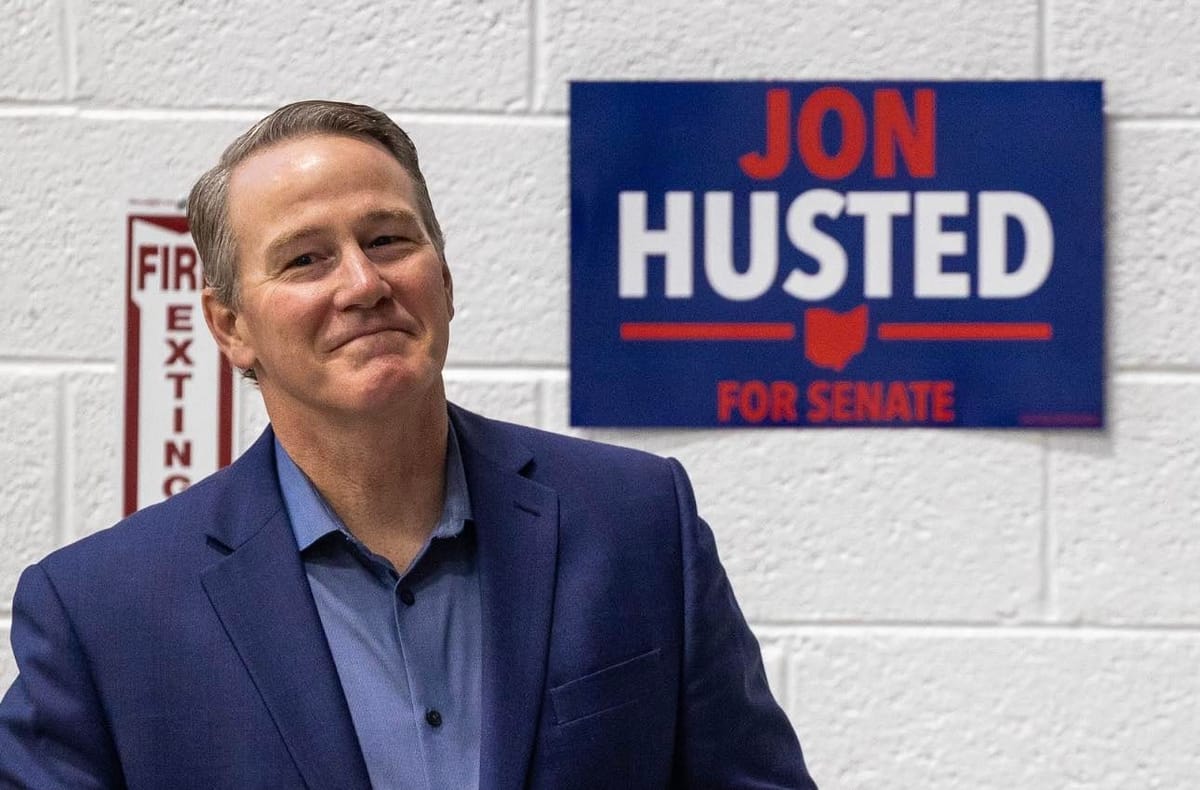
NBC4 in Columbus reported this week that Husted, then a freshman state representative, helped push a bill to shield Ohio nursing homes from liability in abuse and wrongful death cases — and that he has since accepted more than $1 million in campaign money from the nursing home industry, its executives and its lobbyists.
What the 2002 law actually did
The bill is Amended Substitute House Bill 412 of the 124th General Assembly, titled "Residential care facilities--liability." It took effect on Nov. 7, 2002. The primary sponsor was Rep. Bill Seitz; Husted, elected to the Ohio House in 2000, is one of the 45 representatives on the cosponsor list, alongside 10 senators.
It rewrote how Ohioans sue nursing homes in three ways, and every one of them made it harder:
- It cut the clock in half. The law added nursing homes and residential care facilities to Ohio's legal definition of a "medical claim." That dropped the filing deadline from the two years that applies to ordinary negligence down to one year, with an outer limit of four. It also folded lawsuits brought under Ohio's nursing home residents' rights law into that same shortened definition — those are the claims families bring over the care inside a facility, and they're often filed by an estate after a resident has already died.
- It told juries to worry about the nursing home's finances. When a jury weighs punitive damages, the law directs it to consider whether the award is enough to deter future conduct — and also whether the home can afford to pay, and whether the home would still be financially able to provide housing, personal care and skilled nursing care afterward. Read those last two again. Before a jury punishes a facility for harming someone, it is instructed to think about the facility's bottom line.
- It locked the state's own evidence out of the courtroom. The results of Ohio Department of Health inspections, including statements of deficiencies, generally cannot be used or admitted as evidence in court. The act created a parallel restriction for the Medicaid surveys regulators run on nursing facilities.
That last one is the part worth sitting with. Ohio pays inspectors to go into nursing homes and write down what's wrong. When a family sues over exactly the thing the inspectors wrote down, the family mostly can't use it.
Then came the money
Norm Wernet, president of the Ohio Alliance for Retired Americans, told NBC4 what the arrangement looks like from the outside — as TiffinOhio.net reported it, from a transcript of the segment circulated by the Ohio Democratic Party:
"It is wrong to see that somebody like Senator Husted, when he was in the legislature, would co-sponsor a bill that, in fact, avoided the liability on the nursing homes."
Wernet's group advocates for home- and community-based care for aging Ohioans, and argues the nursing home industry lobbies against it. The station separately reviewed Husted's most recent campaign finance report and found more than a dozen nursing home PACs or lobbyists have given at least $34,000 to his Senate campaign so far.
Husted's office pushed back — but not about the bill. Its statement to the station argued that nursing homes did not receive a net cash infusion or additional federal dollars under H.R. 1, and that the law actually made it easier for states to move toward home- and community-based care. The question was about a 2002 state law and a million dollars.
This is not the first time Husted has taken away someone's right to sue
In 2006, as Speaker of the Ohio House, Husted stripped the one-year window from Ohio's clergy abuse bill — the provision that would have let survivors of decades-old abuse actually sue the institutions that covered for their abusers. House Republicans replaced it with an online registry that named abusers but paid victims nothing. The Catholic Conference of Ohio had lobbied hard against the window. It got what it wanted.
Different industry, same move: when a powerful institution's exposure to lawsuits is on the table, Husted has reliably reduced it.
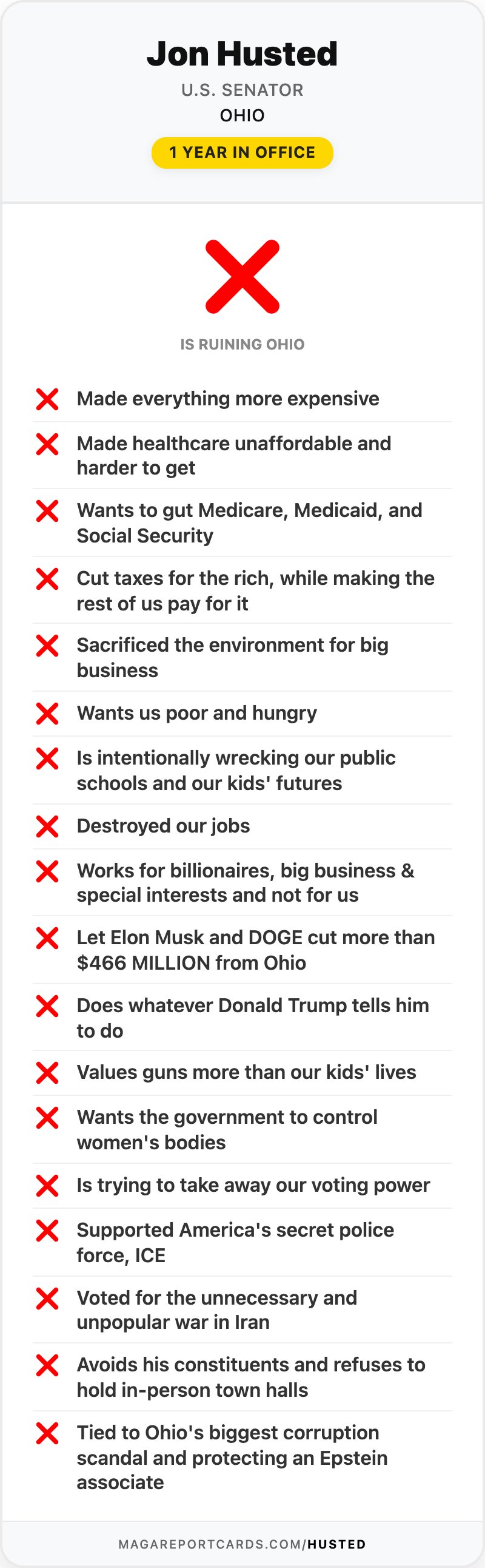
The pattern extends to who funds him. We've already documented that the companies raising Ohioans' electric bills are funding his campaign while he promises to protect those bills, and that his top aide was on a lobbying firm's payroll while working in his Senate office.
The federal vote that makes 2002 matter more, not less
Medicaid is the primary payer for long-term nursing home care in Ohio. That is the whole ballgame — the program funding the beds is the program Husted voted to cut.
On July 1, 2025, the Senate passed H.R. 1 on a 50–50 vote broken by the vice president. Husted voted yes. The law reduces federal Medicaid and CHIP spending by $911 billion over a decade.
What that means inside Ohio:
- A Public Citizen analysis published in March identified nine Ohio hospitals at heightened risk of closing or cutting services.
- An Urban Institute projection found Medicaid work requirements could strip coverage from as many as 356,000 Ohioans — on top of the 161,385 who lost Affordable Care Act coverage after the enhanced tax credits expired. We wrote about that coverage loss — the steepest of any state when the numbers came out.
- States can direct Medicaid dollars toward home- and community-based care. But those services are optional under the law, which means analysts expect them to be squeezed first when money gets tight. Husted's office cited that flexibility as a defense. Optional is not the same as funded.
So the squeeze is coming from both directions at once. Less money for the facilities. Fewer staff. And a 2002 law still sitting on the books that shortens your deadline to sue, tells the jury to consider the home's finances, and keeps the inspection reports out of evidence.
Ohioans are already seeing the strain
In June, an HVAC failure at Spring Creek Nursing & Rehabilitation Center in Green Springs forced a full-day evacuation involving more than 30 agencies, with ventilator-dependent and bariatric residents moved to Bellevue Hospital. And a Signal Ohio investigation this summer documented wrongful death suits and regulatory penalties against facilities in one large Ohio chain, with families alleging thin staffing led to fatal falls and pressure ulcers.
Those are the cases where the 2002 rules bite. Thin staffing is exactly what state inspectors write up — and exactly what the law says a jury generally doesn't get to see.
Who he's working for
Husted is running in what is expected to be the most expensive Senate race in the country. NBC4 reported the Republican Senate Leadership Fund is investing $79 million behind him.
His opponent's campaign points to nearly $700,000 Husted has taken from insurance companies. Add the nursing home industry's million. Add the utilities. There is a shape to it, and it isn't Ohio seniors.
A million dollars is a lot of money. But it's cheap compared to what a nursing home saves when the family that wants to sue it runs out of time in twelve months instead of twenty-four.
Source
Dave Miller, "Husted co-sponsored nursing home liability shield, got $1M back," TiffinOhio.net, Aug. 14, 2026, reporting on NBC4's investigation into special interest spending in the Ohio Senate race. Photo via TiffinOhio.net.